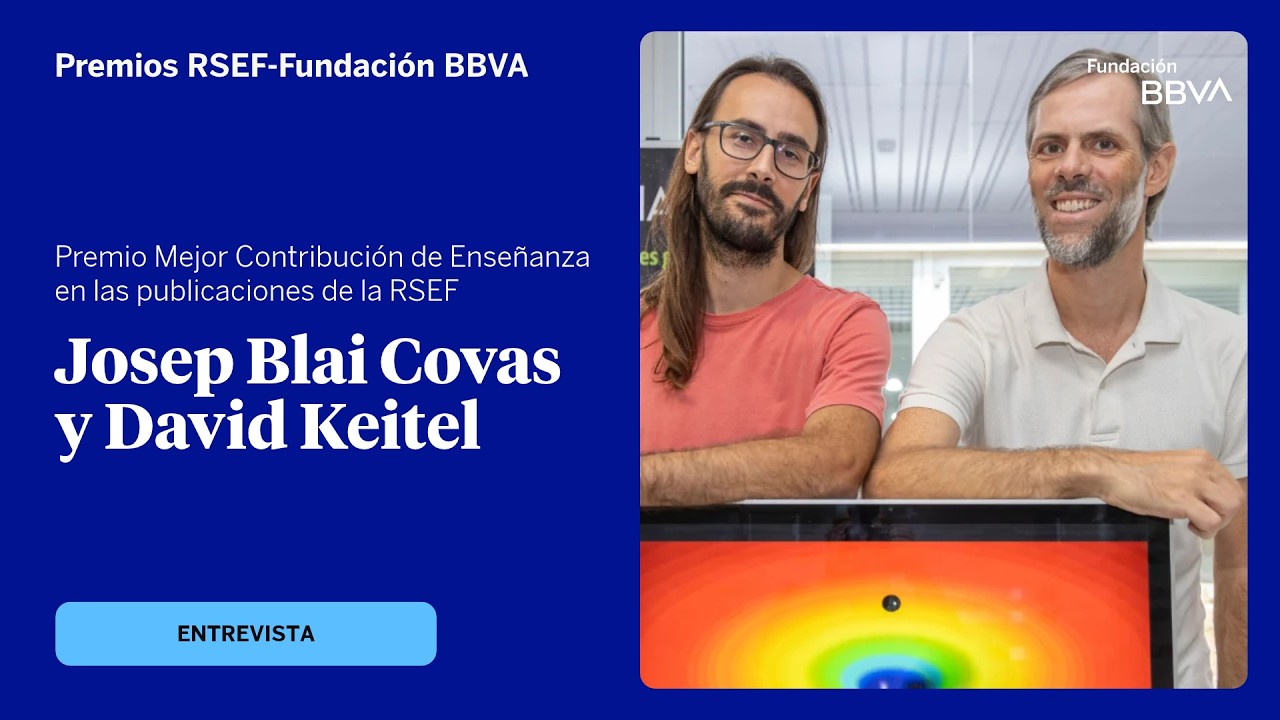
Josep Blai Covas Vidal: "Las ondas gravitacionales nos han abierto una nueva ventana al universo"
Title history
- Josep Blai Covas Vidal: "Las ondas gravitacionales nos han abierto una nueva ventana al universo" — observed on 20261120-0930 UTC (YouTube)
Keywords
Summary
199 words
Critical Evaluation
Value of the Information & Strength of the Argument
The video provides a concise and accessible overview of gravitational wave physics, conveying the importance of the field and the challenges involved. The argumentation is coherent, rooted in established scientific facts, and the interviewee’s expertise lends credibility to the statements. The discussion effectively bridges technical details with everyday analogies, making the content persuasive and informative without oversimplifying the core concepts.
Scientific Rigor, Source Quality, Title Accuracy
The content is scientifically rigorous, with the interviewee drawing on his own research and the cited literature in the field. The sources referenced are explicit: the award-winning article in the Spanish Journal of Physics and the associated news release from the Fundación BBVA. The title matches the content well, encapsulating the interview’s theme. No contradictory evidence or unsupported claims are presented.
136 words
Title / Content Match
The title accurately reflects the central theme: the interview revolves around gravitational waves as a new observational window on the universe.
Quality & Reliability
8/10
The interviewee is a physicist specialized in gravitational waves, and the content aligns with current scientific understanding. The discussion is based on peer-reviewed work and established facts, with no evident distortions.
Key Moments
Markers derived by PSI from the transcript: the creator did not define chapters.
- Motivation for writing the award-winning article and its main messages
- Significance of gravitational waves for exploring the universe
- Approach to explaining complex physics in accessible language
- Importance of public awareness of gravitational wave physics
- Assessment of physics research in Spain and its international standing
- Defending the importance of physics and science communication for society
Cited Sources
- Fundación BBVA news: Fallados premios física RSEF-Fundación BBVA 2026 — Official announcement of the prize awarded to Covas Vidal and Keitel for their outreach article.
External References
Contribution & Novelties
This interview does not present new scientific results but synthesizes the decade of progress since the first gravitational wave detection, offering a clear framework for understanding the field’s evolution and impact. It contributes to science communication by demonstrating effective strategies for explaining complex topics to a broad audience.
Pour aller plus loin :
- Gravitational wave — Overview of gravitational waves, their theory, and detection.
- LIGO — The interferometer that made the first direct detection, central to the discussion.
- LISA mission — Planned space-based detector mentioned as the future of gravitational wave astronomy.
- Multi-messenger astronomy — Combining gravitational waves with electromagnetic signals, highlighted by the neutron star merger example.
108 words
Radar Profile
The profile shows high reliability and good information quality, with moderate quantitative substance typical of a short interview. Technical level is medium, reflecting the balance between accessibility and scientific depth, while the overall score remains solid due to expert presentation and factual accuracy.