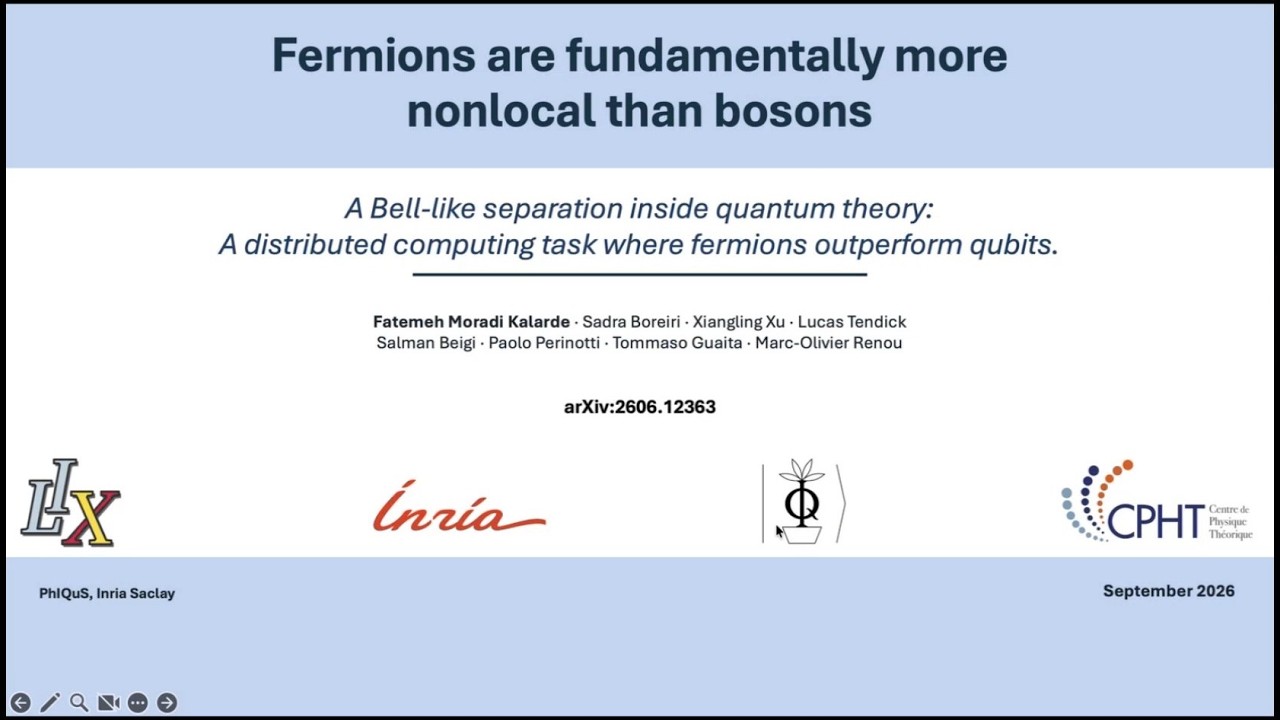
Fermions are fundamentally more nonlocal than Bosons
Keywords
Summary
184 words
Critical Evaluation
Value of the Information & Strength of the Argument
The talk provides a novel and significant contribution by rigorously demonstrating that fermionic encodings offer a strictly larger set of correlations than bosonic or qubit-based approaches under identical communication constraints. The argumentation is well-structured: it first establishes the framework for defining information theories, then identifies the key operational difference (parity superselection and braided composition), and finally constructs a concrete game that exposes the advantage. The speaker carefully distinguishes between the fermionic and standard quantum scenarios, ensuring that the comparison is fair by keeping the communication rounds constant. The use of self-testing techniques to prove impossibility is elegant and strengthens the claim. The presentation also addresses potential loopholes, such as the trivial phase-adjustment strategy for bosons, and explains why the game design prevents such workarounds. Overall, the value lies in exposing a fundamental resource for information processing that has been overlooked, and the argumentation is both convincing and pedagogically clear.
Scientific Rigor, Source Quality, Title Accuracy
The scientific rigor is high: the talk presents a formal theorem with a proof sketch based on self-testing, and the background on Bell’s theorem and quantum information is accurate. However, the presentation does not explicitly cite a published paper or provide references in the video description, limiting the ability to verify the claims directly. The title precisely matches the content: the focus is on demonstrating that fermions exhibit a stronger form of nonlocality than bosons within quantum theory. The talk adheres to the standards of a research seminar, with explicit definitions and logical progression. No comments were analyzed, as none were provided.
266 words
Title / Content Match
The title accurately reflects the core thesis: the talk proves that fermionic information theory exhibits stronger nonlocality than bosonic or standard quantum information theory, matching the title's assertion.
Quality & Reliability
8/10
The talk presents a rigorous theoretical proof from a PhD research project, with clear logical structure and technical depth. The results appear to stem from a peer-reviewed study, though no external verification is provided within the video itself. The argumentation is coherent and the mathematical framework is sound, but the presentation relies entirely on the speaker's claims without independent cross-checking.
Key Moments
Markers derived by PSI from the transcript: the creator did not define chapters.
- Introduction to two ways of encoding quantum information: standard qubits vs fermionic febits.
- Comparison of composition rules and the parity superselection rule in fermionic systems.
- Construction of the three-party game with a referee creating loops of different sizes.
- Proof outline using self-testing to show fermionic correlations cannot be reproduced by tensor-product strategies.
Contribution & Novelties
The talk introduces a novel separation in nonlocality within the quantum realm, showing that fermionic information carriers (febits) are inherently more nonlocal than qubits or bosons. This extends Bell’s theorem to compare different quantum information theories, establishing a new hierarchy of nonlocal resources. The result has implications for distributed computing, where fermionic advantage can reduce communication rounds. This work challenges the assumption that qubits are the ultimate quantum information primitive, suggesting that fermionic modes may be essential for certain tasks.
Pour aller plus loin :
- Bell’s theorem — Foundational result on quantum nonlocality, directly relevant to the comparison made in the talk.
- Fermionic field — Provides background on anticommutation relations and fermionic statistics.
- Quantum information science — Overview of the field, useful for understanding the context of information carriers.
- Superselection rule — Explanation of the parity superselection rule, central to fermionic information theory.
143 words
Radar Profile
The profile shows very high scores in information quality and technical level, indicating a dense and rigorous presentation. The quantity of information and global reliability are slightly lower, likely due to the absence of external references and the single-voice format of a seminar talk. Overall, this is a high-caliber research presentation.