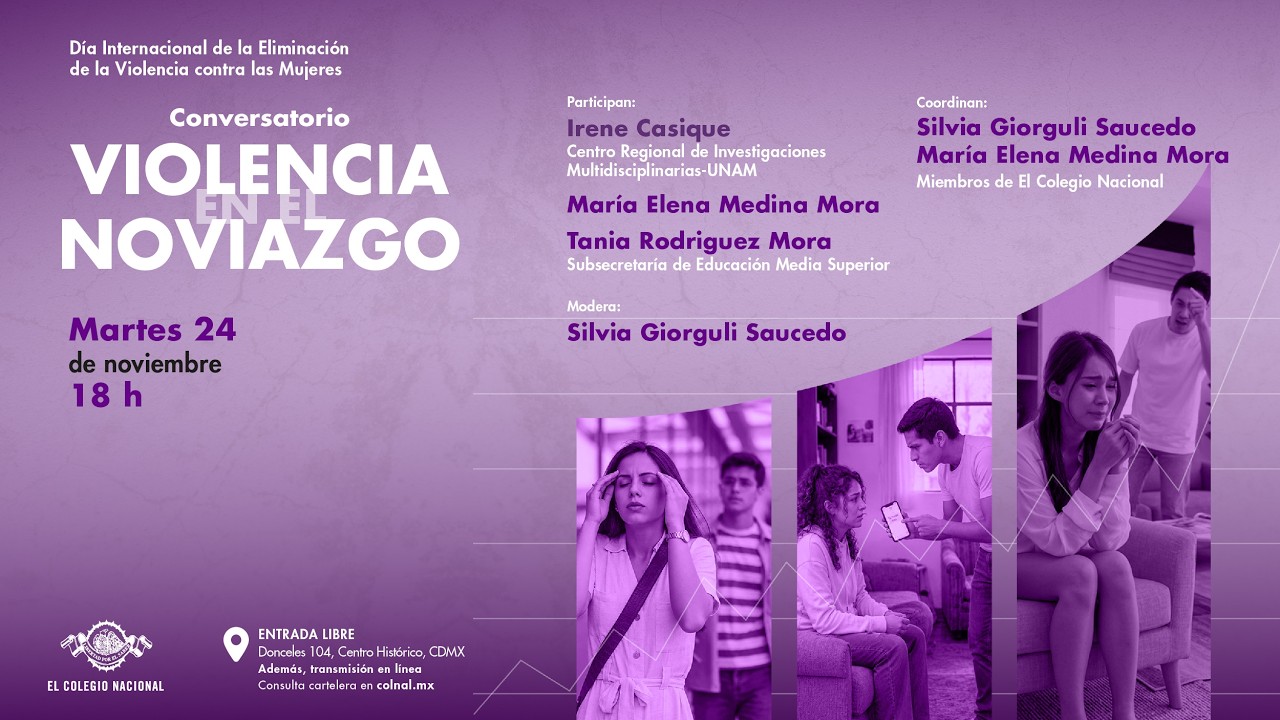
Violencia en el noviazgo | Día Internacional de la Eliminación de la Violencia contra las Mujeres
Dating violence | International Day for the Elimination of Violence against Women
Keywords
Summary
252 words
Critical Evaluation
Value of the Information & Strength of the Argument
The main value of the session lies in making visible undercounted forms of dating violence and in refusing a simple male-perpetrator/female-victim model. Casique uses two survey bases to support her argument: a large representative school-based survey and a smaller online survey of LGBTQ+ adults. The argument is constructed by juxtaposing prevalence estimates with consequences, showing that bidirectionality does not imply symmetry: women and sexual-minority groups report more severe outcomes, more fear and more mental-health burden. The discussion of LGBTQ+ data is particularly valuable because it tests explanations based only on gender inequality and shows that violence can occur in couples without a male-female power differential. The argument also has limits. Most evidence is descriptive and self-reported; the speaker explicitly notes reporting biases, including men’s tendency to underreport their own violence and overreport violence received, and women’s greater awareness and reporting of their own violence. The online LGBTQ+ survey is non-representative, so its prevalence figures cannot be generalized. The policy and sociological contributions are suggestive rather than tested, and the transcript available here does not include the full dialogue or the later presentations.
Scientific Rigor, Source Quality, Title Accuracy
The session has strong institutional credibility: it is organized by El Colegio Nacional and features named researchers and a senior education official. The empirical core is presented with sample sizes, states, target populations and explicit caveats about representativeness, which is good practice. However, the talk does not provide a bibliography, exact publication titles, survey questionnaires, confidence intervals, weighting details or links, and the slides are only described in the transcript. The statistics are therefore difficult to verify independently from the recording alone. The LGBTQ+ survey is explicitly an online, non-representative sample, which the speaker acknowledges. The title/content fit is strong: the event is clearly about dating violence and is framed around 25 November, even though it expands into intimate partner violence, sexual diversity and public policy.
323 words
Title / Content Match
The title closely matches the content: the session is explicitly framed around dating violence on the occasion of 25 November, and the panel addresses definitions, prevalence, consequences and policy responses. It broadens into intimate partner violence and LGBTQ+ experiences, but remains centered on the announced theme.
Quality & Reliability
6/10
The session is hosted by a prestigious academic institution and brings together recognized specialists who present original survey data and policy experience. Credibility is reinforced by explicit discussion of sample design and limitations. However, the transcript provides no bibliography, exact publication references, confidence intervals or links, and one of the two surveys is explicitly non-representative, which limits verifiability and generalizability.
Key Moments
Markers derived by PSI from the transcript: the creator did not define chapters.
- Silvia Giorguli opens the session and frames it around the International Day for the Elimination of Violence against Women.
- The three panelists are introduced: Irene Casique, Tania Rodríguez Mora and María Elena Medina Mora.
- Irene Casique begins her presentation on challenges in studying dating violence in Mexico.
- Casique distinguishes dating violence from partner violence through the criterion of non-cohabitation.
- She discusses adolescent gender roles, identity formation and the persistence of stereotyped relationship norms.
- Survey designs are presented: more than 13,000 high-school students in three states and an online LGBTQ+ sample of 824 adults.
- Results show emotional violence as the most frequent form and highlight bidirectionality with asymmetric consequences.
- LGBTQ+ survey results are discussed by sexual orientation, including physical and sexual violence prevalence and mental-health consequences.
- Casique concludes that analysis must expand to all couple types and raises digital violence as an emerging dimension.
- Silvia Giorguli opens the discussion with questions on bidirectionality and digital violence.
Cited Sources
- Survey on dating violence, empowerment and sexual health among high-school students in Morelos, Jalisco and Puebla — Presented by Irene Casique as a representative survey of more than 13,000 high-school students; used for prevalence and consequence estimates.
- Online survey on partner violence among LGBTQ+ populations in Mexico and Colombia — Presented by Irene Casique as a non-representative online survey of 824 adults; used for prevalence, heterogeneity and suicidal-ideation findings.
Contribution & Novelties
The original contribution is to shift the discussion from a single victim/perpetrator model toward a more differentiated account of dating violence. The session combines demographic survey evidence with sociological and public-policy perspectives, and it explicitly includes female-perpetrated violence and violence in LGBTQ+ relationships. It also distinguishes bidirectionality from symmetry: violence may be reported by both partners, but its consequences are not equivalent. The discussion of suicidal ideation and mental-health consequences among sexual-minority respondents adds a dimension often absent from heterosexual-focused dating-violence research.
Further reading:
- Dating violence — Background on definitions and prevalence of violence in dating relationships.
- Intimate partner violence — Broader framework for situating dating violence within partner-violence research.
- Gender-based violence — Context for the feminist conceptualization discussed by the panel.
- Minority stress — Relevant to the LGBTQ+ findings on vulnerability and mental health.
- Bidirectionality versus symmetry in adolescent dating violence — Conceptual distinction emphasized by Casique.
148 words
Radar Profile
The profile is strongest in information quantity and moderate in quality and technical depth: the session offers extensive empirical and policy discussion but relies on presented statistics without full citations. Reliability is constrained by the absence of a bibliography and by one non-representative online survey, while the institutional setting and expert panel support credibility.