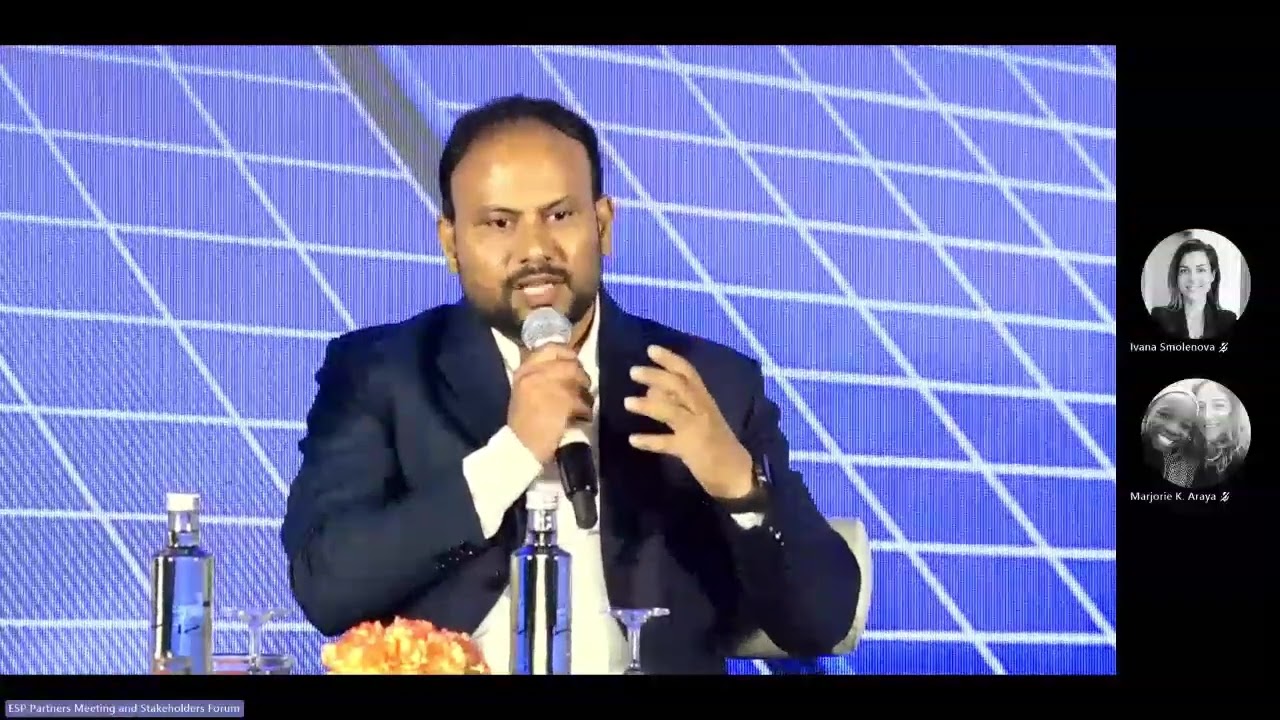
ESP Forum Day 3: India's Journey In Scaling Energy Storage
Title history
- ESP Forum Day 3: India's Journey In Scaling Energy Storage — observed on 20261119-1825 UTC (YouTube)
Keywords
Summary
199 words
Critical Evaluation
Value of the Information & Strength of the Argument
The video provides substantial value through first-hand industrial insights on scaling energy storage in India, covering manufacturing, integration, recycling, and financing. The arguments are generally coherent and well-articulated, with each panelist presenting concrete examples and data points (e.g., $10 billion imports, 4.5 GWh deployed, 3.02 rupees/kWh tariff). The World Bank speaker adds strategic depth on financing mechanisms and policy support. However, some claims are presented without formal evidence, and the panel varies in analytical rigor: while the manufacturing and integration discussions are grounded in practical experience, the macro-level comparisons (e.g., China vs. India) rely on broad assertions rather than comprehensive data. The argumentation is persuasive but not deeply technical or evidence-dense.
Scientific Rigor, Source Quality, Title Accuracy
The forum is organized under the ESMAP (Energy Sector Management Assistance Program) and hosted by the World Bank, lending institutional credibility. However, the speakers do not cite specific academic or industry sources; they reference personal experiences and observed trends. Some quantitative figures are mentioned (e.g., 200 GW solar panel capacity, 4.5 GWh integrator record) but lack pinpoint verification. The title is accurate: the session indeed explores India’s scaling of energy storage. No comments were provided for analysis, so no public sentiment assessment was possible.
210 words
Title / Content Match
The title accurately reflects the content: a forum session on India's efforts to scale energy storage, covering manufacturing, integration, recycling, and financing.
Quality & Reliability
7/10
Panelists from established companies and the World Bank provide detailed insights, but specific data points (e.g., import figures, cost numbers) are presented without formal citations. The forum's credibility is high, yet the reliability is moderate due to lack of verifiable sources.
Key Moments
Markers derived by PSI from the transcript: the creator did not define chapters.
- Amara Raja's Dwarka introduces the company's legacy in lead-acid batteries and its pivot to lithium-ion, with plans for a 21,700 cylindrical cell line and $160M investment in R&D and production.
- Rahul from Amperehour Energy explains the integrator's approach: proprietary energy management software, factory acceptance testing, and operations across 11 countries.
- World Bank representative outlines three focus areas: scaling financing for proven tech, supporting frontier technologies (sodium-ion, compressed air), and developing storage as an asset class.
- Pranati from Loham discusses the company's evolution from refurbishment to vertical recycling, including acquisition of lithium assets in Zimbabwe and production of cathode active materials.
- Panel on green hydrogen vs. batteries: they are complementary, with batteries for up to 6 hours, green hydrogen for 12-16 hours, and pump storage beyond.
- Discussion of China's advantages (scale, R&D, raw material ecosystem) and India's need for technology investment, policy support, and a holistic energy transition approach.
Contribution & Novelties
This panel offers a multi-stakeholder perspective on India’s energy storage sector, combining views from manufacturing, integration, recycling, and financing. Its originality lies in the detailed operational insights (e.g., sample production steps, integration software) and the candid discussion of challenges like investor mindset and policy needs. The discourse also highlights emerging technologies like sodium-ion and recycling as critical components, bridging the gap between global climate goals and local industrial realities.
Pour aller plus loin :
- Lithium-ion battery - Wikipedia — Provides foundational knowledge on the technology discussed extensively in the panel.
- Energy storage - Wikipedia — Contextualizes the various storage technologies mentioned (batteries, pumped storage, hydrogen).
- India’s National Green Hydrogen Mission — Relevant to the green hydrogen vs. batteries debate and India’s policy landscape.
- Recycling lithium-ion batteries — Addresses the recycling challenges and value chain discussed by Loham.
137 words
Radar Profile
The profile shows a strong score in quantity of information (8), indicating a broad coverage of topics, but a slightly lower technical depth (6) and reliability (7), reflecting the panel's emphasis on strategic insights rather than hard data. The overall balance is typical of a high-level industry forum where expert experience outweighs academic rigor.