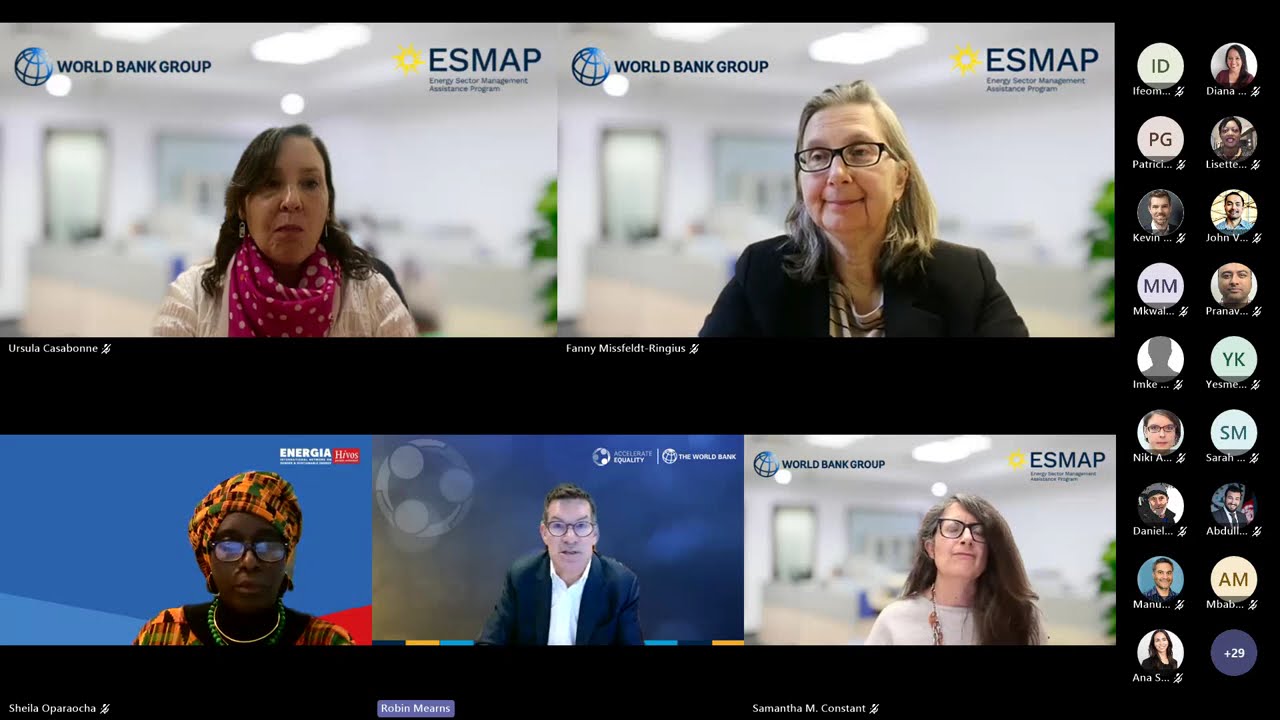
Preventing Violence Against Women and Girls in Energy Projects: Launch of the New Guidance Note
Title history
- Preventing Violence Against Women and Girls in Energy Projects: Launch of the New Guidance Note — observed on 20261119-1200 UTC (YouTube)
Keywords
Summary
168 words
Critical Evaluation
Value of the Information & Strength of the Argument
The webinar provides substantial value by translating a complex issue into actionable guidance. It effectively argues that energy projects can inadvertently increase VAWG risks, and that proactive integration of prevention measures improves project outcomes. The argumentation is solid, drawing on statistics (840 million women affected), cross-country evidence (electricity access reducing domestic violence in 22 sub-Saharan countries), and concrete examples (Ethiopia’s utility women’s representation increase from 6% to 18%). The speakers present a coherent case for moving beyond risk mitigation to broader institutional change, and emphasize survivor-centered principles. The panel discussion adds practical depth, showing how the guidance is applied in large hydropower and private solar projects.
Scientific Rigor, Source Quality, Title Accuracy
The session demonstrates high rigor in its approach, with speakers referencing World Bank instruments (ESF, SEASH risk assessments), the VAWG Resource Guides, and Energia’s experience. The guidance note is presented as evidence-based, and the panelists provide real-world examples. The title accurately reflects the content: a launch event for the guidance note. No external sources are cited beyond institutional references, but the webinar itself is a primary source for the guidance note’s content. The discussion is well-structured and stays on topic, with all speakers contributing relevant insights.
207 words
Title / Content Match
The title accurately reflects the webinar's purpose: launching a guidance note on preventing VAWG in energy projects. The content directly addresses this theme throughout.
Quality & Reliability
8/10
The webinar features senior specialists from the World Bank Group and Energia, presenting a newly launched guidance note grounded in evidence and operational experience. The content is well-structured, with clear references to institutional frameworks and practical case examples. While not a peer-reviewed academic presentation, it offers authoritative expert perspectives and concrete operational guidance.
Key Moments
Markers derived by PSI from the transcript: the creator did not define chapters.
- Welcome and housekeeping by Samantha Constance, ESMAP senior gender specialist
- Fanny Mitsvelt-Ringis introduces the topic, citing that 1 in 3 women experience violence globally
- Robin Mearns keynote: links VAWG prevention to World Bank gender strategy and energy transition
- Dr. Sheila Oparachau from Energia highlights gaps in off-grid and clean cooking companies' safeguarding practices
- Ursula Cassaban presents the guidance note's framework: risks for consumers, workers, and communities; interventions at policy, institutional, and community levels
- Panel discussion begins: Dan Owen and Lizette Mino-Conde on Inga III hydropower project in DRC, integrating GBV prevention into community development pillar
- Private sector perspectives from Patricia Gimenez (Alcazar Energy) and Ifyoma Dyke (Cross Boundary Energy) on implementing safeguards
- Q&A session addressing practical challenges and survivor-centered approaches
Cited Sources
- World Bank Group Gender-Based Violence Action Plan (upcoming) — Mentioned by Robin Mearns as upcoming tool
- VAWG Resource Guides (World Bank) — The new energy brief is part of this series
- INGA III Hydropower Project (World Bank) — Discussed as case example in panel
Concurring Sources
- World Bank Gender-Based Violence Action Plan (future) — Aligns with the webinar's call for systematic integration
- UN Women facts on violence against women — Provides broader statistical context for the issue
Contribution & Novelties
This webinar introduces a new sector-specific guidance note on preventing VAWG in energy operations, which is a novel resource that operationalizes existing frameworks for the energy sector. It provides a structured framework for identifying risks across three domains (consumer, worker, community) and interventions at three levels (policy, institution, community). The session highlights innovative approaches such as integrating GBV prevention into benefit-sharing schemes (Inga III) and showcasing private sector examples. The discussion emphasizes moving from recognition to implementation, with clear entry points for project teams.
Pour aller plus loin :
- World Bank Gender Strategy — Relevant for understanding institutional commitment.
- Violence Against Women and Girls Resource Guides — Direct context for the new energy brief.
- SEAH (Sexual Exploitation, Abuse and Harassment) risk management — Covers key safeguards referenced in the webinar.
- Inga III Hydropower Project details — Illustrates the case example discussed.
- Energia International Network — Partner organization providing civil society perspective.
151 words
Radar Profile
The radar profile shows high scores across all dimensions, indicating a well-rounded and reliable webinar. The strength lies in balanced coverage of information quality, technical depth, and credibility, though quantity is slightly lower due to the focused scope of a launch event.