CS 471/671 (How to grow language models) - #23 - Fall 2026
Title history
- CS 471/671 (How to grow language models) - #23 - Fall 2026 — observed on 20261121-1612 UTC (YouTube)
Keywords
Summary
161 words
Critical Evaluation
Value of the Information & Strength of the Argument
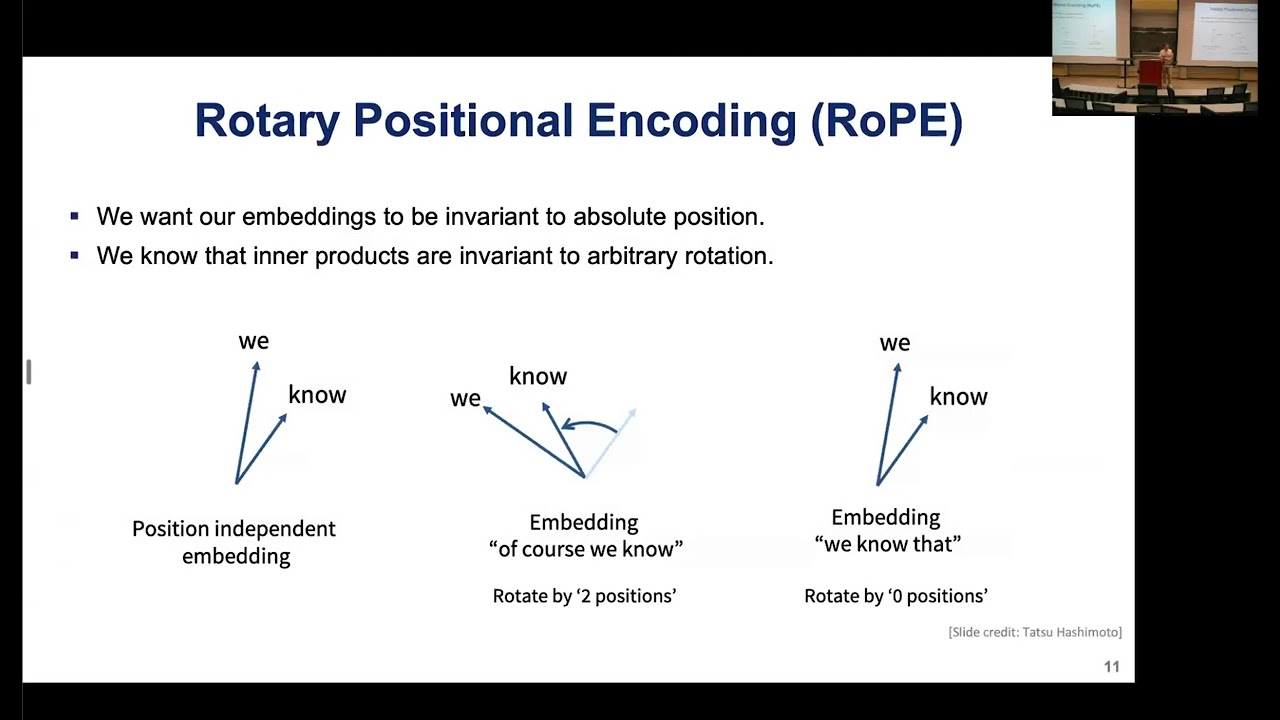
The lecture provides a solid conceptual foundation for understanding positional encodings, especially RoPE, by building from first principles. The transition from absolute to relative encoding is well-motivated with concrete examples, and the mathematical derivations are rigorous yet accessible. The argument for using 2D rotations in practice is pragmatic, emphasizing sanity and ease of implementation. The instructor also addresses common concerns, such as the effect on KV caching. The interactive visualizations enhance comprehension, making complex geometric concepts tangible. Overall, the value lies in its clear pedagogical approach that bridges theoretical concepts and practical implementation.
Scientific Rigor, Source Quality, Title Accuracy
The content is scientifically rigorous, referencing standard transformer architecture and known research in positional encoding. However, the lecture is based on course material rather than citing external sources directly, so specific citations are not provided within the video. The title accurately reflects the course’s broader objective, and this session’s focus on positional encodings is a necessary technical component. The description includes a link to the course website, which serves as the primary reference. There are no comments provided for analysis.
188 words
Title / Content Match
The title correctly situates the lecture within the course's scope of growing language models, focusing on technical details of positional encodings.
Quality & Reliability
9/10
The lecture is from a reputable academic institution (JHU) and provides a technically rigorous explanation of positional encoding methods, particularly RoPE, with clear mathematical derivations and practical considerations.
Key Moments
Markers derived by PSI from the transcript: the creator did not define chapters.
- Introduction to mid-training as a bridge between pre-training and post-training.
- Discussion on permutation equivariance and the need for positional encoding.
- Comparison of absolute vs relative positional encoding with motivating examples.
- Properties of rotation matrices and their application in RoPE.
- Definition of high-dimensional rotation matrix and the frequency formula.
- Discussion on KV-cache efficiency and visualization of RoPE in 16 dimensions.
Cited Sources
- Course website: Self-Supervised Learning (Fall 2026) — The official course page providing lecture notes, schedule, and additional resources.
Contribution & Novelties
While the lecture does not introduce new research, it offers a clear pedagogical synthesis of existing positional encoding methods, particularly RoPE. The key contribution is the explicit connection between theoretical rotation matrices and their practical implementation in transformer models, with intuitive visualizations and reasoning for design choices. The lecture also highlights the importance of mid-training, a relatively less-discussed phase in the language model pipeline.
Pour aller plus loin :
- RoFormer: Enhanced Transformer with Rotary Position Embedding — The original paper introducing RoPE, essential for understanding the formal basis.
- Attention Is All You Need — The Transformer paper that introduced absolute positional encodings.
- Exploring the Limits of Transfer Learning with a Unified Text-to-Text Transformer (T5) — T5 uses relative positional encodings; useful for comparison.
- Self-Attention with Relative Position Representations — Another foundational work on relative position encoding.
- Wikipedia: Rotary Positional Encoding — General overview of RoPE if available.
147 words
Radar Profile
The radar profile is strongly skewed toward technical depth and reliability, with high scores for quality and technical level. The relatively lower quantity score reflects the focused scope of the lecture, which is acceptable for a single session. The overall profile indicates a high-quality, authoritative educational resource.