NLP: Self-supervised Models (or: "How to grow language models") - Lecture 5 - Fall 2026
Keywords
Summary
131 words
Critical Evaluation
Value of the Information & Strength of the Argument
The value of this lecture lies in its clear pedagogical approach to backpropagation. The instructor builds intuition step by step, from the basic formulation to the final algorithm, using concrete examples and mathematical derivations. The argumentation is solid: he justifies each step, addresses potential confusions (e.g., sum vs. average in loss), and emphasizes the three core insights. The complexity analysis is rigorous, showing how the naive approach scales quadratically and how backprop reduces it to linear time. The lecture is highly effective for understanding the mechanics of backpropagation.
Scientific Rigor, Source Quality, Title Accuracy
The lecture is scientifically rigorous, with well-defined notation and correct mathematical derivations. The sources are implicit, as it is a lecture, but the content aligns with standard machine learning textbooks. The title of the video is somewhat misleading at the lecture level, but it fits within the course context. The instructor demonstrates mastery of the subject and effectively addresses student questions. No external sources are cited besides the course website, which is expected for a lecture.
179 words
Title / Content Match
The title refers to the course topic (self-supervised models) while this lecture specifically covers backpropagation, a foundational component. The link is indirect but justifiable within the course context.
Quality & Reliability
8/10
University lecture with clear mathematical derivations, well-structured explanation of backpropagation, and interactive Q&A. The content is reliable and accurate for an academic context.
Key Moments
Markers derived by PSI from the transcript: the creator did not define chapters.
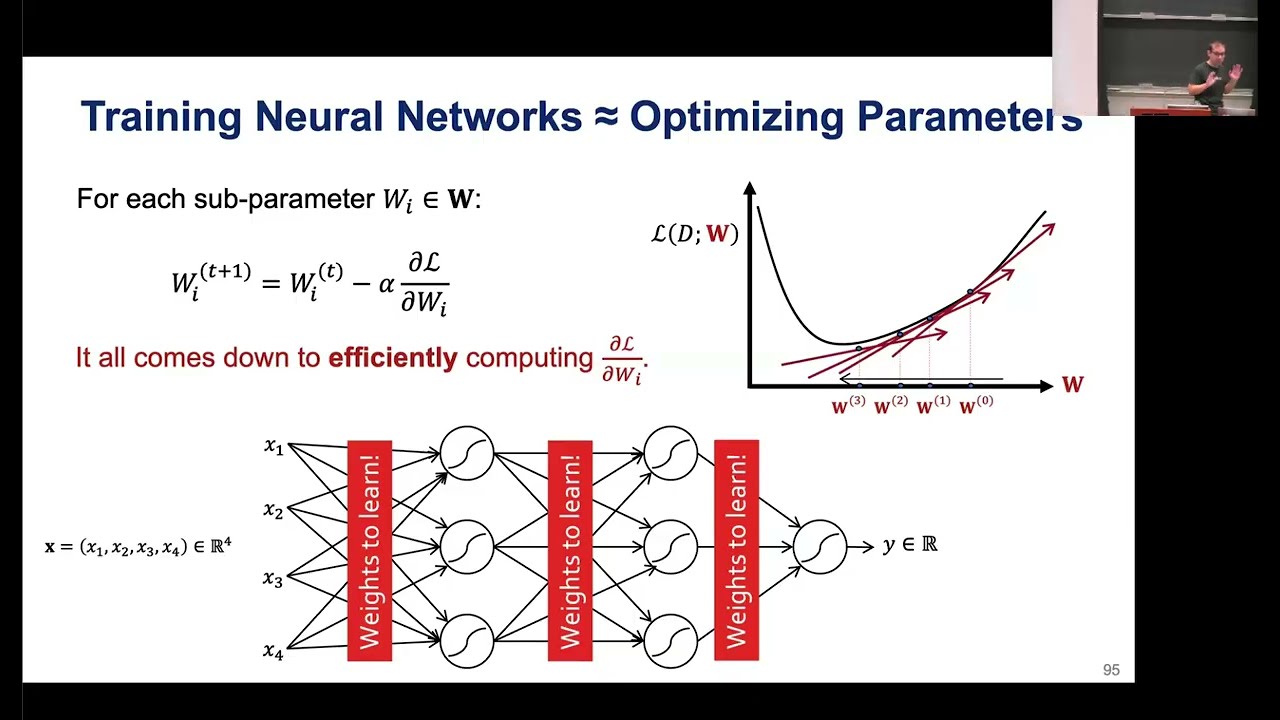
- Introduction to the training problem and formalization of neural network parameters and loss function.
- Discussion on gradient descent and the intuition for optimizing the loss function.
- Introduction to backpropagation and the three key insights: gradient descent, chain rule, and dynamic programming.
- Derivation of gradients for the final layer and intermediate layers using the chain rule.
- Complexity analysis showing how naive computation is O(L^2) and backprop achieves O(L) by reusing computations.
- Summary of the full backpropagation algorithm and concluding remarks.
Cited Sources
- Course website: Self-Supervised Models — Course materials and additional information.
Contribution & Novelties
The lecture provides a clear and intuitive explanation of backpropagation, emphasizing the combination of gradient descent, chain rule, and dynamic programming. It breaks down the derivation step by step, making the concept accessible. The complexity analysis is particularly valuable, showing the contrast between naive O(L^2) gradient computation and the linear time achieved by backprop.
Pour aller plus loin :
- Backpropagation on Wikipedia — Overview of the algorithm and its history.
- Chain rule on Wikipedia — Fundamental calculus concept used in backprop.
- Dynamic programming on Wikipedia — The optimization technique used to reuse computations.
93 words
Radar Profile
The radar profile shows high scores in technical level and reliability, moderate in quantity and quality, indicating a technically dense yet well-structured lecture with strong scientific accuracy.