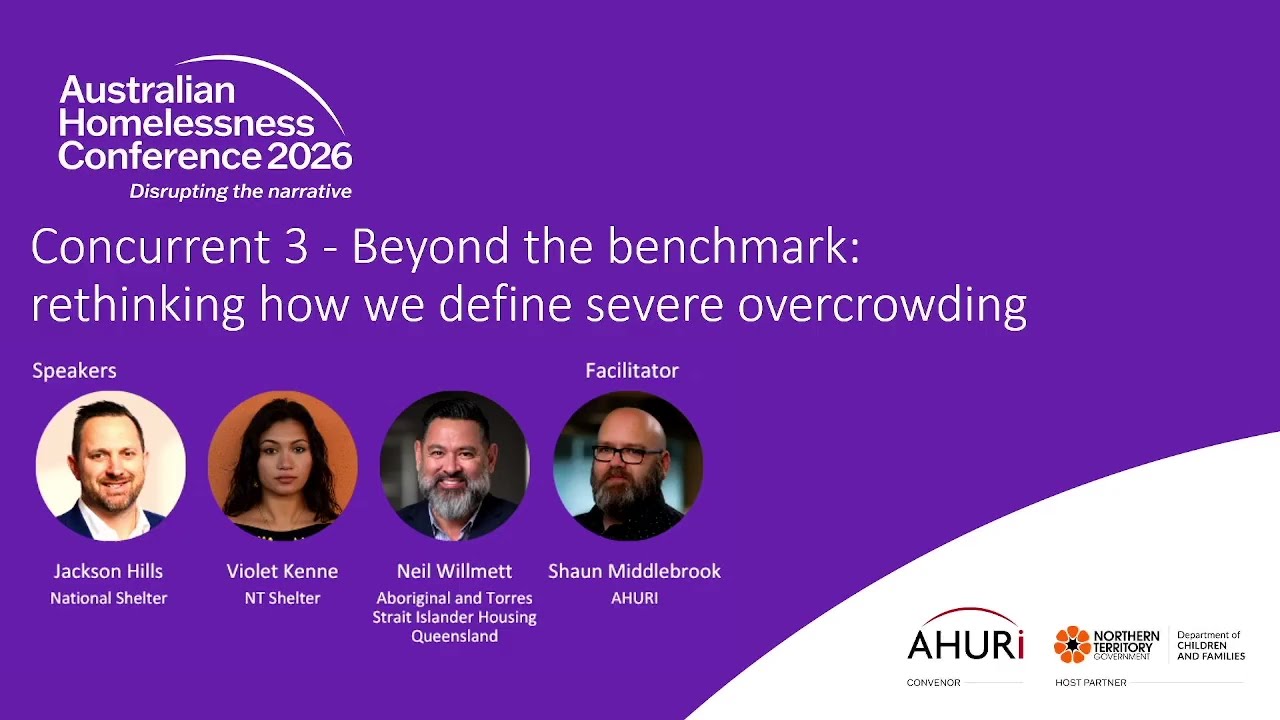
Concurrent 3 Beyond the benchmark rethinking how we define severe overcrowding
Title history
- Concurrent 3 Beyond the benchmark rethinking how we define severe overcrowding — observed on 20261121-1609 UTC (YouTube)
Keywords
Summary
188 words
Critical Evaluation
Value of the Information & Strength of the Argument
The session provides substantial value by presenting original research alongside personal testimonies, which together build a strong case for rethinking overcrowding definitions. The argumentation is solid: it uses empirical data (e.g., 66% renting, 76% born overseas) to demonstrate that the aggregate statistic obscures diverse realities. The speakers carefully differentiate between voluntary and constrained overcrowding, and highlight the trade-offs households face. The argument that policy responses must be place-based and culturally aware is well supported by examples. However, the presentation is more descriptive than prescriptive, and some claims (e.g., about waiting lists) would benefit from explicit citations. Overall, the reasoning is cohesive and persuasive, though it leans on a single commissioned study and does not extensively compare with other research.
Scientific Rigor, Source Quality, Title Accuracy
The scientific rigor is generally high: the session references a two-stage study by Shelter NSW, which includes both quantitative analysis and qualitative interviews. The use of CNOS as a definitional benchmark is clearly explained, and its limitations are articulated. While specific sources are not always named with URLs, the provenance is credible (a state housing body). The title fits the content well, as it precisely describes the session’s objective to move beyond the standard benchmark. The room for improvement lies in the lack of direct source citations or links to the underlying research, which would strengthen the academic reliability. The inclusion of lived-experience speakers adds authenticity but also introduces subjective elements that are balanced by the empirical data.
252 words
Title / Content Match
The title accurately captures the session's aim to challenge the conventional definition of severe overcrowding and propose rethinking it beyond the current benchmark.
Quality & Reliability
8/10
The session is presented by a reputable housing research institute and features commissioned research from Shelter NSW, along with expert and lived-experience perspectives. The content aligns with known housing policy issues in Australia, and the methodology appears sound, though not all sources are explicitly cited with URLs.
Key Moments
Markers derived by PSI from the transcript: the creator did not define chapters.
- Welcome and acknowledgment of country; introduction of speakers and session topic.
- Jackson Hills begins presentation on Shelter NSW research on severe overcrowding in Southwest Sydney.
- Key statistics: 66% of overcrowded households in private rental, 76% overseas-born residents, median age 26.
- Introduction of three categories within the same definition: acute constraints, intersecting considerations, and constrained agency.
- Discussion of trade-offs: households choose crowded living near family and services versus dislocation with more space.
- Mismatch between housing provision (smaller dwellings) and need for larger, adaptable homes; policy considerations.
- Provocation: Should the CNOS definition be supplemented or separate from the homeless definition? Panelists Neil and Violet share perspectives.
- Neil discusses First Nations experiences, including cultural aspects of overcrowding and the need for nuanced understanding.
- Violet recounts her lived experience as a migrant from Fiji, linking overcrowding to displacement and homelessness.
- Final discussion and Q&A, reinforcing the need for context-responsive definitions and policy.
Contribution & Novelties
The original contribution lies in the session’s challenge to a single statistical definition of severe overcrowding, using a place-based case study and lived-experience narratives. It introduces the idea that overcrowding can be a deliberate trade-off for community and cultural preservation, and argues for supplementary indicators beyond CNOS. This adds a human dimension to what is usually a dry metric, and suggests that housing policy should account for non-material benefits.
Pour aller plus loin :
- Overcrowding (housing) - Wikipedia — Provides a general overview of overcrowding definitions and measurements, useful for context.
- [Canadian National Occupancy Standard (CNOS) - Australian Bureau of Statistics concept] (no URL) — A key definitional tool used in Australian housing statistics, here critiqued for insufficient nuance.
- Housing stress - Wikipedia — Related to housing affordability, often intersecting with overcrowding discussions.
133 words
Radar Profile
The radar profile shows strong scores in quantity of information and fiability, but slightly lower in technical level, indicating a focus on qualitative insights and policy rather than deep technical methodology. The session is accessible while being evidence-rich, making it valuable for a broad audience interested in housing policy.