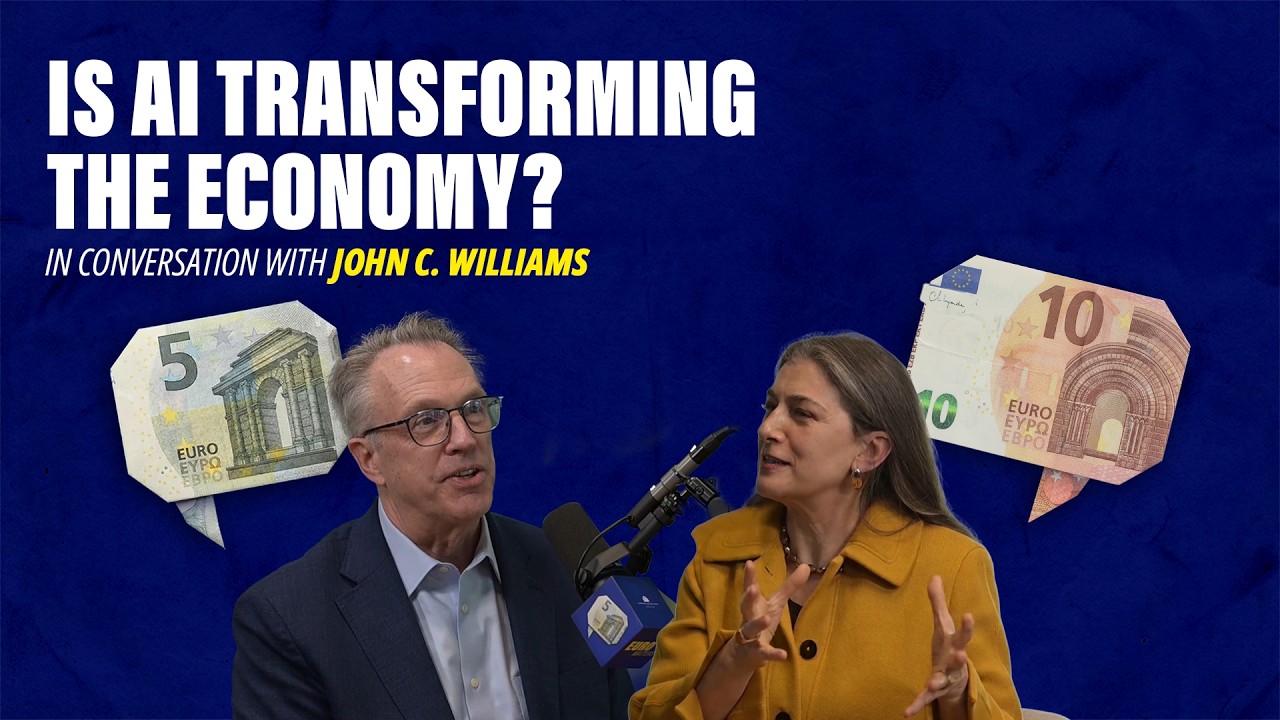
Is AI transforming the economy? – In Conversation with John C. Williams
Keywords
Summary
207 words
Critical Evaluation
Value of the Information & Strength of the Argument
The conversation provides valuable qualitative insights from a top central banker, clarifying nuanced mechanisms linking AI to productivity and inflation. The argumentation is well-structured, comparing historical productivity booms with current conditions and distinguishing short-run demand-supply dynamics from medium-term supply effects. Williams’s reasoning is balanced, acknowledging uncertainties and the importance of data and implementation choices. He effectively argues that the benefits of AI depend on how it is utilized and distributed, raising important questions about wages and profits. The discussion is coherent and intellectually honest, avoiding overhype while recognizing potential transformative impacts.
Scientific Rigor, Source Quality, Title Accuracy
The video maintains high scientific rigor in its reasoning, though it lacks formal citations. John Williams draws on his extensive experience and references historical events (the 1990s productivity boom) and internal research. He mentions a book titled ‘In Person’ by a colleague but provides no publication details. The title accurately reflects the content, directly addressing the core question. No external sources or links are provided in the description, which limits the ability to verify claims independently. However, the speaker’s authority and balanced approach lend credibility. The discussion is consistent with established economic theories on general-purpose technologies and productivity.
204 words
Title / Content Match
The title directly reflects the content, as the entire conversation addresses whether AI is transforming the economy, including productivity, jobs, inflation, and financial stability.
Quality & Reliability
8/10
The discussion features a highly authoritative central banker with decades of experience, providing balanced and thoughtful analysis. However, no formal citations or data sources are provided, and the arguments rely on anecdotal evidence and historical analogies. The reasoning is clear and credible, but not rigorously sourced.
Key Moments
Markers derived by PSI from the transcript: the creator did not define chapters.
- Introduction of guest John Williams and the topic of AI's economic impact.
- Discussion on productivity: aggregate data not yet showing acceleration, but micro evidence from firms is promising.
- Williams explains that AI implementation determines whether it cuts costs or empowers workers, affecting long-term benefits.
- Comparison of AI's potential in Europe vs the US, noting differences in AI production hubs.
- Analysis of AI's impact on inflation: medium-term disinflationary, short-term inflationary due to demand-supply imbalance.
- Discussion of financing of AI investments, shift from equity to debt and structured finance, and associated risks.
- Financial stability concerns: warning signs include hidden leverage and potential fire sales; scrutiny needed.
- Williams outlines what he hopes to see in five years: higher real earnings, productivity, and using AI to address societal needs like healthcare and housing.
Cited Sources
- In Person (book mentioned by Williams) — Williams recommends a book written by a colleague about remote work and productivity, but provides no title details beyond 'In Person'.
Contribution & Novelties
This video offers a unique perspective from a senior Federal Reserve official on how AI may influence monetary policy and financial stability. It bridges the gap between theoretical discussions of general-purpose technologies and practical central banking considerations, such as scenario analysis and financing risks. The distinction between short-run inflationary pressures and medium-term disinflationary effects is particularly insightful, as is the emphasis on micro data to detect productivity shifts. The conversation also touches on the evolving role of AI in financial markets and the importance of understanding leverage and interdependencies.
Pour aller plus loin :
- General-purpose technology — This concept underlies Williams’s view that AI will have broad and sustained economic effects.
- Productivity paradox — Also known as the Solow paradox, it relates to the difficulty in observing productivity gains despite technological advances.
- Financial stability — The discussion central bank’s role in monitoring risks from AI-related investment booms.
147 words
Radar Profile
The radar profile shows high fiabilité and qualite_information, reflecting the authoritative speaker and coherent reasoning. Quantite_information is moderate, as the discussion is broad but not deeply technical. Niveau_technique is moderate, accessible to a general audience with economic interest.