Automatización de tareas repetitivas con Make y Zapier
Keywords
Summary
190 words
Critical Evaluation
Value of the Information & Strength of the Argument
The value of the content lies in its practical, hands-on approach: rather than teaching programming, it empowers non-developers to automate everyday tasks using accessible integration platforms. The instructor effectively argues for the benefits of automation by sharing concrete user stories and connecting them to industrial revolutions, reinforcing the message that automation is a natural progression that enhances human work rather than replacing it. The argumentation is logically structured, moving from identifying repetitive tasks to formalizing the trigger-action-result model, and finally to a guided exercise. This incremental approach helps learners internalize the concepts without feeling overwhelmed, and the interactive format fosters engagement and clarification of doubts.
Scientific Rigor, Source Quality, Title Accuracy
The session does not cite specific external sources; reliance is placed on the instructor’s expertise and illustrative examples. However, the reasoning is coherent and consistent, and the tools demonstrated (Make and Zapier) are well-known in the automation space. The title perfectly matches the content, as the entire session is dedicated to explaining and practicing automation of repetitive tasks with these tools. No comments were provided, so no public feedback analysis is possible.
192 words
Title / Content Match
The title accurately reflects the content: the session focuses on automating repetitive tasks using Make and Zapier.
Quality & Reliability
7/10
The video is a clear instructional tutorial by an instructor with a background in mathematics and AI. It provides practical guidance on using Make and Zapier, but does not cite external sources. The content is logically structured and offers a hands-on approach.
Key Moments
Markers derived by PSI from the transcript: the creator did not define chapters.
- Introduction and self-presentation of instructor Stefanie Amador.
- Interactive discussion: participants share repetitive tasks they would like to automate.
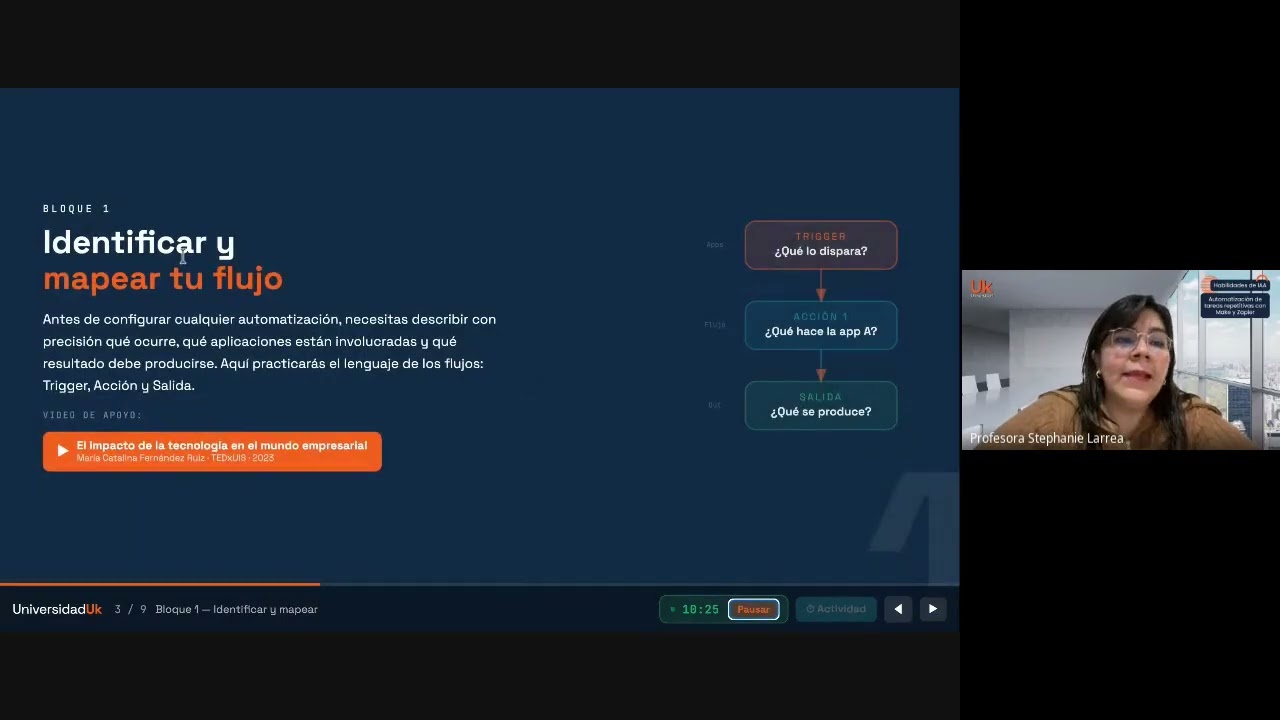
- Explanation of the core concepts: trigger, action, and result in workflow automation.
- Screening of a video about Industry 4.0 and 5.0 and the role of intelligent technologies.
- Practical activity: mapping a real task using the trigger/application/result template.
Contribution & Novelties
This tutorial provides an accessible entry point to no-code automation, addressing a common pain point for non-technical professionals. It emphasizes the importance of clearly defining the workflow before using any tool, which is a crucial but often overlooked step. The interactive format and real-world examples make it relatable, and the session is structured to produce tangible outcomes: a documented workflow and a configured automation.
Pour aller plus loin :
- No-code development platform — Provides an overview of the no-code paradigm and its relation to automation tools.
- Zapier — Details on one of the most popular automation platforms, its features, and integrations.
- Make (software) — Explains the capabilities of Make (formerly Integromat), including visual workflow design.
- Workflow — A general definition of workflows and how they apply to business process automation.
130 words
Radar Profile
The radar shows high scores in quantity of information (8) and moderate quality (7), indicating a substantial amount of well-presented content. Technical level is beginner (5), and reliability is moderate (6) due to the absence of external citations. This profile suits an instructional tutorial that prioritizes practical application over deep technical depth.