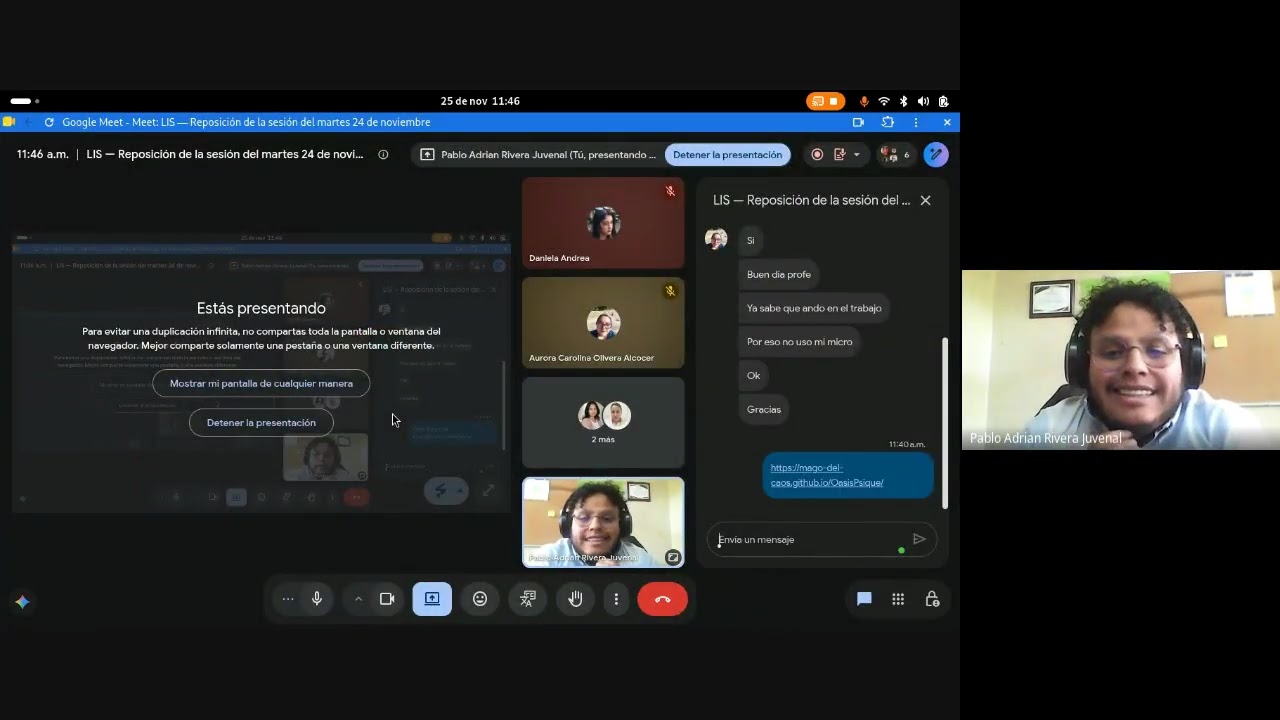
LIS sesión módulo 3-4 grupo 405
LIS session module 3-4 group 405
Keywords
Summary
276 words
Critical Evaluation
Value of the Information & Strength of the Argument
The value of the information is almost entirely procedural. What the viewer gains is a step-by-step, screen-shared demonstration of how to complete two course assignments: which boxes a social-diagnosis template contains, in what order to fill them, and what a finished pitch video must state. The instructor makes this concrete by building a single worked example live, from the statement of a negative situation to three candidate solutions, and by anticipating the recurring questions of past cohorts (whether the problem must come from the cooperative case, whether editing rights can be granted, how long the video may be). On this operational level the content is clear and usable. The argumentation, however, is not demonstrative: every prescription rests on the instructor’s authority as the person who designed the assignment and grades it, not on evidence. No data, no study and no theoretical framework is invoked to justify why a diagnosis should be structured in these dimensions rather than others, why exactly three solutions are required, or why a two-and-a-half-minute format is the appropriate vehicle for a project pitch. Where the session touches on a factual claim outside its own logistics, in the chatbot demonstration, the reasoning is explicitly framed as unreliable: the instructor asks the model to define comorbidity, then asks what the DSM-5 says, and immediately cautions that the text is generated and must be checked, illustrating the point by having the model produce an unverified answer about graduation requirements. That caveat is sound in spirit but is neither followed up nor applied to the definition the class has just read out. Illustrative figures such as a 10,000-peso municipal budget versus a 50,000-peso target are placeholders, clearly presented as such. The session contains no competing viewpoints, no discussion of the limitations of the social-innovation approach it teaches, and no attempt to connect the assigned deliverables to the wider literature on the subject. Its argumentative strength is that of a well-organised teaching walkthrough; its weakness is that nothing in it is argued beyond ‘do it this way because this is the rubric’.
Scientific Rigor, Source Quality, Title Accuracy
No sources are cited anywhere in the session, and none could be: the video description is empty, so there is no bibliography, no link list and no reading material attached. The only external reference named at all is the DSM-5, mentioned in passing as a prompt typed into a chatbot, and the resulting answer is neither quoted with precision nor verified. The empirical basis of the worked example, a neighbourhood in Mexico City described as having young people who use drugs and lack sports facilities, is anecdotal and presented as an invented illustration for the template rather than as a documented case; the budget figures are likewise invented for the exercise. Methodologically, the session is rigorous in only one sense: the instructor repeatedly tells students to use a problem from their own area so that real local data can be gathered, which is a sound instinct for a diagnostic exercise, and he flags the chatbot’s unreliability. Against that, the scientific register is loose. The definition of comorbidity is read out from an unverified model output and used without correction, and the AI demonstration is framed around giving a website ‘a brain’ through an API key, a metaphor that obscures what the system actually does. Nothing is said about how students should document or reference the local information they are told to collect, so the exercise remains at the level of structured description rather than evidence-based diagnosis. On title-to-content adequacy, the match is good: the session is genuinely a module 3 and module 4 class for group 405, and the title promises nothing it does not deliver.
622 words
Title / Content Match
The title matches the content closely: it announces a recorded session of the Laboratorio de Innovación Social covering modules 3 and 4 for group 405, and that is exactly what is delivered, with no misleading promise.
Quality & Reliability
3/10
The recording is a university class session: it is factually accurate about its own course logistics and templates, which can be checked against the course platform, but it carries no external evidence, no bibliography and no data. The only factual claims beyond the classroom relate to a chatbot demo, and the instructor himself concedes the tool is unreliable and must be double-checked. Reliability is therefore limited to the operational level, not to any scientific content.
Key Moments
Markers derived by PSI from the transcript: the creator did not define chapters.
- Opening: instructor introduces himself and the Laboratorio de Innovación Social, announces that the session covers the end of module 3 and the start of module 4.
- Presentation of the revamped course support platform (Oasis), now installable as an application on mobile and desktop, with links to tutorials and to the official university microsite.
- Introduction of a page hosting four AI characters (psychology tutor, administrative assistant, innovation and technology, humanities); explanation that a free API key from a commercial provider must be generated once per device to activate it.
- Live chatbot demo: the model defines comorbidity and is asked about the DSM-5, then is asked an administrative question; the instructor warns that outputs must always be verified.
- Start of module 3: deadline extended to Friday, two accepted templates presented, and explanation of why editing rights cannot be shared (risk of overwriting other students' work).
- Step one of the diagnosis: a local example is built live (young people in a Mexico City neighbourhood using drugs and not exercising), with negative effects, affected population and the physical space of the effects.
- Actors involved in the present situation versus in the desired future, and needs on the physical, social and ecological dimensions, contrasted between current state and desired state.
- Place characteristics, context and available versus required resources (illustrative municipal budget figures), followed by the requirement to propose three candidate solutions.
- Start of module 4: a pitch video of up to two and a half minutes presenting the problem, the project, its vision and aims, plus an invitation to participate, with a script and upload to TikTok, YouTube or a shared Drive link.
- Closing practical instruction: from the three solutions drafted in module 3, students must select the one that best fits the needs identified before moving to the pitch.
Concurring Sources
- Social innovation — Wikipedia — General framework underpinning the course; the diagnosis-to-solution structure taught in the session follows the standard social-innovation project cycle described in this entry.
- Theory of change — Wikipedia — The template's present-state versus desired-future columns and its effects/actors/needs breakdown correspond closely to the logic-model approach formalised in theory of change practice.
- Design thinking — Wikipedia — The emphasis on local needs, stakeholder mapping and rapid generation of three candidate solutions is consistent with the design-thinking process commonly used in social innovation labs.
Contribution & Novelties
The session’s originality is pedagogical rather than scientific. It shows a distance-learning course migrating its support infrastructure to an installable web application and to a low-cost AI layer built on a free API key, with four conversational characters covering psychology tutoring and administrative procedures. What is genuinely new for a course of this kind is the coupling of a classical social-innovation template (negative situation, effects, affected population, space, actors, needs across physical, social and ecological dimensions, resources, three candidate solutions) with a pitch-video deliverable and a demonstrated, explicitly caveated use of a language model as a study aid. The didactic device worth noting is the live construction of a single worked example carried from problem statement through to the three solutions, which turns an abstract rubric into a reproducible model. On the negative side, the session adds no empirical content of its own: the example is invented, the figures are placeholders, and the AI demonstration is left unverified.
Further reading:
- Social innovation — Wikipedia — Background framework for the diagnosis-to-proposal sequence the class requires.
- Theory of change — Wikipedia — Conceptual grounding for the present-versus-desired-future structure of the template.
- Design thinking — Wikipedia — Methodology behind stakeholder mapping and the generation of multiple candidate solutions.
- DSM-5 — Wikipedia — Reference mentioned in the session for the diagnostic definition the chatbot was asked to supply.
- Verification of AI-generated answers and hallucination in large language models — directly relevant caveat raised but not developed by the instructor.
- Community-based participatory needs assessment — the methodological family the local-data-collection instruction implicitly belongs to, not named in the video.
264 words
Radar Profile
The profile is flat and low, with a slight peak in quantity of information: the session delivers a dense sequence of procedural instructions and administrative detail. Technical level and reliability stay low because no method, evidence or source is brought in, and the only technical segment is a hands-on AI demonstration presented with explicit warnings about its trustworthiness.