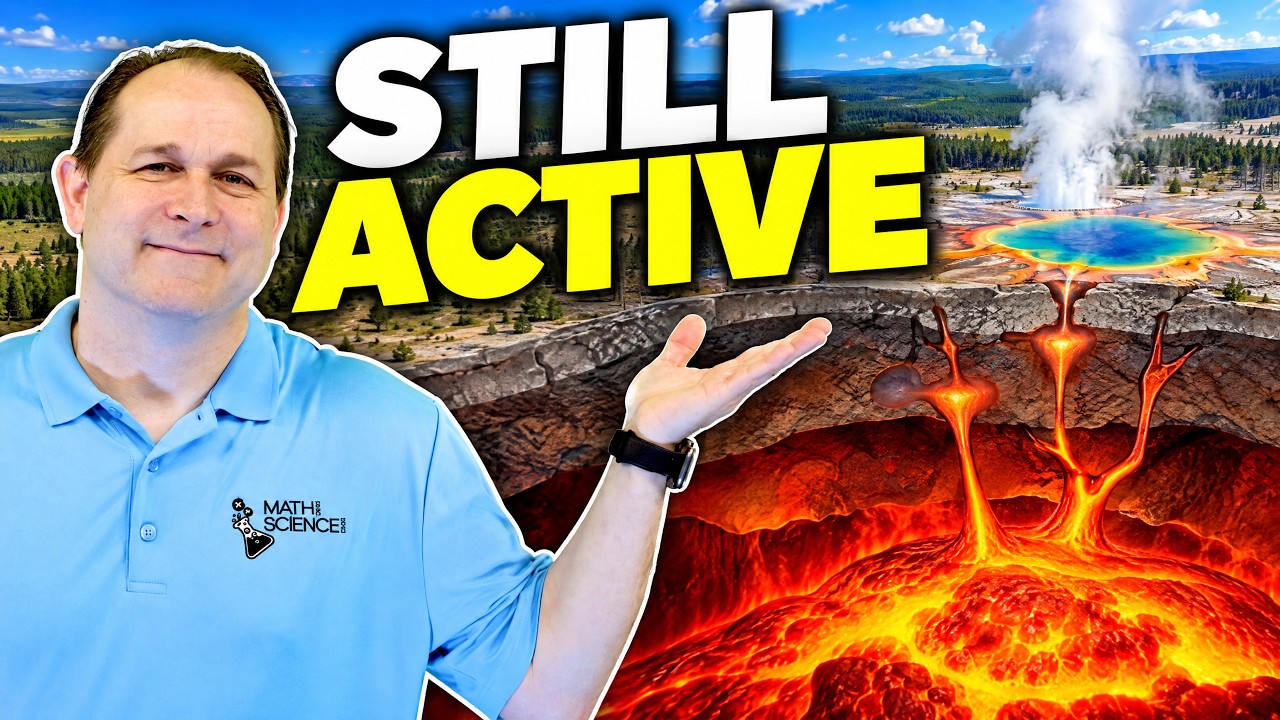
A Supervolcano Sits Under America. What If It Erupts?
Keywords
Summary
209 words
Critical Evaluation
Value of the Information & Strength of the Argument
The value of the information is high: the video assembles a comprehensive portrait of Yellowstone’s volcanic system, from the Nebraska fossil evidence to current monitoring practices, with concrete figures (magma chamber dimensions, uplift measurements, eruption intervals). It provides genuine educational value in explaining the distinction between cone volcanoes and calderas, the partial-melt nature of the magma body, and the role of the deep mantle plume. The argumentation is well-structured and progressive, building from surface phenomena to subsurface mechanisms, then to risk and scenarios. The video avoids both panic and complacency, acknowledging the destructive potential of a super-eruption while citing USGS data on the low annual probability and the conclusion that Yellowstone is not overdue. The case studies (Nebraska fossils, Hebgen Lake earthquake, Thermus aquaticus) are well chosen, each serving a distinct pedagogical purpose and reinforcing the systemic, cross-disciplinary nature of volcanology.
Scientific Rigor, Source Quality, Title Accuracy
Scientific rigor is generally solid: the video draws on USGS data and the Yellowstone Volcano Observatory, uses accurate geological facts such as eruption timelines and GPS-measured plate velocity, and appropriately caveats unknowns regarding eruption precursors. However, no formal citations or on-screen references are provided, so the viewer cannot directly trace claims to primary literature. The tone remains measured, with only the opening ’end civilization’ phrasing bordering on the dramatic. The title accurately reflects the content: the question is answered directly in the final part, and the intervening contextual material strengthens rather than dilutes the response. The title slightly overpromises immediacy, but overall the adequacy is good.
262 words
Title / Content Match
The title's central question — what a Yellowstone eruption would do — is explicitly answered in the final quarter of the video, after substantial geological context is built. The match is faithful and the content delivers on the promise.
Quality & Reliability
7/10
The video relies on USGS data and the Yellowstone Volcano Observatory, presents accurate geological facts (eruption timelines, magma chamber structure, plate velocity), and appropriately caveats uncertainties. However, it uses no formal citations or on-screen references, and some framing is slightly dramatized.
Key Moments
Markers derived by PSI from the transcript: the creator did not define chapters.
- 1971 Nebraska discovery of rhino and other fossils buried by volcanic ash from a Yellowstone eruption 12 million years ago.
- Yellowstone's three super-eruptions in 2.1 million years: 2.08 Mya, 1.3 Mya, and 631,000 years ago, averaging ~725,000-year intervals.
- Definition of supervolcanoes: caldera-forming eruptions that collapse the ground rather than build a mountain.
- Yellowstone's geysers: Old Faithful erupting every ~90 minutes and Steamboat Geyser, the world's tallest active geyser at 300-400 feet.
- The hotspot mechanism: a fixed mantle plume and the North American plate drifting southwest at 4.6 cm/year.
- The magma plumbing system: a shallow 5-15% molten chamber and a deeper reservoir 4.5 times larger, discovered in 2015.
- Ground deformation: 28-inch uplift from 1923-1985 and evidence that Yellowstone Lake is physically tilting due to magma pressure.
- Thermal feature dangers: thin crusts over boiling water, the 2016 fatal incident at Norris Geyser Basin, and hydrothermal explosions.
- Eruption scenario: USGS 1-in-730,000 annual probability, expected precursors (earthquake swarms, uplift), and a 30-50 km eruption column.
Cited Sources
- United States Geological Survey (USGS) — Mentioned as the source of the 1-in-730,000 annual probability estimate for a Yellowstone super-eruption.
- Yellowstone Volcano Observatory — Described as the body monitoring seismic activity, ground deformation, gas emissions, and hydrothermal features in the park.
Contribution & Novelties
The video’s original contribution is its comprehensive visual synthesis of Yellowstone’s entire volcanic system — from deep mantle plume to surface hydrothermal features — presented with accessible framing of complex geophysical data. It bridges geology, microbiology (Thermus aquaticus and PCR), and risk communication in a single narrative, making interdisciplinary connections that are rarely combined in one presentation.
Pour aller plus loin :
- Yellowstone Caldera (Wikipedia) — Detailed geological history and structure of the caldera.
- Supervolcano (Wikipedia) — General concept and comparison with other large volcanic systems.
- Hotspot (geology) (Wikipedia) — Mechanism of mantle plumes and plate movement over stationary hotspots.
- Thermus aquaticus (Wikipedia) — The extremophile bacterium whose enzyme enabled PCR, as highlighted in the video.
- Yellowstone Volcano Observatory (USGS) — official monitoring page (no URL provided in the video).
130 words
Radar Profile
The radar profile shows high scores in information quantity, quality, and global reliability, with a moderate technical level. This indicates a well-researched, accurate science documentary accessible to a broad audience, with emphasis on factual density and dependable sources.