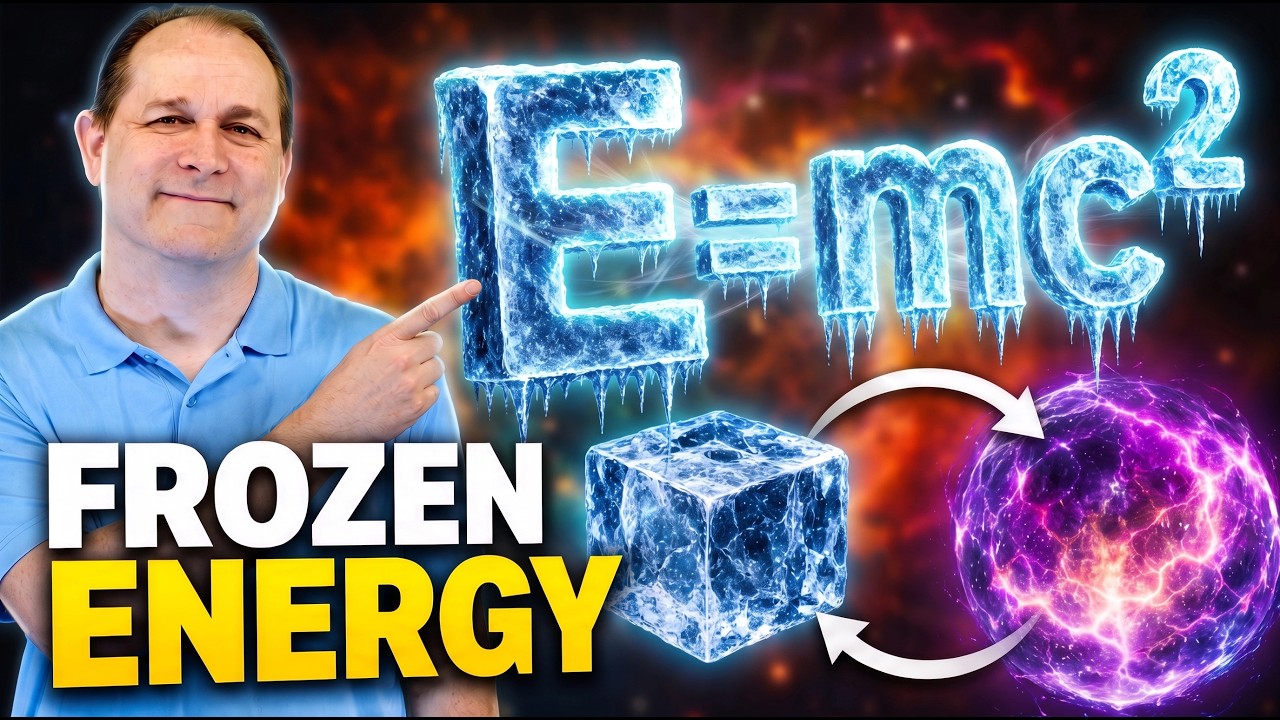
The Most Famous Equation of All Time...What it REALLY Means
Keywords
Summary
186 words
Critical Evaluation
Value of the Information & Strength of the Argument
The video provides substantial value by demystifying a famous equation without oversimplifying. It correctly identifies common misconceptions, such as treating the equation as a simple conversion for nuclear reactors, and instead offers a nuanced explanation rooted in modern physics. The argumentation is sound: it builds from observable facts (inertia, nuclear reactions) to the logical necessity of the speed of light squared, and it uses the mass defect and solar fusion as empirical evidence. The step-by-step reasoning from acceleration and effective mass to the impossibility of reaching light speed is coherent and well-structured. The inclusion of quark-gluon dynamics and the Higgs field shows a contemporary understanding, avoiding outdated simplifications. Overall, the information is accurate, logically presented, and effectively communicated.
Scientific Rigor, Source Quality, Title Accuracy
The scientific rigor is high. The video avoids misstatements about relativity and particle physics, and it correctly distinguishes between the popular ‘mass as condensed energy’ notion and the precise role of the Higgs mechanism. Sources are not explicitly cited, but the content aligns with established physics as taught in university courses and described in standard references. The title is aptly chosen as it emphasizes the ‘really’ meaning, which the video delivers. The video does not present any original research but accurately synthesizes known physics, making it a reliable educational resource. The title and content are well matched.
230 words
Title / Content Match
The title accurately reflects the video's content, which explains the deeper meaning of E=mc² beyond the popular shorthand.
Quality & Reliability
8/10
The video presents accurate physics explanations, correctly distinguishes between popular misconceptions and the deeper meaning, and uses reliable analogies. It covers the derivation of E=mc², its implications for nuclear reactions, and current understanding of mass from quark and gluon energy.
Key Moments
Markers derived by PSI from the transcript: the creator did not define chapters.
- Introduction to E=mc² and its core meaning of mass-energy equivalence.
- Analogy of ice and water to illustrate that matter is concentrated energy.
- Explanation of why the speed of light appears and the concept of inertia.
- Einstein's 1905 papers and the derivation of E=mc² from relativity.
- Nuclear fission and fusion: mass defect and the sun's energy production.
- Quarks and the origin of mass: 99% from binding energy and kinetic motion.
- Higgs field and the final synthesis of mass as a form of energy storage.
Contribution & Novelties
The video’s contribution lies in its clear and accessible explanation of E=mc², emphasizing that mass is a form of energy and exploring the underlying physics including quark and Higgs field explanations. It bridges historical context and modern particle physics, making the concept tangible for a general audience.
Pour aller plus loin :
- Mass–energy equivalence — The core equation and its derivation.
- Special relativity — Einstein’s theory from which E=mc² emerges.
- Higgs boson — Particle associated with the mechanism that gives intrinsic mass.
- Nuclear fission — Practical application of mass-energy conversion.
90 words
Radar Profile
The radar profile shows strong scores in information quality and quantity, with slightly lower technical depth, indicating a comprehensive yet accessible educational video.