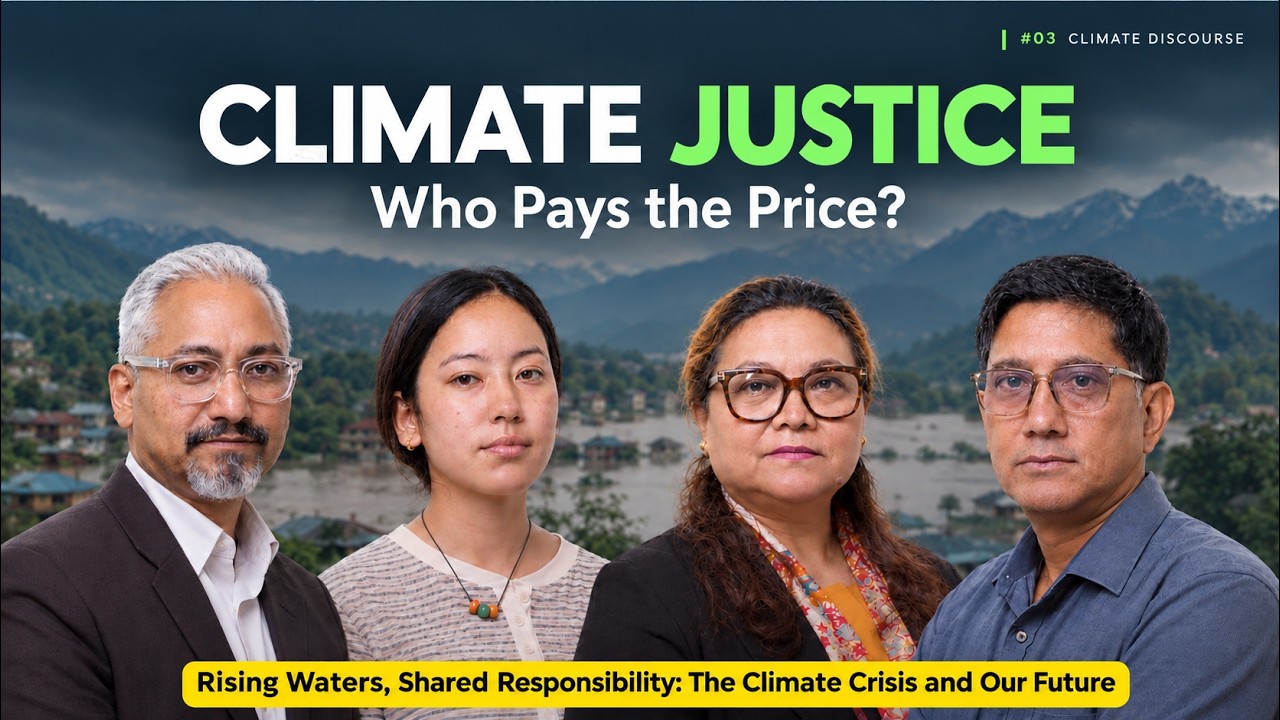
Who Pays for the Damage? Not Charity, but Climate Justice for Nepal | Climate Discourse Series EP03
Keywords
Summary
226 words
Critical Evaluation
Value of the Information & Strength of the Argument
The video’s value lies in its combination of local testimony, scientific evidence, and policy advocacy. The argumentation is solid: it establishes the reality of climate impacts in Nepal, cites specific scientific studies (e.g., ICIMOD’s glacier inventory and Highrise publication), and connects these to the need for climate justice. The speakers effectively argue that Nepal suffers disproportionately due to factors beyond its control, and they propose concrete steps like transboundary early warnings and joint advocacy. The argument is persuasive, though it occasionally relies on emotional appeals without quantifying all claims; however, the inclusion of specific figures (deaths, financial losses, scientific projections) strengthens the case. The panel maintains a balanced tone, acknowledging the ongoing suffering while advocating for long-term solutions.
Scientific Rigor, Source Quality, Title Accuracy
The discussion demonstrates strong scientific rigor: Dr. Pradhan references ICIMOD studies, IPCC reports, and specific flood events, providing a credible foundation. The speakers distinguish between data and information, emphasizing the need for actionable communication. The title accurately captures the essence: the video focuses on who bears the cost and the call for justice rather than charity. There are no explicit external sources cited in the description besides social media, but the speaker credentials (ICIMOD, BlinkNow) add authority. The lack of formal citations in the video is typical for panel discussions, but viewers are directed to ICIMOD’s research. The title’s emphasis on “not charity” aligns with the argument for rights-based justice, which is well-argued. Overall, the sources are credible and appropriately used, though deeper referencing would enhance reproducibility.
260 words
Title / Content Match
The title accurately reflects the core topic of climate justice for Nepal, focusing on responsibility and damages.
Quality & Reliability
8/10
The video presents a well-informed expert panel with scientific references (ICIMOD, IPCC) and personal testimony, offering a coherent and credible discussion on climate justice in Nepal.
Key Moments
Markers derived by PSI from the transcript: the creator did not define chapters.
- Dr. Kalaunee discusses the human and economic toll of the floods, emphasizing irreversible losses and the intensity of the crisis.
- Dr. Pradhan presents scientific evidence from ICIMOD on glacial lake dangers and accelerated glacier melt, including the 65 times faster mass loss.
- Discussion on rethinking early warning systems, highlighting the challenge of "dirty water floods" and the need for community preparedness.
- Ngawang Dolma Sherpa shares personal testimony from Rasuwa, detailing the loss of family and the urgent needs of affected communities.
- Panelists conclude by advocating for climate justice, emphasizing Nepal's minimal emissions versus disproportionate burden, and the need for international action.
Cited Sources
- KU Dialogue Series Facebook Page — Channel's social media for collaboration and additional information.
- ICIMOD High-Altitude Glaciers Study — Referenced by Dr. Pradhan regarding glacial lake hazards and glacier mass loss.
- IPCC Sixth Assessment Report — Mentioned as a basis for cascading hazards and unprecedented extremes.
Concurring Sources
- ICIMOD Highrise Publication — Supports statements on glacier mass loss in the Hindu Kush Himalaya.
Contribution & Novelties
The video contributes a nuanced perspective on climate justice by integrating scientific evidence with local testimonies, specifically addressing the 2025-2026 Nepal floods. It highlights the understudied nature of “dirty water floods” and proposes innovative early warning approaches. The call for transboundary, community-level information sharing adds practical value. The discussion also stresses the need for climate attribution to strengthen international negotiations.
Pour aller plus loin :
- Climate justice — Relevant background on the ethical and political dimensions.
- Loss and damage (climate change) — Explains the international mechanism to address unavoidable impacts.
- Hindu Kush Himalaya — Context of the mountain region’s vulnerability and ICIMOD’s work.
103 words
Radar Profile
The profile shows high scores across all dimensions, indicating a well-balanced and informative discussion. The strongest aspects are information quantity and reliability, while technical level is moderate, making it accessible yet substantive.