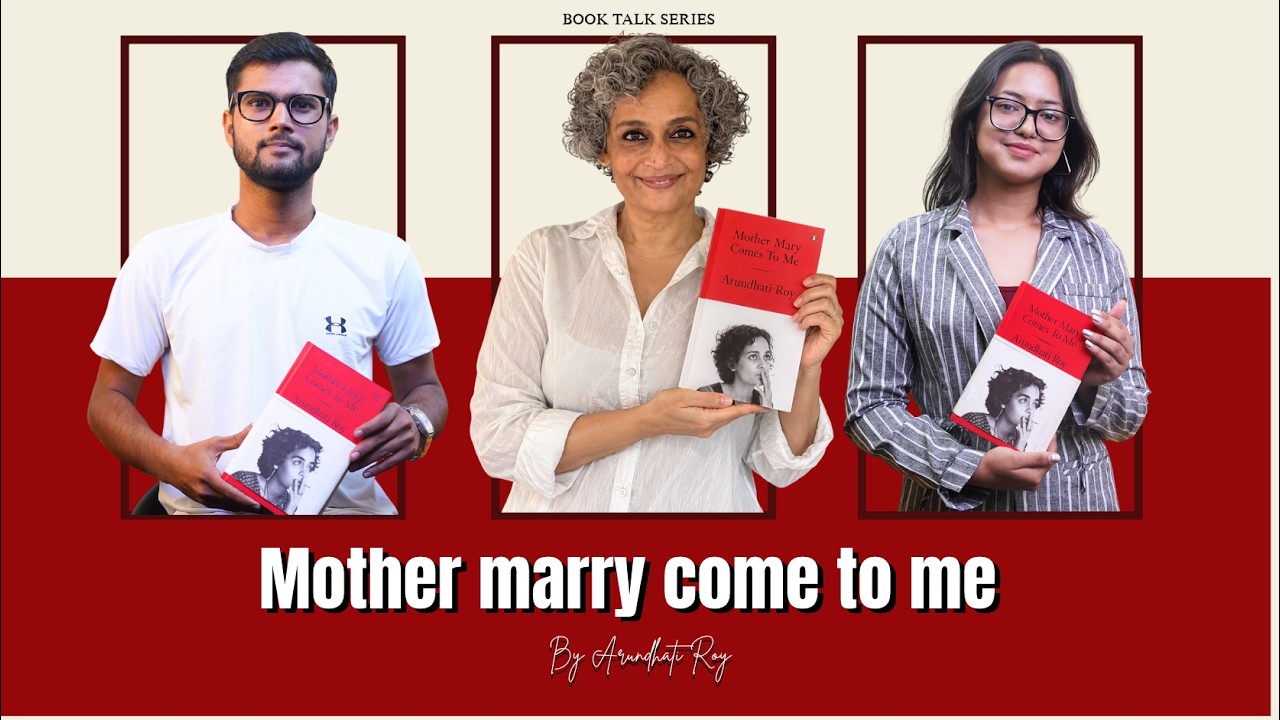
The Reflection of Mother Marry come to me – Life Lessons and Insights. Book Talk Series EP02
Title history
- The Reflection of Mother Marry come to me – Life Lessons and Insights. Book Talk Series EP02 — observed on 20261119-1454 UTC (YouTube)
Keywords
Summary
165 words
Critical Evaluation
Value of the Information & Strength of the Argument
The video offers valuable insights into Arundhati Roy’s memoir, presenting a thoughtful exploration of maternal love, family dynamics, and personal freedom. The guest provides specific examples from the book, such as the mother’s contradictory behavior and her legal battles, which ground the discussion in concrete details. The argumentation is coherent and emotionally resonant, but it remains largely subjective, based on personal impressions rather than critical analysis. The host’s questions guide the conversation effectively, though the reasoning could benefit from more structured argumentation and external references to strengthen its persuasive power. Overall, the value lies in its relatable and humanizing portrayal of complex relationships, but the lack of rigorous academic depth is noticeable.
Scientific Rigor, Source Quality, Title Accuracy
The video does not cite external sources beyond the memoir itself and Arundhati Roy’s other works. The discussion is based on the speakers’ personal interpretations and knowledge, with no formal referencing or verification. The title is accurate but contains a typo (‘Marry’ instead of ‘Mary’), which slightly detracts from its professionalism. The content aligns well with the title, as it indeed reflects on the memoir and its life lessons. However, the scientific rigor is moderate: the speakers rely on anecdotal evidence and subjective opinions, making it difficult to assess the factual accuracy independently. No contradictions or errors were detected, but the lack of sources prevents thorough validation. The adéquation between title and content is strong, but this does not significantly elevate the overall score.
251 words
Title / Content Match
Title accurately reflects the discussion on Arundhati Roy's memoir about her mother.
Quality & Reliability
6/10
The discussion is thoughtful and well-informed about the memoir, but it is subjective and lacks external verification.
Key Moments
Markers derived by PSI from the transcript: the creator did not define chapters.
- Introduction of the book and initial impressions from the guest.
- Discussion of the mother as both a refuge and a storm, with specific childhood anecdotes.
- Exploration of the complexity of love and family relationships, including unconventional expressions.
- Challenging the ideal of the perfect mother and societal expectations of unconditional maternal love.
- Recognizing parents as imperfect humans and the difficulty of reconciling love and flaws.
- Connection of personal experiences to political activism, focusing on Mary Roy's legal fight for property rights.
- Discussion on freedom and separation without needing all answers, referencing Arundhati's life choices.
- Legacy of Mary Roy as an educator and feminist, and the impact of her actions on broader society.
Cited Sources
- Mother Mary Comes to Me — The memoir discussed in the video, providing the foundation for all themes and examples.
- The God of Small Things — Arundhati Roy's earlier novel referenced for comparison and context.
- The Ministry of Utmost Happiness — Another work by Arundhati Roy mentioned during the discussion.
Contribution & Novelties
The video provides a thoughtful and personal reflection on Arundhati Roy’s memoir, emphasizing the complexity of maternal love and the reconciliation of flaws and admiration. It contributes to the discourse on feminism and family dynamics from a South Asian perspective, highlighting how personal experiences shape political views and how choosing freedom can be a form of love. The discussion, while insightful, does not present original research but offers a nuanced interpretation that may resonate with readers. It also encourages viewers to question idealized notions of motherhood and embrace ambiguity in relationships.
Pour aller plus loin :
- Arundhati Roy — Background on the author, including her literary career and activism.
- Memoir — Overview of the memoir genre and its distinguishing features.
- Feminism — Broad introduction to feminist theories and movements relevant to the discussion.
- Motherhood — Cultural and social perspectives on motherhood and its expectations.
144 words
Radar Profile
The radar profile shows moderate scores across all dimensions, with a slightly lower technical level and higher information quantity. This indicates a discussion that is informative and engaging but not deeply technical or rigorously sourced, aligning with its nature as a personal reflective debate.