Aleksey Cherman: Does the Hot QCD Chiral Transition Live on a Conformal Manifold? (November 6, 2026)
Title history
- Aleksey Cherman: Does the Hot QCD Chiral Transition Live on a Conformal Manifold? (November 6, 2026) — observed on 20261120-1758 UTC (YouTube)
Keywords
Summary
150 words
Critical Evaluation
Value of the Information & Strength of the Argument
The talk provides a high-value contribution by integrating recent lattice QCD results with theoretical anomaly arguments, yielding new constraints on the nature of the chiral transition. The argumentation is systematic: first presenting evidence against the first-order hypothesis, then explaining why Ginzburg-Landau reasoning fails, and finally showing how the ’t Hooft anomaly severely limits possible CFTs. The speaker carefully distinguishes conjectures from established results, acknowledges uncertainties, and engages with audience questions, strengthening the credibility of the conclusions. The proposed conformal manifold scenario, though speculative, is logically motivated and supported by multiple calculational methods.
Scientific Rigor, Source Quality, Title Accuracy
The talk is scientifically rigorous, drawing on multiple lattice QCD collaborations (JLQCD, others) and referencing the original works by Pisarski and Wilczek. The speaker is transparent about the status of lattice evidence and the assumptions behind anomaly matching. The title accurately reflects the content and is precisely addressed in the talk. No deviations from the announced topic are observed. The presentation makes clear the chain of reasoning from numerical data to theoretical constraints, demonstrating high scientific standards.
184 words
Title / Content Match
The title poses a specific question that the talk directly answers, making for an excellent match.
Quality & Reliability
9/10
Talk by a recognized physicist at a prestigious institute, based on recent lattice results and rigorous anomaly arguments. High reliability due to engagement with current literature and explicit discussion of uncertainties.
Key Moments
Markers derived by PSI from the transcript: the creator did not define chapters.
- Introduction and apology for not discussing confinement directly
- Review of Columbia plot and old expectations of first-order transition
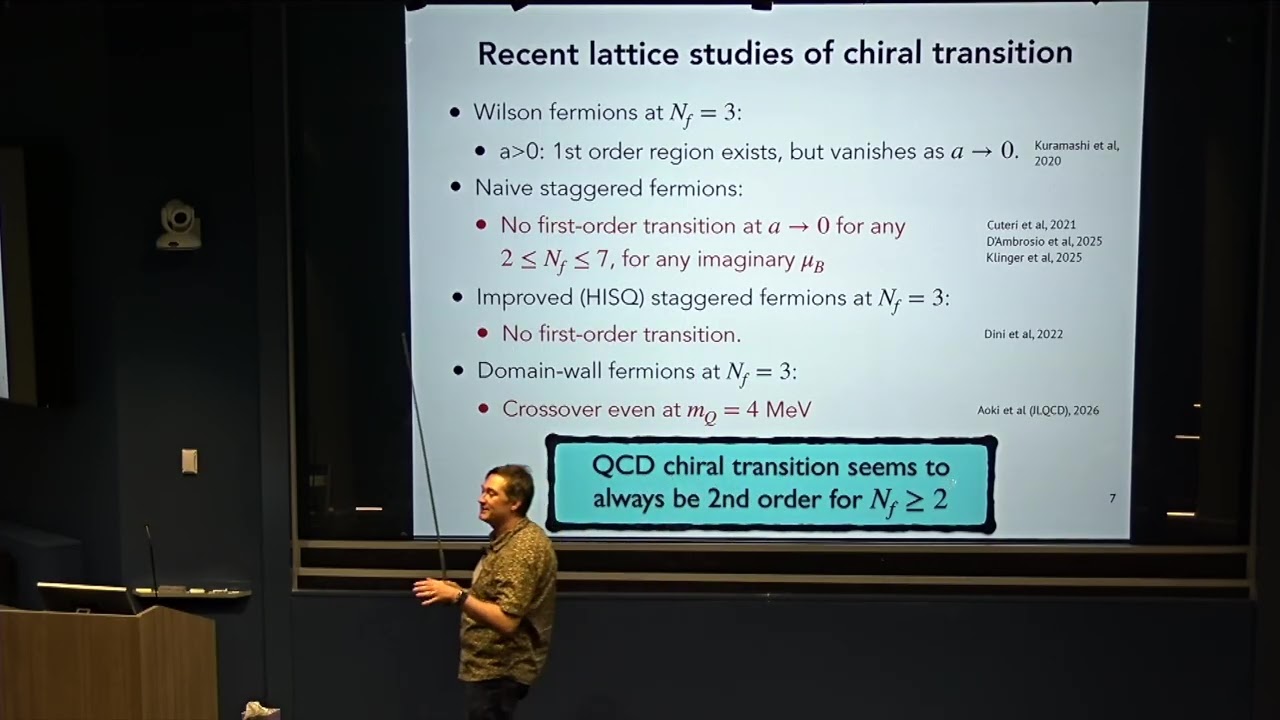
- Presentation of recent lattice evidence indicating no first-order transition
- Explanation of Ginzburg-Landau failure and introduction of 't Hooft anomaly
- Constraints on possible CFTs and derivation of consistent scenarios
- Discussion of conformal manifold scenario and supporting methods (epsilon expansion, lattice)
- Conclusion and final remarks
Cited Sources
- Simons Collaboration on Confinement and QCD Strings Annual Meeting 2026 — Event page for the talk, providing program and related details.
Contribution & Novelties
The talk offers a novel synthesis of recent lattice QCD results with anomaly arguments, showing that the chiral transition cannot be described by standard Ginzburg-Landau-Wilson fixed points but may instead be governed by a conformal manifold. This challenges conventional beliefs and proposes a testable scenario involving an exactly marginal operator. The identification of a finite-temperature ’t Hooft anomaly as a decisive constraint is a key original contribution.
Pour aller plus loin :
- Chiral symmetry breaking — Fundamental concept behind the phase transition.
- Conformal field theory — Essential framework for describing critical phenomena.
- Quantum chromodynamics — The underlying theory discussed throughout.
100 words
Radar Profile
The radar profile shows high scores across information quantity, quality, technical level, and typo correction. The talk is exceptionally dense and technically advanced, with rigorous argumentation and reliable sourcing. Weakness is only relative in the 'quality of information' dimension, reflecting inherent uncertainty in the field.