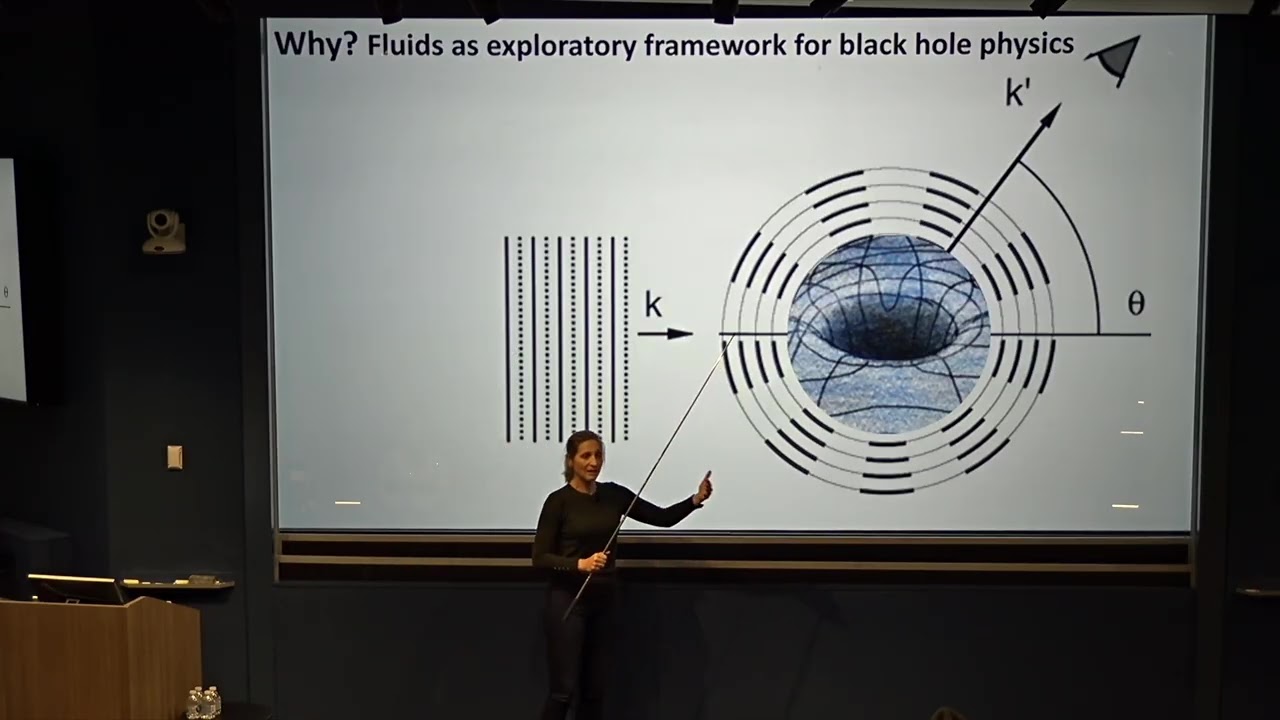
Silke Weinfurtner: How to Build a Black Hole (November 11, 2026)
Title history
- Silke Weinfurtner: How to Build a Black Hole (November 11, 2026) — observed on 20261119-0651 UTC (YouTube)
Keywords
Summary
132 words
Critical Evaluation
Value of the Information & Strength of the Argument
The video offers a compelling and clear explanation of complex theoretical physics through accessible analogies. The argumentation is well-structured: from the basics of wave-particle duality to the derivation of an effective metric for fluid flows, the speaker builds a solid case for the validity of analog gravity. She presents her own experimental results as evidence, along with references to theoretical predictions, and acknowledges limitations such as the absence of quantum entanglement in the classical system. The logical progression is strong, and the use of visual aids and demonstrations enhances the persuasiveness.
Scientific Rigor, Source Quality, Title Accuracy
The talk is presented under the aegis of the Simons Foundation, known for supporting high-quality scientific discourse. The speaker cites fundamental works by Hawking and Penrose, and mentions a key theoretical paper that justifies using classical systems to simulate quantum effects. The content is consistent with established literature in analog gravity. The title is perfectly aligned with the content, as the talk indeed focuses on building analogue black holes. No external sources are explicitly cited in the description besides the event page, but the lecture itself references seminal publications.
195 words
Title / Content Match
The title accurately reflects the content: the speaker demonstrates how to build analog black holes in the lab and discusses their implications.
Quality & Reliability
8/10
The lecture is given by a leading expert on analog gravity at a prestigious institution, with clear explanations and references to established theoretical concepts, though it remains a single presentation without peer review.
Key Moments
Markers derived by PSI from the transcript: the creator did not define chapters.
- Introduction: what is a black hole?
- Gedanken experiment with waterfall to illustrate sonic horizon
- First experiment using open channel flow
- Explanation of water wave behaviour and horizon creation
- Derivation of effective metric for fluid waves
- Stimulated Hawking radiation observed in the experiment
- Discussion of Penrose process and rotating black holes
- Conditions for a black hole bomb and superradiance
- Future perspectives and limitations
Cited Sources
- Event page: How to Build a Black Hole — Official page of the lecture, providing context and potential further resources.
Concurring Sources
- Analog gravity — Supports the concept that fluid flows can mimic black hole spacetimes.
- Hawking radiation — Confirms the theoretical background discussed in the lecture.
- Penrose process — Confirms the theoretical mechanism introduced for rotating black holes.
Contribution & Novelties
The lecture provides a comprehensive overview of experimental analog gravity, highlighting how a simple water tank can simulate black hole physics. The novelty lies in the accessible demonstration of Hawking radiation and the proposal for studying superradiance. It bridges theoretical concepts and practical experiments, offering a hands-on approach to testing quantum effects in curved spacetimes.
Pour aller plus loin :
- Hawking radiation — Detailed explanation of the quantum effect predicted near black holes.
- Penrose process — Theoretical mechanism to extract energy from rotating black holes.
- Analog gravity — Overview of physical systems that mimic gravitational phenomena.
- Acoustic black hole — Specific analogue using sound waves in fluids.
107 words
Radar Profile
The radar profile shows high scores in technical level and quality, reflecting a deeply informative lecture with rigorous scientific content. Quantity is slightly lower due to the focused scope, and reliability is high given the speaker's expertise and institutional backing.