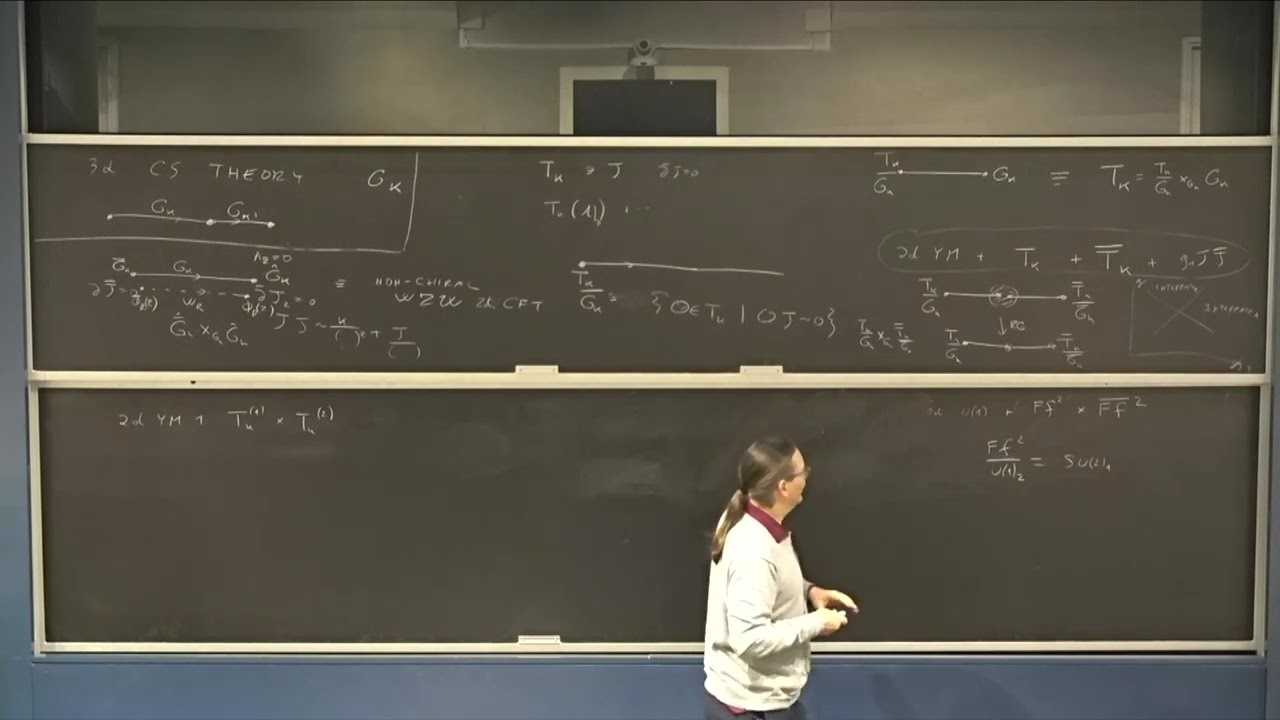
Davide Gaiotto: Holography in Chern-Simons Theory and Minimal Model (November 5, 2026)
Title history
- Davide Gaiotto: Holography in Chern-Simons Theory and Minimal Model (November 5, 2026) — observed on 20261120-1758 UTC (YouTube)
Keywords
Summary
184 words
Critical Evaluation
Value of the Information & Strength of the Argument
The talk is valuable for experts in theoretical physics, offering a unifying perspective that connects diverse topics such as Chern-Simons theory, conformal field theory, and holography. The argumentation is based on well-established results and conjectures, with plausible consistency checks. The speaker systematically builds from simple boundary conditions to more complex configurations, illustrating the logic with diagrams and formulas. He also addresses audience questions, clarifying the physical reasoning behind the RG flows and coset constructions. While some claims are not fully proven, they are presented with enough evidence to be convincing as a research program.
Scientific Rigor, Source Quality, Title Accuracy
The title is accurate. The talk draws on prior works by Costello, Gaberdiel, Gopakumar, and others, though specific references are not explicitly cited in the video. The scientific rigor is high, as the speaker carefully explains the logical steps and ties them to known results. The content is presented in a manner typical of a seminar for specialists. No peer-reviewed sources are cited, but the reasoning is solid and the conjectures are plausible. The description links to the Simons Foundation event page, providing context for the talk.
196 words
Title / Content Match
The title accurately describes the talk's focus on holography in Chern-Simons theory and minimal models.
Quality & Reliability
8/10
The talk is by a leading expert in string theory and holography, presenting rigorous mathematical and physical arguments. The content is technical and appears to be based on established research, though it is not peer-reviewed in this format.
Key Moments
Markers derived by PSI from the transcript: the creator did not define chapters.
- Introduction and review of Chern-Simons theory boundary conditions
- Discussion of coset constructions and their relation to RG flows
- Generalization to multiple gauge group factors and phase diagram as an associahedron
- Transition to holography: SU(N) Chern-Simons with fermions and minimal models
- Introduction of W-infinity algebra and its triality symmetry
- Description of the five-dimensional noncommutative Chern-Simons theory on D-branes
- Holographic dictionary and comparison of correlation functions between minimal models and the D-brane theory
Cited Sources
- Simons Foundation: Simons Collaboration on Confinement and QCD Strings Annual Meeting 2026 — Event page for the talk, providing background for the presentation.
Contribution & Novelties
The talk offers a novel synthesis of existing ideas, proposing a concrete holographic dictionary between W_N minimal models and a five-dimensional noncommutative Chern-Simons theory. It highlights the triality symmetry of the W-infinity algebra as a key to understanding the holographic correspondence, and integrates insights from Costello and Gaberdiel-Gopakumar. The speaker suggests testable predictions for RG flows in heterotic coset models, which could be verified via integrability techniques.
Pour aller plus loin :
- Chern–Simons theory — A foundational background on Chern-Simons theories.
- Minimal model (physics) — Overview of minimal models, including W_N generalizations.
- W-algebra — Introduction to the symmetry algebras that play a central role in the talk.
These concepts are directly related to the main ideas and provide accessible context for understanding the talk.
124 words
Radar Profile
The radar profile shows high scores in quantity and technical level, with slightly lower but still strong scores in quality and reliability. This reflects a dense, expert-level talk that is rigorous but remains a personal synthesis rather than a peer-reviewed publication.