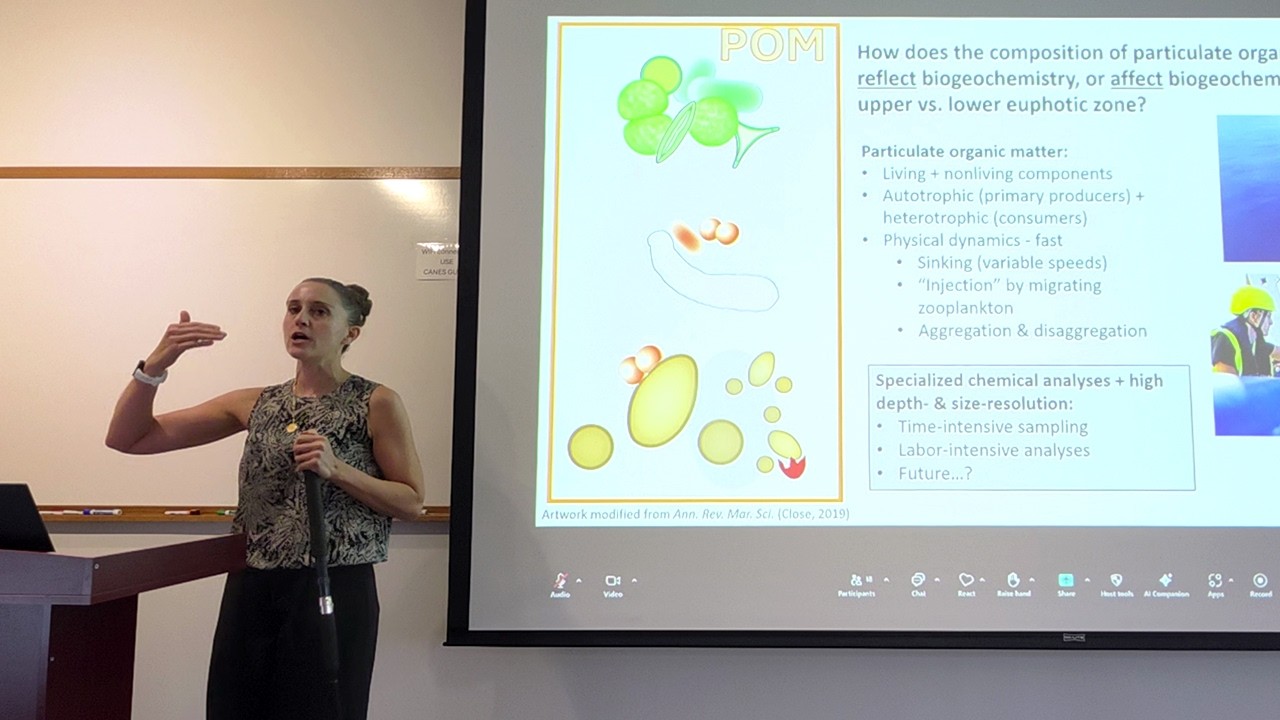
Hilary Close, Rosenstiel: Biogeochemistry of the Euphotic Zones
Keywords
Summary
180 words
Critical Evaluation
Value of the Information & Strength of the Argument
The value of the information is high: the talk presents novel data from multiple ocean basins, integrating observations from physical, chemical, and biological oceanography. The argumentation is structured and logically progresses from the definition of the euphotic zone to specific measurements, then to hypotheses about nitrogen cycling and heterotrophic metabolisms. The speaker uses compound-specific isotope analysis to link molecular-level processes to ecosystem-scale patterns, strengthening the chain of reasoning. However, some arguments rely on indirect inference (e.g., interpreting C:N ratios as indicators of metabolic activity), and the presentation is more an overview of ongoing work than a single definitive study, which slightly limits the conclusiveness.
Scientific Rigor, Source Quality, Title Accuracy
Scientific rigor is high: the speaker is an established researcher with a strong publication record (42 papers) and extensive field experience (29 cruises). The methods (in-situ pumps, isotope analysis) are well-established and clearly explained. The sources cited are largely from her own and collaborative projects (EXPORTS, BIOSCOPE, BATS, Station ALOHA) which are reputable programs. However, no specific external references or links are provided in the video description, so direct verification of cited data is limited. The title accurately matches the content, though it is somewhat general; the talk remains focused on biogeochemistry and carbon export. The presentation is internally consistent and acknowledges uncertainties, further supporting credibility.
225 words
Title / Content Match
The title accurately reflects the content: a focused lecture on the distinct biogeochemistry of upper and lower euphotic zones and its implications for deep ocean carbon export.
Quality & Reliability
8/10
The presentation is based on original, peer-reviewed research (as evidenced by the speaker's extensive publication record and funding from NSF, Simons, and Schmidt Sciences). Methodology is detailed, but no external sources or links are provided in the description, limiting independent verification.
Key Moments
Markers derived by PSI from the transcript: the creator did not define chapters.
- Introduction to the lab's research approach: marine organic and isotope geochemistry, compound-specific isotope analysis.
- Definition of the biological pump and organic carbon export; importance for carbon sequestration and deep ocean food webs.
- Discussion of oligotrophic gyres, deep mixed layers, and the concept of deep chlorophyll maximum.
- First results from BATS: distinct C:N ratios and nitrogen cycling in upper vs lower euphotic zones.
- Hypotheses about heterotrophic metabolisms, nitrogenous waste production, and implications for export.
- Zooplankton-mediated transformations of sinking particles and their role in modulating carbon flux to the deep ocean.
- Conclusions: broader applications to other gyres, climate change implications, and future research directions.
Contribution & Novelties
The talk contributes original data and hypotheses that challenge the traditional view of the euphotic zone as homogeneous. By distinguishing upper and lower euphotic zone biogeochemistry, it highlights previously underappreciated heterotrophic processes that significantly influence carbon export. The use of compound-specific isotope analysis provides a novel window into metabolic cycling. These findings have implications for refining global carbon models and interpreting paleoceanographic records.
Pour aller plus loin :
- Biological pump — Core concept underlying the export of organic carbon.
- Photic zone — Definition and depth variations in the ocean.
- Deep chlorophyll maximum — Key feature of stratified oligotrophic waters.
- Isotope analysis — Technique used for compound-specific studies.
107 words
Radar Profile
The radar profile shows consistently high scores across information quantity, quality, technical level, and reliability, reflecting a specialized and rigorous scientific talk. The lowest dimension is information quantity, though still strong, indicating a focused presentation rather than a broad overview.