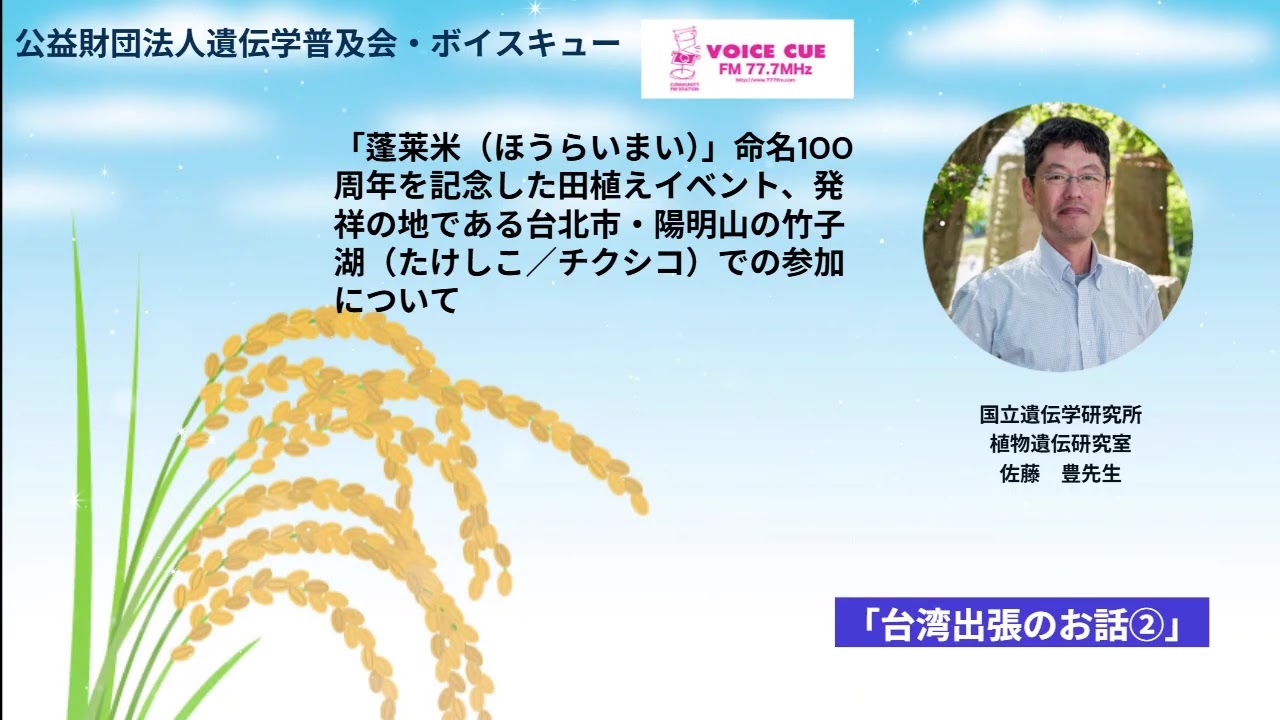
きゅんです!サイエンス|台湾出張のお話② 国立遺伝学研究所・佐藤豊先生
Kyun! Science|Story about the business trip to Taiwan ② National Institute of Genetics, Professor Yutaka Sato
Keywords
Summary
180 words
Critical Evaluation
Value of the Information & Strength of the Argument
The information value lies in the direct account of a researcher uncovering historical genetic materials that could resolve a specific scientific puzzle. Professor Sato’s reasoning is methodical and transparent, clearly linking the evidence (old notes, seed stocks) to the hypotheses. He acknowledges uncertainty and outlines planned experiments. His argument that preserving genetic resources is crucial, especially as analytical methods improve, is well supported by the example of the newly found seeds. The discussion is grounded in concrete documentary evidence and avoids overstatement.
Scientific Rigor, Source Quality, Title Accuracy
The rigour is high as the speaker carefully cites archival records and explicitly distinguishes between confirmed facts and conjectures. The use of original notes and conserved seed stocks constitutes primary source material. No external publications are explicitly cited, but the reliance on institutional documentation and the professional expertise of the speaker ensures a solid foundation. The title accurately matches the content, which admirably lives up to its promise of sharing insights from a Taiwan trip. No comments were provided for analysis, so no public commentary is discussed here.
185 words
Title / Content Match
The title accurately reflects the content, which is the second part of a talk about a Taiwan business trip, featuring Professor Sato's narrative.
Quality & Reliability
8/10
The content is based on the expert account of Professor Yutaka Sato, a trained geneticist, who discusses historical records and genetic resources with high scientific integrity. Deductions are clearly separated from established facts.
Key Moments
Markers derived by PSI from the transcript: the creator did not define chapters.
- Introduction and recap of the previous episode on Ponlai rice and Tai-chung 65
- Explanation of the genetic mystery of Tai-chung 65 lacking parental markers
- Discovery of old seed stocks in Professor Oka's notes, originating from Taiwan
- Seeds germinate successfully and discussion on possible research directions
- Reflection on the importance of preserving genetic resources and institutional memory
- Introduction to the Ponlai 100th anniversary event and the restored experimental paddy field
- Participation in traditional hand-planting of rice at the field, with notable attendees
- Discussion of Taiwanese cuisine, including shaved ice and rice-based sake tasting
- Mention of sake made from Tai-chung 65 and comparison of grain size
- Closing summary and thanks to the guest
Cited Sources
- Professor Oka's notebooks (referenced in video) — Mentioned as historical records indicating the import of Kameji and Shinriki seeds from Taiwan.
Contribution & Novelties
The video provides an original insight into the ongoing research on the genetic origins of Tai-chung 65, highlighting the value of preserved historical seed stocks and correspondence. The contribution is the demonstration that institutional archive keeping can yield new scientific opportunities, especially with modern genomic tools. It also underscores the importance of international collaboration and historical documentation in genetic research.
Pour aller plus loin :
- National Institute of Genetics — Relevant as the guest’s institution and central to the preservation story.
- Genetic resources — Directly ties to the core theme of conserving biological material for research.
- Plant breeding — Provides context on how varieties like Tai-chung 65 are developed and the challenges involved.
113 words
Radar Profile
The radar profile shows balanced strengths across information quantity, quality, technical depth, and reliability. The scores are relatively high, with a slight dip in technical level, reflecting the show's accessible approach while maintaining scientific credibility.