Ofir Schlisselberg - Toward Optimal Regret in Adversarial MDPs with Unknown Dynamics
Title history
- Ofir Schlisselberg - Toward Optimal Regret in Adversarial MDPs with Unknown Dynamics — observed on 20261119-1454 UTC (YouTube)
Keywords
Summary
201 words
Critical Evaluation
Value of the Information & Strength of the Argument
The value of the information is high, as it offers a significant theoretical advance in reinforcement learning, addressing an open problem with a novel reduction and an algorithm that improves dependence on the horizon. The argumentation is solid: the speaker carefully decomposes the regret into bias, learner bias, and inner algorithm components, and provides a coherent sequence of lemmas and identities. The use of concentration bounds and the law of total variance is appropriately justified, and the downstream-dependence property is cleverly exploited to bypass dependencies that would otherwise hinder analysis. The talk also clearly identifies gaps and future directions, strengthening its credibility.
Scientific Rigor, Source Quality, Title Accuracy
The scientific rigor is evident in the detailed mathematical proofs and the careful handling of technical challenges such as dependent random variables. However, the talk does not provide explicit references to prior work (e.g., the 2019, 2013, and 2025 papers mentioned) beyond informal mentions, which limits the ability to verify claims against published sources. The title is accurate and well-chosen, reflecting both the ambitious goal and the partial contribution. The abstract in the description provides a concise summary that matches the content presented.
200 words
Title / Content Match
The title accurately reflects the talk's goal of improving regret bounds for adversarial MDPs, emphasizing the partial progress ('toward optimal') and the specific setting of unknown dynamics.
Quality & Reliability
8/10
The talk presents a rigorous mathematical framework for regret minimization in adversarial MDPs with unknown dynamics, leveraging established concentration inequalities and novel reductions. The argumentation is precise and technically sound, though the lack of explicit citations reduces verifiability.
Key Moments
Markers derived by PSI from the transcript: the creator did not define chapters.
- Introduction to online learning and the motivation for multi-step decision making.
- Definition of MDPs, state/action/horizon notation, and the example of a machine with hot/cold states.
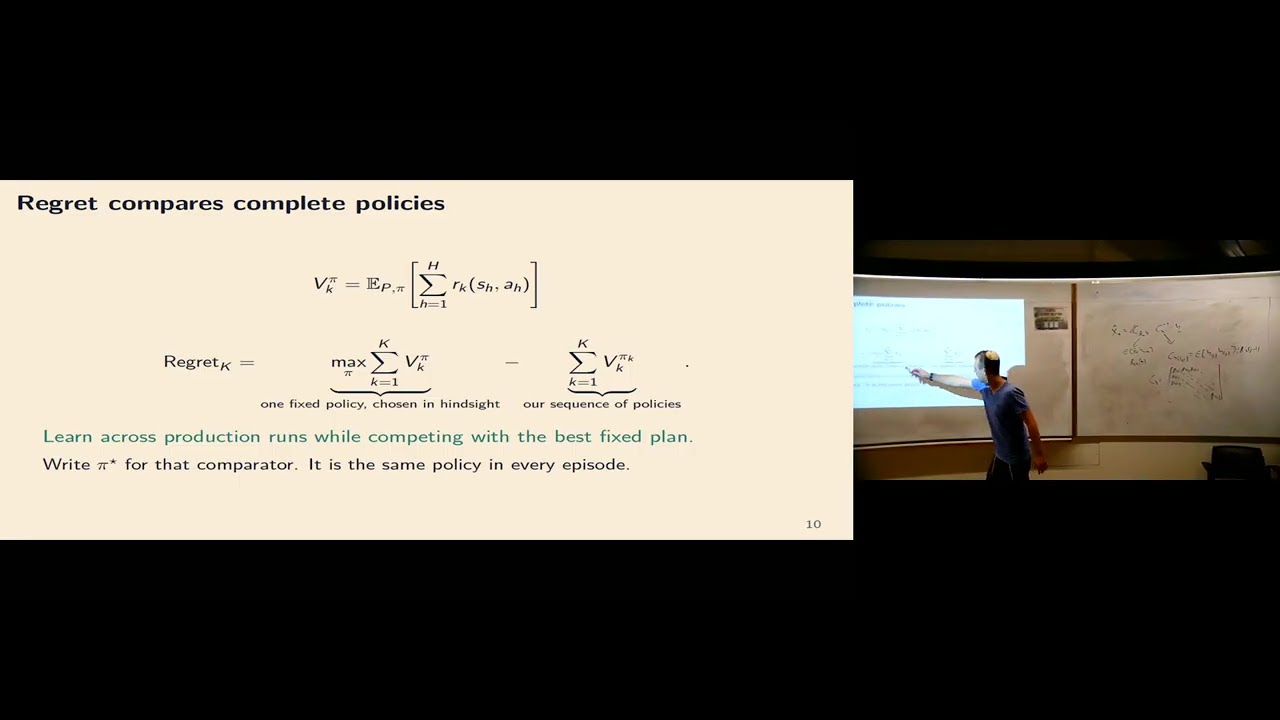
- Formal definition of regret, full-information setting, and the open problem of unknown dynamics.
- Presentation of the reduction: using epochs and a doubling trick to restart a known-dynamics algorithm.
- Introduction of the downstream-dependence property and its role in handling estimation bias.
- Description of the policy-optimization algorithm using local Hedge updates and the state-only bonus.
- Analysis of the variance term via the law of total variance and the resulting regret bound.
- Conclusion and open problem: closing the gap to the lower bound.
Contribution & Novelties
The talk contributes a novel reduction from unknown-dynamics MDPs to known-dynamics algorithms under the downstream-dependent property, which had not been systematically exploited before. It also introduces a new downstream-dependent policy-optimization algorithm with an improved regret bound of \widetilde O(\sqrt{H^3 K}), achieved through a cleverly designed state-only bonus that exactly matches the variance-stability term. This constitutes a meaningful step toward the optimal regret, though a \sqrt{H} gap remains.
Pour aller plus loin :
- Multiplicative weights update method — This is the foundation of the Hedge algorithm used in the talk; it provides the exponential-weight update framework.
- Markov decision process — The core model studied in the talk, essential for understanding the setting.
- Reinforcement learning — The broader context in which MDPs and regret minimization are studied.
125 words
Radar Profile
The profile shows a very high technical level (9) and strong information quality (8), with substantial quantity (8) and reliability (8). The talk is dense and mathematically rigorous, making it suitable for a specialized audience, while the balanced scores suggest a well-structured and credible presentation.