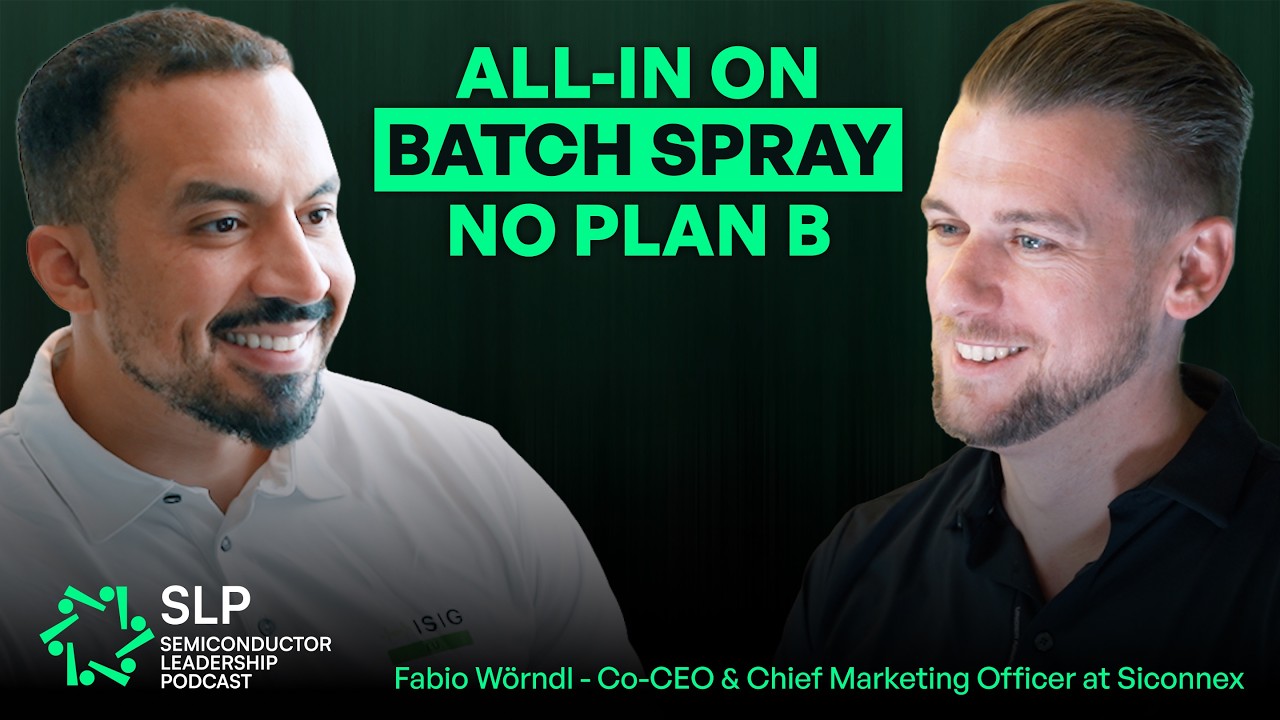
From the Cleanroom to the Boardroom: Why Focus Wins in Wet Processing
Title history
- From the Cleanroom to the Boardroom: Why Focus Wins in Wet Processing — observed on 20261120-1542 UTC (YouTube)
Keywords
Summary
209 words
Critical Evaluation
Value of the Information & Strength of the Argument
The information provided holds substantial value for listeners interested in career development within the semiconductor equipment industry and the operational dynamics of a niche equipment maker. Wörndl’s argumentation is grounded in concrete, experiential evidence, such as the detailed explanation of the co-CEO conflict resolution mechanism (’two argue, the third decides’) and the field service anecdotes that underpin his ‘people-first’ philosophy. The discussion of market entry, particularly the ‘chicken-and-egg’ problem of building service infrastructure versus securing early orders, offers pragmatic business insights. Arguments regarding the technological focus on batch spray are coherent but rely heavily on the assertion of superior expertise rather than quantitative performance data. The reasoning is logically structured and credible within the scope of executive personal experience, though it lacks empirical or comparative evidence against competing technologies.
Scientific Rigor, Source Quality, Title Accuracy
From a scientific rigor perspective, the podcast is not a technical or academic presentation, but rather a professional narrative. No external sources or peer-reviewed papers are cited. The only sources mentioned verbally are the historical company Semitool (acquired by Applied Materials) and the host’s own book, ‘The Game of Chips’, but no URLs or supporting documentation are provided in the episode description. The interview does not aim for generalizable scientific validity; it provides a subjective expert outlook. The title accurately reflects the content, directly correlating with the journey from cleanroom operations to boardroom strategy and the thesis that technological focus drives success. The discussion of semiconductor topics is accurate at a high level but remains non-technical, focusing on business and management angles.
266 words
Title / Content Match
The title accurately captures the core narrative: moving from field service engineering to executive leadership, and the competitive advantage gained through an undivided focus on batch spray wet processing technology.
Quality & Reliability
6/10
The interview offers authentic first-hand insights into corporate leadership and business strategy, but relies solely on the guest's subjective professional experience. No external data, scientific publications, or verifiable statistics are provided to support the claims, limiting its factual reliability.
Chapters
- The Game of Chips announcement
- Episode preview
- Welcome and introducing Fabio Wörndl
- Rapid fire round
- From the Fabio of 2011 to the Fabio of 2026
- The lunch that led to the co-CEO role
- Why loyalty gets rewarded
- What field service teaches you that nothing else can
- People first or customers first?
- Combining electronics and industrial engineering
- How your thinking changes as responsibility grows
- How the co-CEO structure works at Siconnex
- How Siconnex frames its value to customers
- The Semitool link behind Salzburg’s wet processing companies
- What Fabio looks for when hiring
- Lessons in building and developing a sales team
- Supply chain shifts, new fabs, and new substrates
- Batch spray focus as the key differentiator
- Photonics demand and indium phosphide
- The hardest decision as a new team leader
- Proudest moment: winning the first US order
- The chicken-and-egg problem of entering a new market
- Explaining batch spray to people outside the industry
- The biggest misconceptions about wet processing
- Sales objections and the value of a focused portfolio
- A day in the life and “still at the beginning”
- The next big shift in wet processing
- Where Fabio sees himself in ten years
- How he disconnects
- Closing message
Cited Sources
- The Game of Chips (by Salah Nasri) — Announced at the beginning of the episode as having reached 20,000 orders on Amazon, discussed as a general guide to the semiconductor ecosystem.
- Semitool — Mentioned as the former American manufacturer that had a subsidiary in Salzburg, which is credited with creating the cluster of wet processing companies in the region.
- Applied Materials — Mentioned as the company that acquired Semitool around 2012, leading to spin-offs and founding of local wet processing firms.
Contribution & Novelties
The primary contribution is the rare, first-hand presentation of a functional co-CEO model in the semiconductor capital equipment industry, offering a practical framework for how equal leadership can be managed. It also provides an inside look at the strategic advantages of a single-technology focus (batch spray) for a smaller equipment player, and clarifies the historical roots of the Salzburg wet processing cluster. The insights into the challenges of entering the US market and building a sales team from scratch provide actionable business knowledge.
Pour aller plus loin :
- Wet etching — Explains the fundamental chemical process central to wet processing, providing technical background to the discussed equipment.
- Indium phosphide — Relates directly to the guest’s mention of growing demand for this substrate, highlighting its role in photonics and high-speed communication.
- Semiconductor device fabrication — Offers a broad overview of the entire manufacturing process, useful for understanding where wet processing fits in the workflow.
153 words
Radar Profile
The radar profile shows a slightly higher score for the quantity of information (7) compared to technical depth (4), indicating a content-rich but non-technical, interview-style discussion. The reliability score (5) sits below the information quality (6), reflecting the expert-opinion nature of the content without external corroboration.