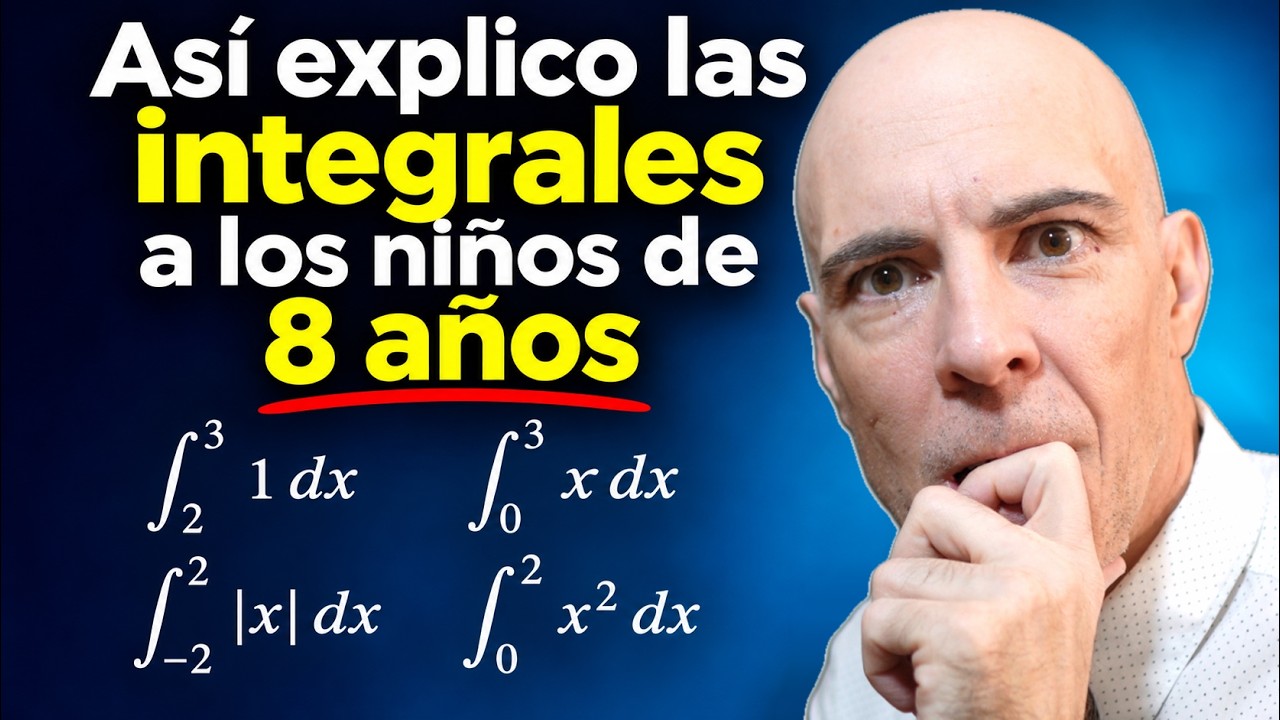
¿Qué son las integrales? Así se las explico a los niños de 8 años
What are integrals? How I explain them to 8-year-olds
Keywords
Summary
248 words
Critical Evaluation
Value of the Information & Strength of the Argument
The informational value lies less in breadth than in the quality of the conceptual bridge being built. The author’s guiding device is a systematic double reading of every example: each integral is first interpreted as the area of a figure whose area formula is available at primary-school level (square, right triangle, two symmetric triangles), and then recomputed with the antiderivative and the evaluation between bounds. This side-by-side treatment makes visible what the integral notation actually encodes, and it does so without ever invoking Riemann sums, limits or the fundamental theorem explicitly, which is a deliberate and defensible simplification for the stated audience. The progression of the four cases is well constructed: the constant function isolates the meaning of the differential and of the bounds; the identity function introduces a non-rectangular region; the absolute value forces a split of the interval and shows that the integral adds signed contributions; the quadratic finally breaks the elementary-geometry route and creates the need for algebraic integration. That last step is the argumentative pivot of the video and it works, because the viewer has been shown three cases where geometry alone sufficed before being shown one where it does not. The weak point is that the transition is asserted rather than demonstrated: the author states that the area under the parabola cannot be obtained with an 8-year-old’s knowledge, which is true for exact closed-form computation, but he never sketches the approximation-by-rectangles idea that would explain why integration nevertheless gives the answer, so the algebraic rule arrives as an authority rather than as a justified tool. A second, smaller gap concerns the absolute-value case, where the manipulation of limits and signs is performed quickly and the verbal explanation is less clear than in the other three, even though the numerical result (4) is correct and is corroborated by the geometric reading. The overall argumentation is honest, self-consistent and free of overreach: no claim is made about applications beyond a passing mention that integrals are used constantly in physics.
Scientific Rigor, Source Quality, Title Accuracy
On scientific rigour, the lesson is sound. Every numerical result is stated twice by two independent routes and the two agree, which is in itself a form of internal verification: 1 for the unit square, 9/2 for the triangle, 4 for the absolute value, 8/3 for the parabola. The antiderivatives used are the elementary ones and are correctly evaluated at the bounds. The treatment of the sign convention when reversing integration limits is correct in substance even though the delivery is hurried. The formal presentation is however loose in places: the antiderivative is occasionally written with an integral sign still attached, a notation that would confuse a student following a textbook, and the drawing of the absolute value and of the parabola is done freehand without stating the scale explicitly. Nothing is claimed beyond what is shown, and there is no extrapolation to applications, which limits the risk of error. On sources, the video cites none: no textbook, no reference work, no external document is invoked at any point. The description links exclusively to the author’s own course material (two video courses on integration and a collection of 100 integral problems, plus his website), so the video is self-referential and its authority rests entirely on the presenter’s own exposition rather than on any external corroboration. A promotional sequence of roughly forty seconds occurs around the middle of the video, and a second short promotional passage appears just before the conclusion; these do not affect the mathematical content. On title-content adequacy, the announced promise is met precisely: the geometric meaning of the definite integral is explained from zero, without prerequisites, and the four worked examples do exactly what the title and description say they will do.
632 words
Title / Content Match
The title is fully honoured: the whole video is built on the promise of explaining what a definite integral means using only primary-school geometry, and the announced geometric reading is actually carried out on four concrete cases.
Quality & Reliability
8/10
The mathematical content is exact: the four worked examples (constant, identity, absolute value and quadratic) give correct areas and correct antiderivative evaluations, and each result is cross-checked between a geometric reading and the algebraic rule. No external reference is invoked beyond the author's own course material, but nothing stated is mathematically false. Minor notational looseness (the antiderivative written as an integral, a rushed justification of the sign-permutation of limits in the absolute-value case) slightly reduces formal polish without affecting correctness.
Chapters
Cited Sources
- 100 integrales resueltas — full integration course (Matemáticas con Juan) — Announced at the start of the video as the academic, university-style treatment of integration for viewers who want the formal methods.
- 50 integrales desde cero (Matemáticas con Juan) — Recommended twice, in the introduction and again in the closing exercise, as the place where the fifth integral (square root between 0 and 2) is solved.
- 100 problemas de cálculo integral desde cero (Matemáticas con Juan) — Presented in the opening as the problem-solving companion to the two integration courses.
- Cálculo integral — course materials (matematicasconjuan.com) — Website page linked in the description for further exercises and material on integral calculus.
- Matemáticas con Juan — author's website — General site of the channel, listed in the description as the hub for his courses.
Concurring Sources
- Integral (Wikipedia) — Confirms the definition used throughout the video: the definite integral of a positive function corresponds to the area of the region under its curve between the bounds.
- Fundamental theorem of calculus (Wikipedia) — Provides the justification for the second, algebraic route used in each of the four examples, where an antiderivative is evaluated between the bounds.
- Riemann integral (Wikipedia) — Supplies the rigorous approximation-by-rectangles framework that the video only alludes to when it states that the area under the parabola requires integration.
Contribution & Novelties
The video makes no claim to new mathematical knowledge; its contribution is pedagogical. The device it uses is the systematic pairing of a geometric reading and an algebraic reading of the same definite integral, applied to four functions whose areas happen to be computable with primary-school formulas. That pairing is what allows the abstract notation to be attached to something concrete before any rule of integration is introduced, and the deliberate choice of the fourth example — the parabola, whose area has no elementary closed form — turns the demonstration into a motivation for learning the algebraic technique. The progression from an exactly computable figure to an inaccessible one is the genuinely instructive moment, because it shows why the calculus machinery is needed rather than merely presenting it.
Further reading:
- Integral — Overview of the concept, including the geometric definition as a signed area that the video illustrates concretely.
- Riemann integral — The formal construction by approximation with rectangles, which is exactly the step the video leaves implicit when it moves from the parabola’s area to the antiderivative rule.
- Fundamental theorem of calculus — Explains why evaluating an antiderivative between the bounds yields the area, the result the video uses repeatedly without naming it.
- Method of exhaustion — Archimedes’ precursor of integration, useful for situating the historical origin of the area-computation problem.
- 3Blue1Brown, “Essence of calculus” video series — A visual, animation-based treatment of the same area/accumulation intuition, complementary to the blackboard approach used here; cited by name only.
- Khan Academy, section on definite integrals — Practice-oriented companion for the kind of exercises left as homework at the end of the video; cited by name only.
276 words
Radar Profile
The profile is that of a deliberately introductory lesson: a low technical level paired with high informational quality and solid reliability, since every result is verified by two independent routes. The relatively modest information quantity reflects the narrow scope of four short examples rather than any superficiality. The shape of the radar is characteristic of good science communication aimed at building intuition before formalism.