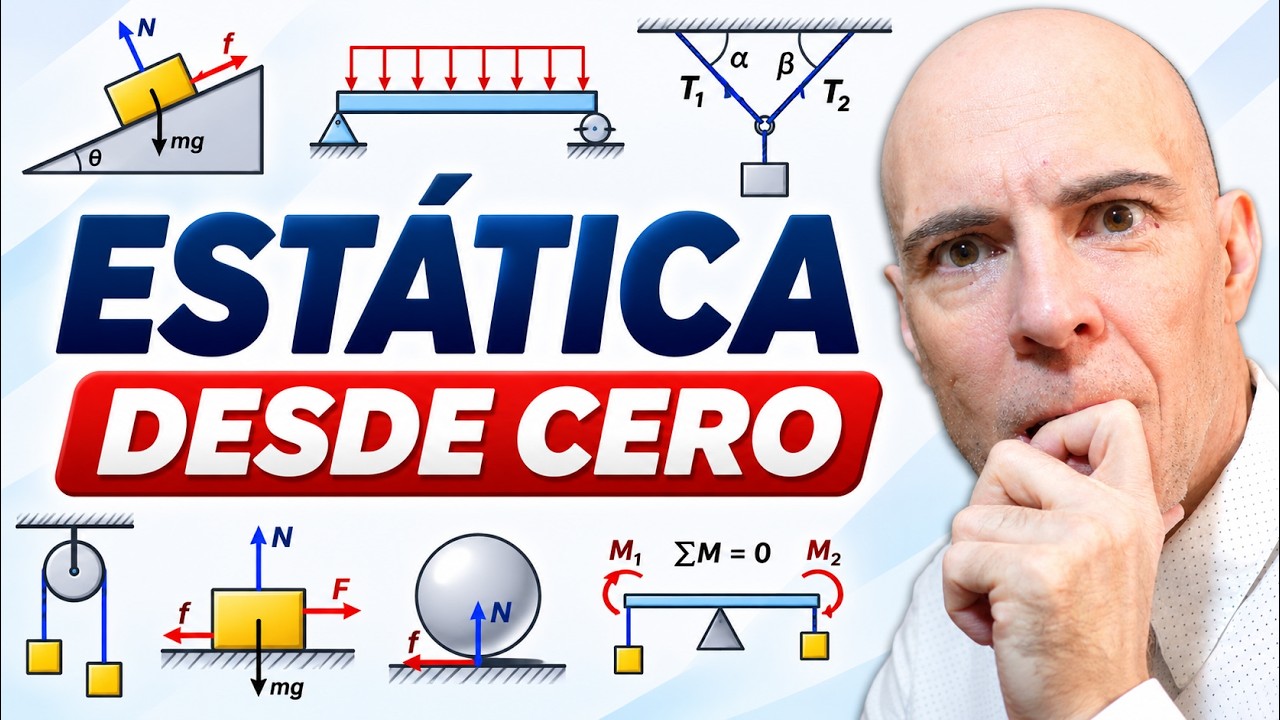
Aprende estática desde 0. 17 problemas resueltos paso a paso
Learn statics from 0. 17 problems solved step by step
Title history
- Aprende estática desde 0. 17 problemas resueltos paso a paso — observed on 20261119-2239 UTC (YouTube)
Keywords
Summary
127 words
Critical Evaluation
Value of the Information & Strength of the Argument
The video provides a pedagogical and thorough demonstration of problem-solving techniques in statics. Each problem is broken down into steps, emphasizing the method: drawing free-body diagrams, establishing sign conventions, applying equilibrium conditions (sum of forces = 0), and using trigonometry for vector decomposition. The argumentation is clear and repeatable, helping learners internalize the methodology. The instructor anticipates common mistakes and shows the logic behind each algebraic manipulation. While the content is not novel, the presentation is effective for building foundational skills.
Scientific Rigor, Source Quality, Title Accuracy
The title accurately reflects the content: a step-by-step solution of 17 statics problems from scratch. The video does not cite external references, but it is consistent with standard physics textbooks. The creator has included a playlist and related videos for further practice, which serve as additional resources. The scientific rigor is high for the level, as the physical laws applied are classical and well-established. No inconsistencies with established physics were found. The teaching approach is structured and pedagogically sound.
175 words
Title / Content Match
The title exactly matches the content: 17 statics problems solved in a progressive, step-by-step manner from basic concepts to more complex systems.
Quality & Reliability
8/10
Classical mechanics content is well-established and accurately presented, with clear step-by-step reasoning. No external references are cited, but the methods align with standard physics textbooks. The instructor demonstrates strong pedagogical rigor.
Chapters
- Presentación del curso de Estática desde cero
- 01. Bloque en equilibrio: fuerza normal y rozamiento
- 02. Equilibrio con tres fuerzas: calcular F₃ y N
- 03. Fuerza máxima sin que haya movimiento
- 04. Fuerza mínima para evitar el deslizamiento en un plano inclinado
- 05. Módulo y dirección de F₃ para el equilibrio estático
- 06. Tensión de las cuerdas de un cuadro colgado
- 07. Tensiones en dos cuerdas a 45° y 30°
- 08. Tensiones de las cuerdas A y B
- 09. Tensión de la cuerda que sostiene un semáforo
- 10. Calcular T y F en un sistema de cuerdas
- 11. Masa desconocida y coeficiente de rozamiento estático
- 12. Tensión y fuerza sobre una pared debida a una barra
- 13. Fuerzas sobre una esfera entre una pared y un plano inclinado
- 14. Distancia de dos niños al punto de equilibrio de un balancín
- 15. Equilibrio de dos poleas solidarias: hallar la masa desconocida
- 16. Coeficiente de rozamiento mínimo de una escalera
- 17. Equilibrio de una barra: tensión, normal y rozamiento
Cited Sources
- Playlist de statique (Static playlist) — Playlist of related statics problems on the same channel.
- 50 problemas de física moderna (50 modern physics problems) — Video suggested for further physics practice.
- 50 problemas de termodinámica (50 thermodynamics problems) — Video suggested for further physics practice.
- 50 problemas de física de fluidos (50 fluid physics problems) — Video suggested for further physics practice.
- 50 problemas de dinámica (50 dynamics problems) — Video suggested for further physics practice.
- 50 problemas de cinemática (50 kinematics problems) — Video suggested for further physics practice.
- 10 problemas de trabajo y energía desde cero (10 work and energy problems from scratch) — Live video on work and energy problems.
Contribution & Novelties
The video’s contribution lies in its pedagogical approach: a carefully curated sequence of problems that build upon each other, making the abstract concepts of statics accessible to beginners. It does not present new scientific findings but offers a comprehensive tutorial.
Pour aller plus loin :
- Newton’s laws of motion — Foundational principles underlying the equilibrium conditions used in the video.
- Friction — Explanation of static friction and the coefficient of friction, essential for many problems.
- Torque — Concepts of moment of force and rotational equilibrium applied in bar and ladder problems.
91 words
Radar Profile
The radar profile shows high scores in quantity and quality of information, reflecting the comprehensive coverage and clarity of the tutorials. The technical level is moderate, suitable for beginners, and reliability is excellent due to the classical nature of the physics content.