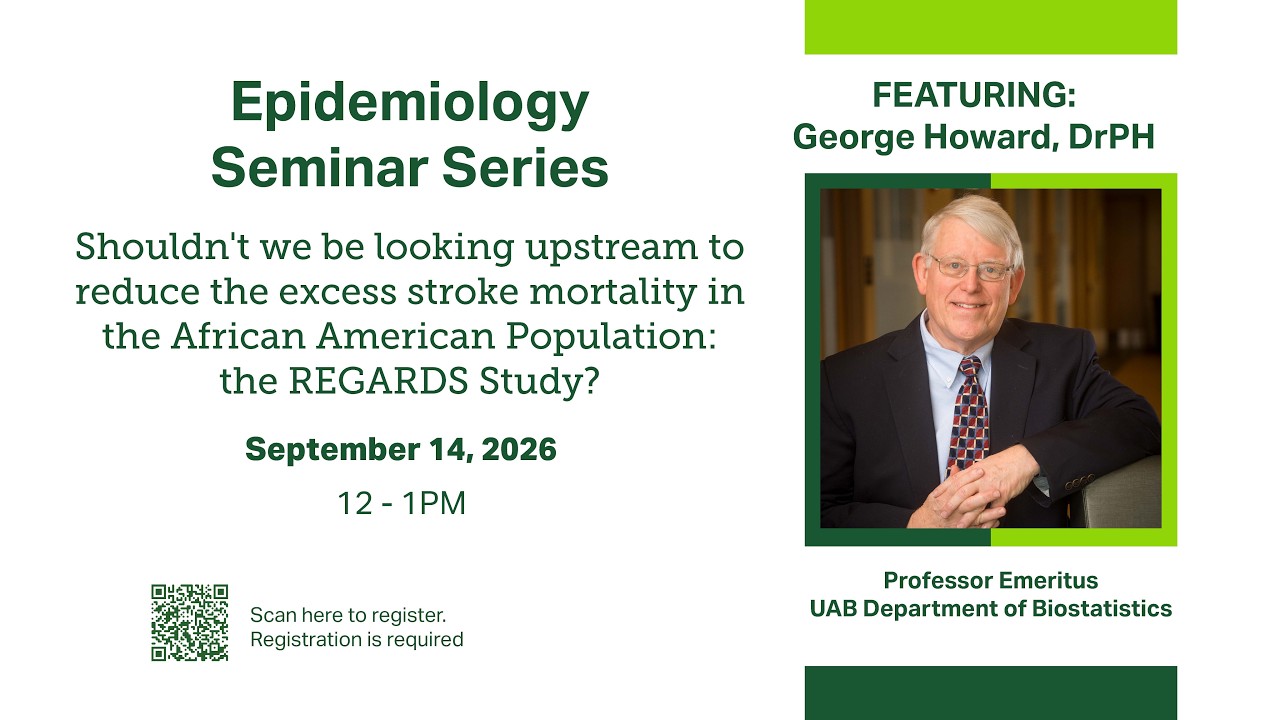
Stroke Mortality in the African American Population and the REGARDS study - George Howard, DrPH
Keywords
Summary
184 words
Critical Evaluation
Value of the Information & Strength of the Argument
The presentation offers high informational value by synthesizing decades of epidemiological data on stroke disparities. The argument is structured logically: first establishing the disparity, then decomposing it into incidence vs. case fatality, then quantifying the contribution of risk factors via mediation analysis, and finally deriving implications for intervention. The use of REGARDS data, a large, well-characterized cohort with physician-adjudicated stroke events, strengthens the evidence. The speaker is transparent about uncertainty, noting that case fatality differences were non-significant and that the mediation analysis explained only about half of the disparity. He also acknowledges that socioeconomic status attenuation is modest because much of its effect operates through risk factors already adjusted for. The argument for primordial prevention is compelling and well-supported by the data showing that treated hypertension still carries elevated risk. However, the talk relies heavily on observational data, and causal inferences are appropriately cautious. The career advice section, while engaging, is anecdotal and not central to the scientific argument.
Scientific Rigor, Source Quality, Title Accuracy
The scientific rigor is high, with data drawn from the REGARDS study, a landmark cohort with over 850 publications, and comparisons to the Greater Cincinnati/Northern Kentucky Stroke Study. The speaker, a leading biostatistician, presents results with appropriate caveats. However, the transcript does not include specific citations or URLs, and the description provides only the seminar series and date. The title accurately reflects the content, focusing on stroke mortality disparities and the REGARDS study. The talk is an expert opinion seminar rather than a systematic review, but the evidence base is robust. No comments were provided, so no audience analysis is included.
275 words
Title / Content Match
The title accurately reflects the content: the talk focuses on stroke mortality disparities in African Americans and extensively uses REGARDS study data. The subtitle about going upstream is also addressed.
Quality & Reliability
8/10
The presentation is delivered by a highly cited biostatistician and stroke epidemiologist, drawing on the REGARDS cohort (over 30,000 participants, 850+ peer-reviewed publications). The data are internally consistent and the speaker acknowledges limitations and uncertainty. However, the talk is a seminar-style expert opinion rather than a systematic review or meta-analysis, and some claims (e.g., mediation analysis results) are presented without full methodological detail or citation in the transcript.
Key Moments
Markers derived by PSI from the transcript: the creator did not define chapters.
- Introduction of Dr. George Howard and his career achievements.
- Dr. Howard begins with career advice and the importance of persistence.
- Presentation of stroke mortality trends showing persistent black-white disparity.
- Age-specific black-to-white stroke mortality ratios from 1949-1951 to 2023.
- Overview of the REGARDS study design and cohort characteristics.
- Analysis of stroke incidence disparities by age in REGARDS.
- Examination of case fatality differences and comparison with the Greater Cincinnati study.
- Mediation analysis showing risk factors explain ~40% of the disparity, socioeconomic status adds ~10%.
- Discussion of primordial prevention and the need to prevent hypertension and diabetes.
- Data showing residual stroke risk even with controlled hypertension.
Contribution & Novelties
The talk provides a comprehensive synthesis of stroke disparities research, emphasizing that the disparity is driven by incidence rather than case fatality, and that primordial prevention is key. It highlights the residual risk of stroke even with controlled hypertension, underscoring the need to prevent risk factor development. The mediation analysis quantifying the contribution of traditional risk factors and socioeconomic status is a valuable contribution.
Pour aller plus loin :
- REGARDS Study — Official website of the REGARDS study, providing cohort details and data access.
- Framingham Heart Study — Landmark study identifying major cardiovascular risk factors.
- Primordial Prevention — WHO page on cardiovascular disease prevention, including primordial prevention concepts.
108 words
Radar Profile
The radar profile shows high scores in information quantity, quality, and reliability, with a slightly lower technical level due to the seminar format. The overall profile indicates a strong, evidence-based presentation with substantial data and clear implications.