QISCA Joint Seminar 2024 Winter - Various Methods of Quantum Gate Decomposition
Keywords
Summary
161 words
Critical Evaluation
Value of the Information & Strength of the Argument
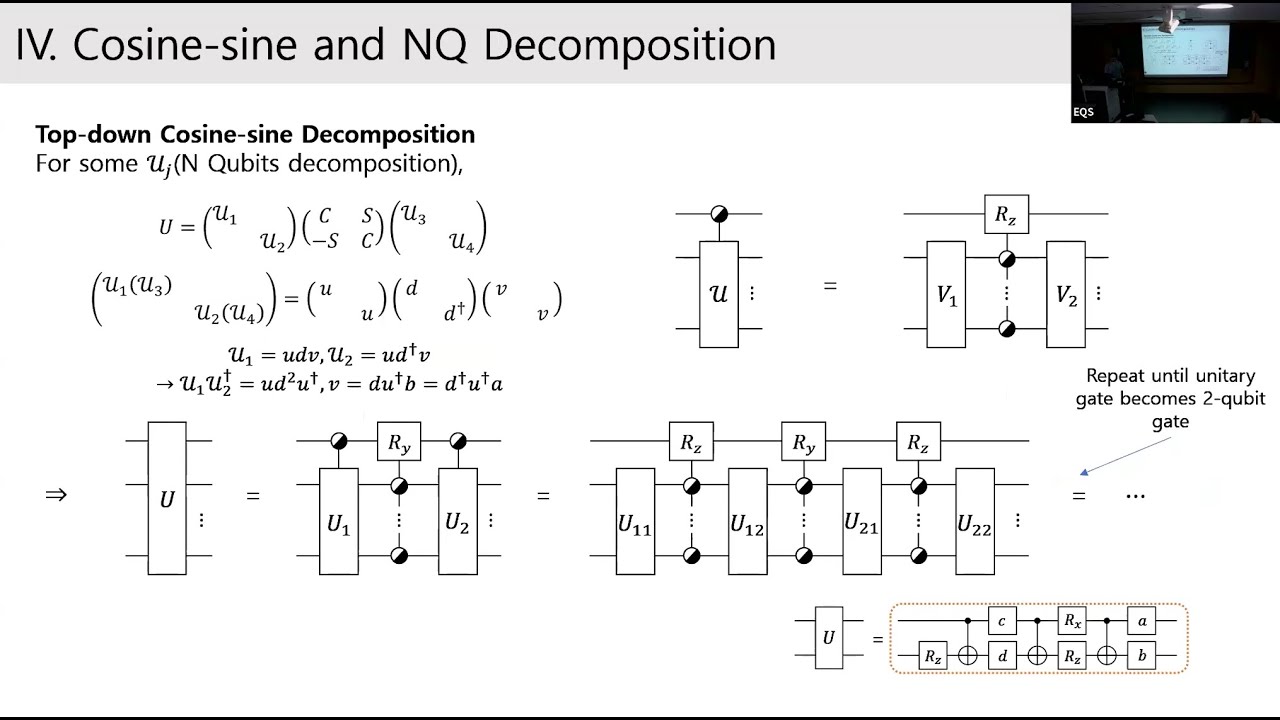
The presentation offers a clear and structured overview of quantum gate decomposition techniques, which are essential for compiling quantum algorithms onto hardware with limited connectivity. The value lies in the systematic comparison of methods: uniformly controlled gates, QR decomposition, cosine-sine decomposition, and NQ decomposition. The speaker explains the motivation for each method, such as the need for nearest-neighbor CNOTs in architectures like IBM’s, and provides formulas for gate counts. The argumentation is logical, building from basic definitions to more complex recursive decompositions. However, the talk is largely a review of existing literature, with limited critical analysis or comparison of trade-offs beyond gate counts. The speaker does not discuss practical implementation challenges, error rates, or experimental demonstrations. The Q&A is brief and somewhat unclear due to audio issues, but touches on relevant topics like tensor networks and ROM. Overall, the presentation is informative but lacks depth in evaluating the methods’ practical relevance.
Scientific Rigor, Source Quality, Title Accuracy
The talk is explicitly based on a single main reference: Möttönen and Vartiainen, ‘Decompositions of General Quantum Gates’ (2006), which is a well-cited paper in the field. The speaker also mentions a related video on the Korea Quantum Clubs channel. The mathematical content is rigorous and follows established results. However, the presentation does not cite additional sources for the specific decompositions (e.g., QR, cosine-sine, NQ) beyond the main paper, and some attributions are vague. The title accurately reflects the content, as the talk covers multiple decomposition methods. The Q&A session is not fully transcribed, but no major contradictions or unsupported claims are evident. The overall scientific rigor is good for a seminar talk, but the lack of broader references and the informal delivery slightly reduce the score.
293 words
Title / Content Match
The title accurately reflects the content: the talk covers various methods of quantum gate decomposition, including uniformly controlled gates, QR decomposition, cosine-sine decomposition, and NQ decomposition. The title is fully consistent with the presentation.
Quality & Reliability
7/10
The presentation is based on a peer-reviewed paper (Möttönen & Vartiainen, 2006) and presents established mathematical results in quantum circuit decomposition. The speaker is a master's student, and the talk is a literature review rather than original research. The mathematical content is correct and well-structured, but the delivery is somewhat disorganized and the transcript is noisy. No major factual errors are apparent, but the lack of detailed citations during the talk and the reliance on a single main reference limit the score.
Chapters
Cited Sources
- Decompositions of General Quantum Gates — Main reference cited in the description: Möttönen, Mikko, and Juha J. Vartiainen. 'Decompositions of general quantum gates.' Trends in quantum computing research (2006): 149.
- Korea Quantum Clubs video — Alternative presentation of the same topic on the Korea Quantum Clubs channel, mentioned in the description.
Concurring Sources
- Decompositions of General Quantum Gates — The primary reference for the talk, which provides the theoretical foundation for the decomposition methods presented.
Contribution & Novelties
The presentation does not introduce new original research; it is a review of existing decomposition methods. Its main contribution is to synthesize and compare several techniques in a single talk, providing a pedagogical overview for students and researchers. The speaker highlights the progression from uniformly controlled gates to more efficient methods like NQ decomposition, emphasizing the reduction in CNOT counts. The talk also touches on practical constraints such as nearest-neighbor architectures. However, no new algorithms or experimental results are presented.
Pour aller plus loin :
- Quantum logic gate — General background on quantum gates and their decomposition.
- Givens rotation — Mathematical basis for QR decomposition used in the talk.
- Cosine-sine decomposition — Detailed explanation of the CSD method discussed.
- Quantum circuit — Overview of quantum circuits and compilation challenges.
129 words
Radar Profile
The radar profile shows high technical level and good information quantity, but moderate reliability due to the review nature and limited sourcing. The presentation is mathematically sound but lacks critical evaluation and practical context.