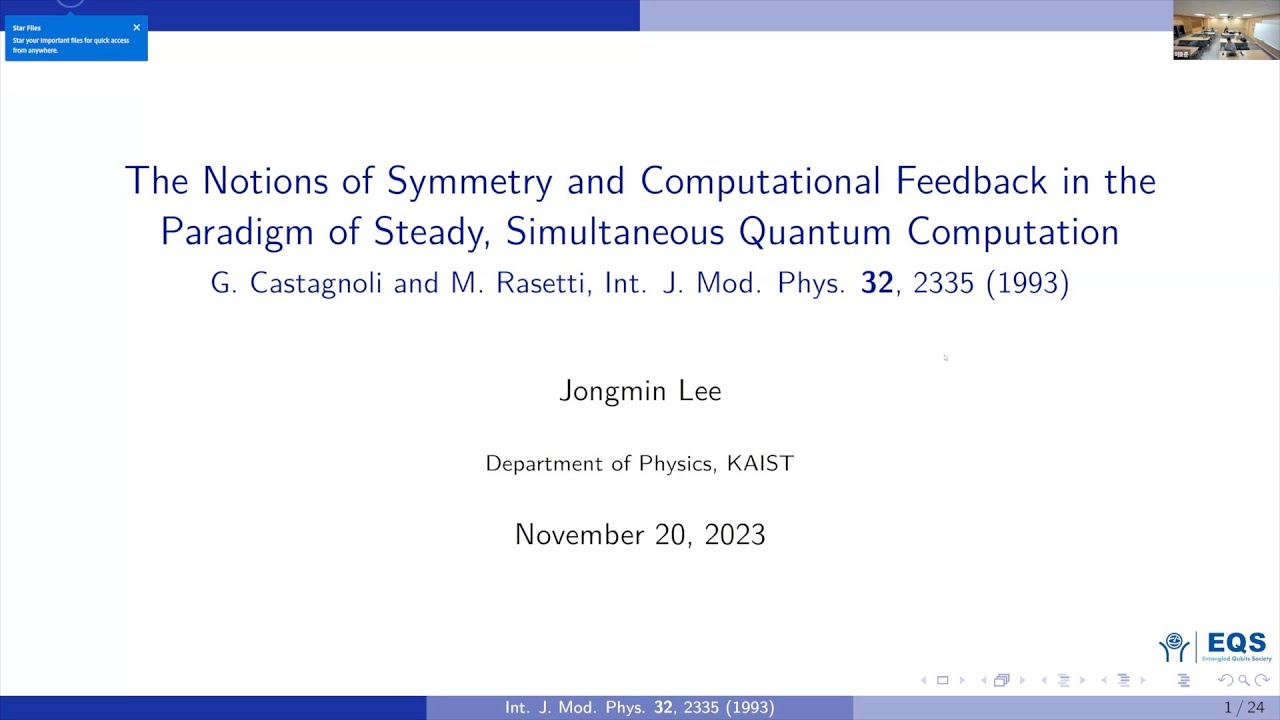
The Notions of Symmetry and Computational Feedback in the Paradigm of Steady, Simultaneous QC
Keywords
Summary
179 words
Critical Evaluation
Value of the Information & Strength of the Argument
The video offers genuine value by providing an in-depth, critical reading of a seminal but difficult-to-access paper. The presenter reconstructs the paper’s arguments, fills gaps with his own derivations, and highlights issues such as unclear statements and unproven components. His argumentation is coherent and demonstrates deep engagement, even when he admits uncertainty, which strengthens the credibility of the analysis. However, since the content is a personal interpretation rather than a peer-reviewed synthesis, its value is limited by the presenter’s own understanding and the lack of broader context.
Scientific Rigor, Source Quality, Title Accuracy
The presenter explicitly refers to the original 1993 paper and to Kitaev’s later work, but no direct links or external sources are given in the description or video. The title aligns well with the content, which is precisely about symmetry, steady-state computation, and feedback. The technical accuracy appears solid, though some derivations are merely stated without full proof, and the presenter criticizes the paper’s flaws. Overall, the rigour is acceptable for a literature review, but the absence of verifiable citations weakens its scholarly value.
186 words
Title / Content Match
The title accurately reflects the content, which focuses on symmetry, steady-state quantum computation, and feedback in a topological quantum computing framework.
Quality & Reliability
7/10
The video provides a detailed technical analysis of a foundational quantum computing paper, with explicit commentary on the paper's strengths and weaknesses. The presenter is transparent about parts he does not fully understand, and adds critical remarks on the original article's proofs and notation. However, the analysis is essentially subjective and not verified externally, limiting the overall reliability.
Key Moments
Markers derived by PSI from the transcript: the creator did not define chapters.
- Introduction: motivation for quantum computer, critique of time-sequential computation, and Feynman's quote.
- Formalization of computation as physical state mapping, introduction of steady states and projection operators.
- Implementation using a two-site Hubbard model to construct NOT and AND gates.
- Discussion on anyons, quantum group SU(1,1), and the paper's non-abelian anyon claims.
- Comparison with Kitaev's later topological quantum computation and concluding remarks.
Cited Sources
- 1993 paper on anyons and quantum computation (presented) — The main paper analyzed in the video.
Contribution & Novelties
The video contributes a detailed critical review of a foundational but obscure paper, making its content more accessible while highlighting its limitations. It provides original commentary on the derivation of gates from a Hubbard model and the role of symmetry protection, which is useful for students and researchers. The presenter also connects the work to later topological quantum computing paradigms.
Pour aller plus loin :
- Anyon — Quasiparticles with fractional statistics, central to topological quantum computation.
- Topological quantum computer — Exploits braiding of anyons for fault-tolerant computation.
- Hubbard model — The starting model for constructing gates in the paper.
99 words
Radar Profile
The radar profile shows very high technical level (9) and good information quality (8), but moderate quantity (7) and overall reliability (7). This indicates a focused, detailed technical analysis with occasional gaps in broader context.