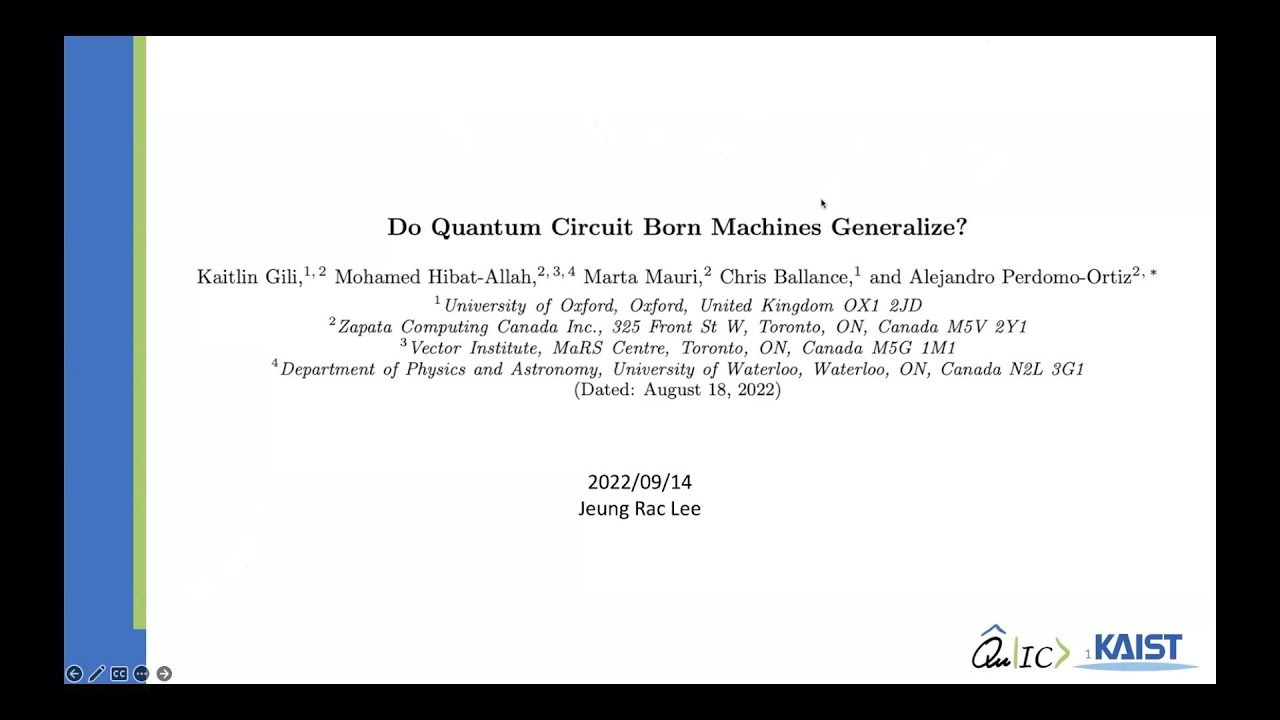
Do Quantum Circuits Born Machines Generalize?
Keywords
Summary
214 words
Critical Evaluation
Value of the Information & Strength of the Argument
The presentation provides a clear and technical overview of the paper’s contributions. The main value lies in the introduction of novel evaluation metrics for quantum generative models, addressing a gap in the literature. The argumentation is supported by numerical simulations and systematic comparisons. The presenter explains the concepts well and illustrates results with graphs. However, the discussion is largely descriptive, with limited critical analysis. The only critical remark is the practical limitation of knowing the target distribution. The argumentation is solid, though a deeper exploration of the limitations of the proposed metrics would have been beneficial.
Scientific Rigor, Source Quality, Title Accuracy
The primary source is the paper itself, presented in a seminar at KAIST. The presentation faithfully follows the paper’s content, without adding external information. The scientific rigor is high: methods (CMA-ES, KL divergence) are correctly employed, and the numerical experiments appear credible. The title perfectly matches the content, as the entire talk centers on the question of generalization in QCBMs. No explicit references beyond the paper are cited, and no external commentary is available to assess reception.
188 words
Title / Content Match
The title perfectly matches the content: the presentation evaluates the generalization of quantum circuit born machines and proposes evaluation metrics, directly addressing the question posed in the title.
Quality & Reliability
7/10
The presentation is a technical review of a research paper. The content is accurate and well-structured, but the presenter's delivery is somewhat hesitant and the analysis is largely descriptive. The source is the paper itself, with no external references. Overall reliable for a seminar talk.
Key Moments
Markers derived by PSI from the transcript: the creator did not define chapters.
- Introduction of the motivation: the lack of generalization criteria for unsupervised generative models.
- Definition of Quantum Circuit Born Machines and the training process using negative log-likelihood and CMA-ES.
- Presentation of the newly proposed generalization metrics: validity-based and quality-based measures.
- First simulation results: effect of circuit depth on generalization (deeper circuits perform better).
- Second set of experiments: learning an induced bias and influence of training set size.
- Conclusion and limitation: the target distribution must be known a priori.
Cited Sources
- Do Quantum Circuit Born Machines Generalize? — Paper reviewed in the presentation; no explicit URL provided in the video or description.
Contribution & Novelties
The paper’s main contribution is the proposal of new generalization metrics for Quantum Circuit Born Machines, moving beyond mere memorization capability. It provides numerical evidence that deeper, more expressive circuits achieve better generalization in both validity and quality terms. The presentation effectively summarizes these findings.
Pour aller plus loin :
- Kullback-Leibler divergence — A fundamental measure of distribution difference, used in the paper’s evaluations.
- CMA-ES — The evolutionary optimization algorithm employed to train the quantum circuit.
- Quantum machine learning — The broader field encompassing QCBMs and other quantum generative models.
- Matrix product states — Another family of tensor network generative models often compared with QCBMs.
105 words
Radar Profile
The radar profile shows an outstanding technical level (9), moderate quantity and quality of information (7 each), and high global reliability (8). This indicates a dense, expert-level literature review suited for an audience already familiar with quantum computing and machine learning.