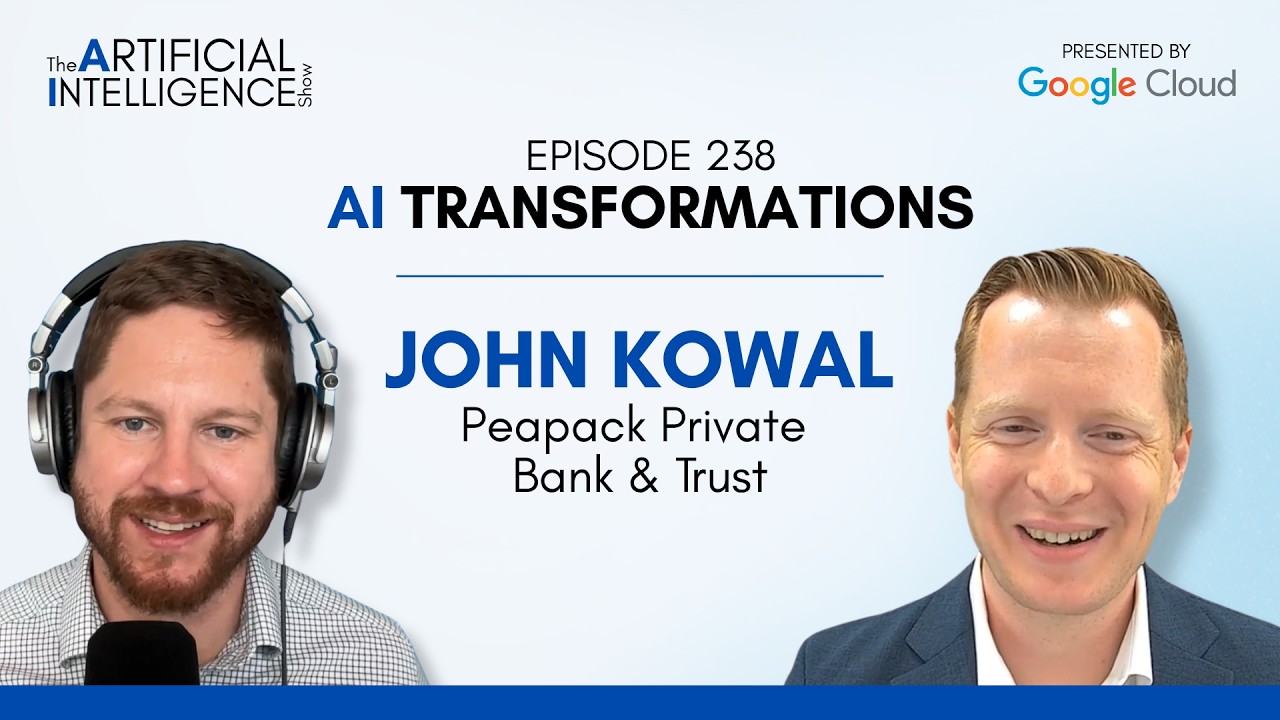
Ep. 238: How a 700-Person Bank Is Using AI to Build Apps, Agents, and Digital Employees
Keywords
Summary
181 words
Critical Evaluation
Value of the Information & Strength of the Argument
The value lies in concrete examples and real-world results. The argument is based on experience, with specific metrics like 50% reduction in review time and Alex closing half the tickets of a full-time employee. The narrative is coherent and shows a progression from individual productivity to organizational transformation. The argument for digital employees is compelling, with a focus on proactive communication and integration with existing tools. However, the discussion is qualitative and relies on anecdotal evidence from a single organization, so it is not a rigorous scientific study but rather an expert opinion. The reasoning is sound, highlighting the importance of leadership, cultural change, and technical prerequisites.
Scientific Rigor, Source Quality, Title Accuracy
The source is a podcast episode with a CTO, which adds credibility. The title accurately reflects the content. The video is sponsored by Google Cloud, which could introduce bias, but the content focuses on OpenAI and Microsoft, not Google, so it appears objective. The description provides a link to show notes for further information. No specific external sources are cited beyond general references to technologies. The overall rigor is moderate, with practical insights but limited verifiable data.
199 words
Title / Content Match
The title accurately reflects the content: a 700-person bank's AI transformation including app building, agents, and digital employees.
Quality & Reliability
7/10
The episode presents a detailed case study from a real CTO, with concrete examples and metrics. However, it is a sponsored podcast, which may introduce bias, and claims are largely anecdotal without independent verification.
Chapters
- Intro
- What PPAC Private Bank and Trust does
- How the AI transformation started
- What's driving PPAC from chat to agents
- Concrete examples of AI changing daily work
- Re-engineering workflows, not just layering on tech
- The technology stack powering the work
- The data warehouse foundation and OpenAI + Microsoft ecosystem
- How AI champions surface use cases
- Measuring impact and ROI
- Lessons learned and what comes next
- Why PPAC gives its digital employees names
- How the CTO role and tech team are changing
- Competing with larger banks
Cited Sources
- Show Notes for Episode 238 — The episode's dedicated show notes page with links and resources mentioned in the episode.
External References
Contribution & Novelties
The original contribution is the detailed case study of a mid-sized bank successfully implementing a digital employee strategy. It provides a playbook for others, including the use of AI champions, the decision to build vs. buy, and the importance of a data warehouse foundation.
Pour aller plus loin :
- AI agent — Overview of AI agents.
- Data warehouse — Foundation for AI applications.
- OpenAI Codex — Tool used for development.
70 words
Radar Profile
The radar profile shows high scores in information quantity and quality, moderate technical depth, and good reliability, indicating a well-rounded informative episode.