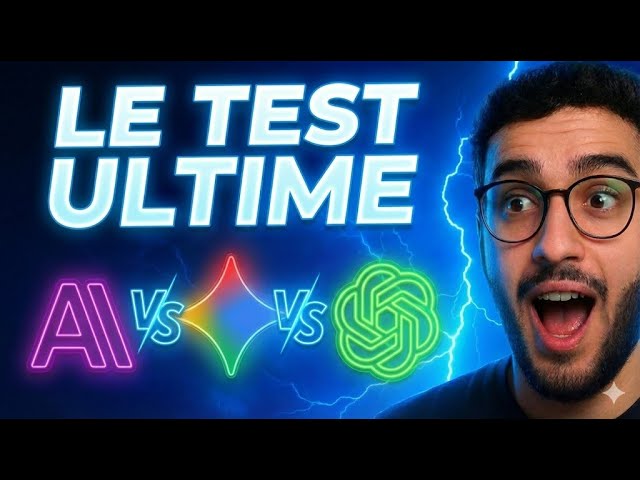
GEMINI vs GPT vs CLAUDE : Le TEST ULTIME en 2025 ! 🔥
GEMINI vs GPT vs CLAUDE: The ULTIMATE TEST in 2025! 🔥
Keywords
Summary
181 words
Critical Evaluation
Value of the Information & Strength of the Argument
The video provides valuable hands-on evidence of AI coding assistant performance in real-world tasks, using identical prompts to compare three leading models. This approach goes beyond benchmark metrics and gives viewers a tangible sense of each model’s capabilities and limitations. The argumentation is based on direct observation, but it lacks controlled conditions: the creator occasionally simplifies prompts between tests for Claude, and failures are not systematically diagnosed. The reasoning is transparent, acknowledging when a model underperforms, but the sample size (four tasks) is small and non-representative. Overall, the value lies in its practical demonstrations, while the argumentation is anecdotal and not scientifically robust.
Scientific Rigor, Source Quality, Title Accuracy
The video’s rigor is limited: it mentions benchmarks (SWE-bench, LiveCodeBench) and shows screenshots of leaderboard positions, but does not cite original sources or explain methodologies. The only provided link is to the GitHub Student Developer Pack, which is accurate and useful but unrelated to the AI comparison. The title accurately matches the content—a head-to-head coding test—and the conclusion aligns with the demonstrations. However, the lack of citations and the subjective evaluation of ‘quality’ (e.g., ‘police’ and aesthetics) reduce scientific credibility. No technical verification of the models’ outputs is performed beyond visual inspection. The title is consistent with the video, and the content delivers what is promised.
224 words
Title / Content Match
The title accurately reflects the content: a head-to-head comparison of Gemini, GPT, and Claude in coding tasks. The emphasis on 'ultimate test' matches the practical evaluation, though the title is somewhat sensationalist.
Quality & Reliability
4/10
The video offers a hands-on, subjective comparison of AI coding assistants. No rigorous methodology, no citations to scientific sources, and results are anecdotal. However, it provides practical demonstrations and honest reporting of failures, giving a moderate level of insight. Overall reliability is low-medium.
Chapters
- Introduction
- Tuto : Avoir VS Code Premium & GitHub Copilot Gratuit (Étudiants)
- Analyse des Benchmarks : Claude 4.5 vs Gemini 3 Pro vs GPT 5.1
- Test 1 : Création d'un Auto Clicker (Python vs Web)
- Test 2 : Site Web Escape Game Horreur (GPT & Gemini)
- Test 2 : La version de Claude (Le résultat est bluffant)
- Test 3 : Site Vitrine Salle de Sport "FitZone" (Claude)
- Test 3 : Comparaison avec Gemini et GPT
- Test 4 : Création d'une App YouTube Downloader
- Conclusion : Quel modèle a gagné
Cited Sources
- GitHub Student Developer Pack — The creator instructs viewers to use this link to obtain VS Code Premium and GitHub Copilot for free as students.
Contribution & Novelties
This video contributes a practical, side-by-side comparison of three major AI coding models using identical prompts, offering concrete examples of their output quality and reliability. It also demonstrates a method for viewers to access premium coding tools via the GitHub Student Pack. The originality lies in the hands-on, unscripted testing that highlights real-world strengths and weaknesses beyond benchmark scores.
Pour aller plus loin :
- SWE-bench: Can Language Models Resolve Real-World GitHub Issues? — This paper introduces SWE-bench, a benchmark referenced in the video for evaluating AI coding performance.
- LiveCodeBench: Holistic and Contamination Free Evaluation of Large Language Models for Code — Another benchmark cited in the video, focusing on contamination-free code evaluation.
- GitHub Student Developer Pack — The resource shown in the tutorial portion, providing free access to development tools for students.
- Claude 4.5 Opus — Anthropic’s model discussed in the comparison; the page offers technical details and capabilities.
149 words
Radar Profile
The scores form a profile with moderate information quantity and quality, low technical depth, and very low reliability. This indicates a vide that is accessible but superficial, aiming for entertainment and practical demonstration rather than rigorous analysis. The low fiabilite reflects the absence of scientific methodology and reliance on anecdotal evidence.