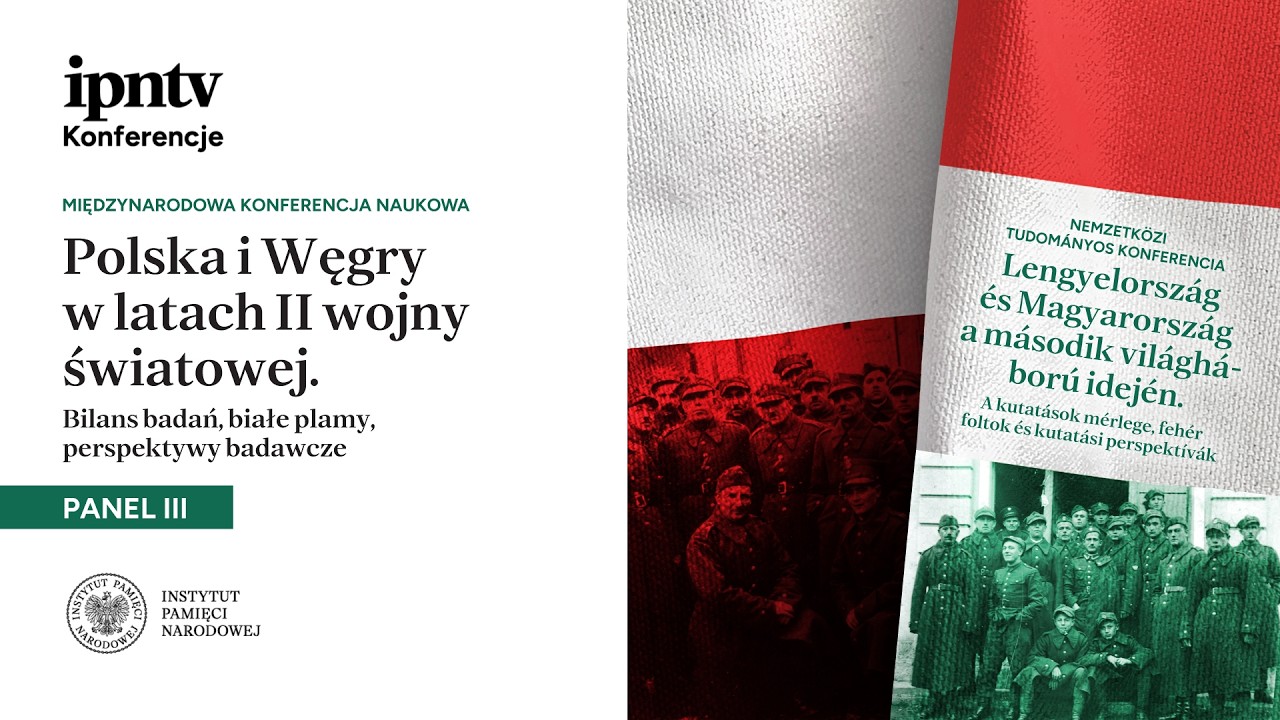
PANEL III
Keywords
Summary
151 words
Critical Evaluation
Value of the Information & Strength of the Argument
The panel offers substantial informational value by combining micro-historical case studies with broader reflections on Polish-Hungarian relations. Balázs provides a nuanced argument about the dual function of cultural life in refugee camps: as a tool of military discipline and as a channel for cultural transfer with the local Hungarian population. He supports this with concrete examples, such as the 1943 report by Tibor Chorba and the Christmas play script from the Eger officers’ camp. Urbańska’s contribution is particularly valuable for its genealogical and biographical detail on Korompay, drawing on parish registers, officer yearbooks, and family memoirs to correct inaccuracies in existing accounts. She acknowledges the fragmentary nature of her sources and the need for further verification, which strengthens the credibility of her presentation. Lagzi’s segment, though less detailed in the transcript, situates his father’s work within the broader historiography of Polish refugees in Hungary. Turi-Móricz addresses the gap between stereotypes and direct experience, a classic theme in social history. The arguments are generally well-structured and evidence-based, though some claims rely on a limited number of personal testimonies, particularly Ilona Korompay’s memoirs, which the speaker herself notes require critical analysis.
Scientific Rigor, Source Quality, Title Accuracy
The scientific rigour is high for a conference panel. The speakers are affiliated with recognised institutions: the Polish Research Institute and Museum in Budapest, Eötvös Loránd University, and the Hungarian Committee of National Remembrance. They cite specific archival sources, including officer yearbooks from 1923, 1924, and 1928, parish registers from Szinn, the memoirs of Ilona Korompay published as ‘Tyś opiekunem sieroty’ (2017), and a 2009 oral history interview conducted by Monika Kryłowska for the History Meeting House and KARTA Centre. Balázs references a report by Tibor Chorba dated 25 November 1943 and camp publications such as the 1942 one-day newspaper from Vámosmikola. However, the description provides only a conference playlist link, with no direct URLs to these sources, which limits external verification. The title ‘PANEL III’ is purely organisational and does not reflect the rich content, making it inadequate as a descriptor. The panel is part of a scientific conference on Polish-Hungarian relations during World War II, which lends it institutional credibility.
366 words
Title / Content Match
The title 'PANEL III' is purely structural and gives no indication of the content, which covers the cultural life of Polish refugees in Hungary, the legacy of Emánuel Aladár Korompay, István Lagzi's research, and stereotypes among Polish soldiers in 1939.
Quality & Reliability
8/10
The panel features established historians from the Polish Research Institute and Museum in Budapest and Eötvös Loránd University, presenting original archival research. Claims are grounded in specific sources such as officer yearbooks, parish registers, wartime reports, and memoirs. The main limitation is the absence of a formal bibliography or direct links to cited documents in the description.
Key Moments
Markers derived by PSI from the transcript: the creator did not define chapters.
- István Miklós Balázs begins his lecture on cultural life in Polish refugee camps in Hungary.
- Joanna Urbańska presents the life and legacy of Emánuel Aladár Korompay.
- Gábor Lagzi discusses István Lagzi, researcher of Polish refugees in Hungary during World War II.
- Zsolt Turi-Móricz examines stereotypes and direct experiences of Polish soldiers regarding Hungarians in 1939.
- Panel discussion with all participants.
Cited Sources
- Conference playlist — Playlist of the scientific conference on Polish-Hungarian relations during World War II.
Contribution & Novelties
The panel contributes original insights by focusing on under-researched aspects of Polish refugee life in Hungary. Balázs highlights the dual role of cultural activities as both a disciplinary tool and a bridge to Hungarian society, a perspective often overlooked in favour of political and military history. Urbańska’s genealogical research on the Korompay family fills gaps in the biographical record, correcting dates and social status based on parish registers. Lagzi’s presentation honours his father’s pioneering work, while Turi-Móricz offers a fresh look at the gap between stereotypes and lived experience. Together, these contributions enrich the historiography of Polish-Hungarian relations during World War II.
Pour aller plus loin :
- Polish refugees in Hungary during World War II — Wikipedia overview of the topic.
- Katyn massacre — Context for the fate of Emánuel Aladár Korompay.
- Hungarian studies — Background on the academic field Korompay helped develop in Warsaw.
145 words
Radar Profile
The radar profile shows a strong emphasis on information quantity and quality, with solid reliability and a moderate technical level. The panel is rich in historical detail and well-sourced, though it remains accessible to a general audience rather than specialists.