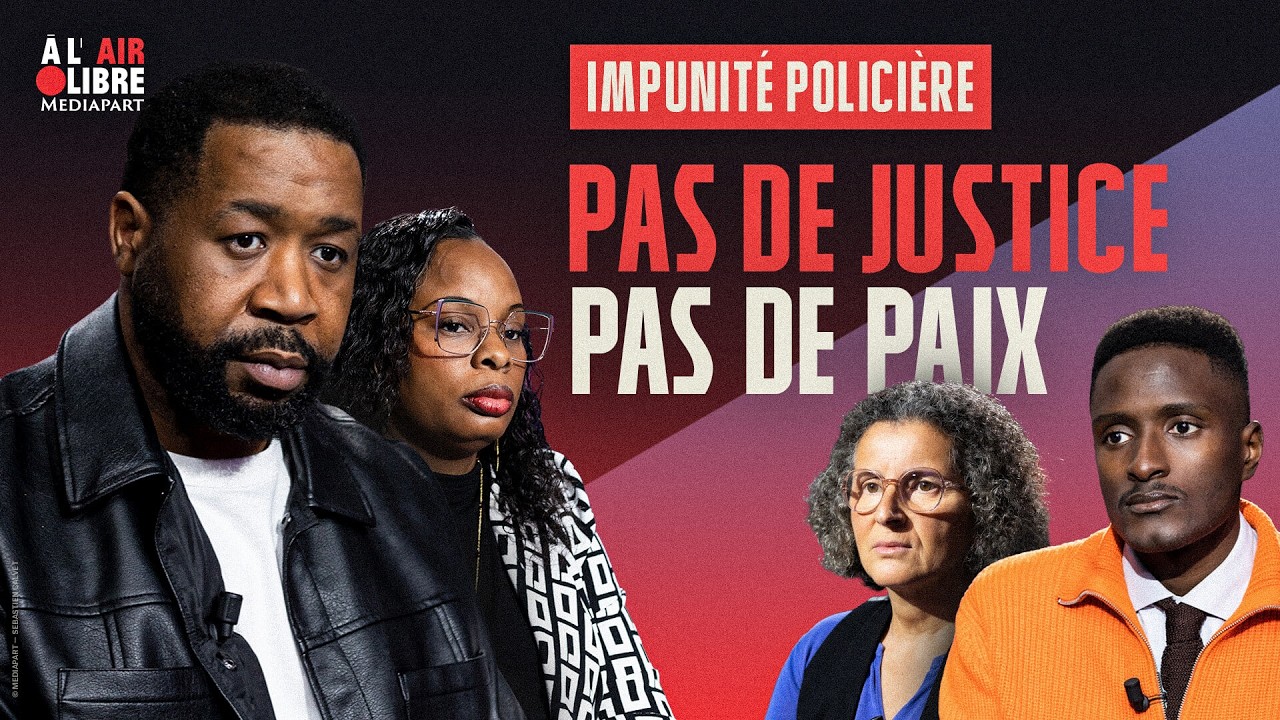
Violences policières : « Quand la justice est rendue, c’est presque un miracle »
Police violence: "When justice is done, it's almost a miracle"
Keywords
Summary
356 words
Critical Evaluation
Value of the Information & Strength of the Argument
The informational value is high and largely first-hand. Viewers obtain the concrete sentencing arithmetic of three separate cases — the Zecler verdict, the five-year term with no committal warrant in the Benjamin case, the eight years with committal on appeal in the Gomez case — plus a procedural reconstruction of how the racist aggravating circumstance was reintroduced over the objections of the indictment order and of defence counsel, and a clear explanation of the difference between the criminal court and the assize court in the Nahel Merzouk referral, including the effect of the Cassation ruling that sent the case back for better reasoning. The lawyers supply the kind of detail rarely available outside a courtroom: the missing audio track that let the accused deny everything, the exploitation of telephone records, the civil parties’ request that the special question be put to the court. The argumentation, however, is cumulative rather than demonstrative. The central claim — that acquittal is the rule and conviction the exception for police officers — is supported by an enumeration of cases and by the practitioners’ professional experience, not by any systematic statistical series, and the selection of examples is made by participants who are committed parties. The formula that a prison sentence for a police officer should be multiplied like a cat’s age is vivid but rhetorical. The new law is characterised as a ’licence to kill’ without any textual or jurisprudential exegesis of what it actually changes, which weakens an otherwise well-documented argument. The reasoning is coherent and internally consistent, built on a clear causal chain (evidentiary asymmetry, institutional solidarity within the police hierarchy, deferred proceedings), but it is conducted entirely within a single interpretive framework, and the conclusion that the verdict is a turning point is deliberately left open by the presenters themselves.
Scientific Rigor, Source Quality, Title Accuracy
The sourcing rests almost entirely on primary oral testimony: the plaintiff, a civil-party lawyer, a victim’s widow, a sociologist and two journalists of the outlet that has covered the case since 2020, one of whom personally obtained the original video. That proximity gives the account density and credibility on factual specifics — dates, charges, sentence structure, referral decisions — and the programme is careful to distinguish what has been definitively decided (the Versailles ruling is immediately qualified as still subject to appeal to the Court of Cassation). It is weaker on verifiable external documentation: no court ruling, official report, inspection finding or statistical study is cited or displayed, and the video description contains only subscription, donation and newsletter links, with no reference apparatus whatsoever. The viewer therefore has no route to check the figures quoted. No opposing expert or institutional representative is present, so the contested legal question of the presumption of self-defence is examined from one side only. The title is faithful to the content: it borrows a phrase actually spoken during the discussion and correctly signals a programme about the exceptional character of judicial condemnation. No advertising sequence was identified in the material supplied.
510 words
Title / Content Match
The headline quotes a phrase from sociologist Nassira Guénif about justice being experienced as 'almost miraculous', which faithfully captures the programme's central argument; the content matches the title well.
Quality & Reliability
7/10
The programme assembles first-hand, high-proximity actors: the plaintiff in the Zecler case, a lawyer for civil parties and for SOS Racisme, a widow whose husband was killed by an officer, a university sociologist and two Mediapart investigative journalists who covered the trial daily. Procedural detail is abundant and precise (charges retained, sentencing structure, committal warrants, referral to the departmental criminal court, the Cassation ruling on the Nahel case). The limits are those of the format: a live panel with an editorial line, no documents or statistics displayed, no adversarial voice defending the police position or the new law, and several strong assertions (systematic impunity, the 'licence to kill' framing) stated rather than evidenced. The description contains only fundraising links, no documentary references.
Key Moments
Markers derived by PSI from the transcript: the creator did not define chapters.
- Opening framing: for police accused of violence, acquittal is habitual and conviction exceptional; the Zecler verdict is set against the law on presumption of self-defence adopted the same evening.
- Introduction of the guests: Michel Zecler, lawyer Seydi Ba, Amalia Nabo, sociologist Nassira Guénif, and journalists Camille Polloni and David Perrotin.
- Zecler explains why the evening felt 'paradoxical': the conviction of the officers who assaulted him coincided with the parliamentary vote on presumption of legitimate self-defence.
- Seydi Ba details how the racist aggravating circumstance was initially excluded from the indictment and had to be reintroduced through telephone records and pressure from the civil parties.
- Ba's comparison of sentences: a prison term for a police officer must be 'multiplied like a cat's age', with reference to the Gomez, Benjamin and Ben Tun cases.
- David Perrotin describes the trial's reversal of roles: Zecler treated as an accused at the outset, the racist dimension initially unspeakable, and around ten officers testifying that they saw and heard nothing.
- Zecler recounts his fear in the courtroom hearing officer after officer deny the shouts of pain that a third-floor neighbour clearly heard.
- Nassira Guénif on the longue durée of such cases, the years of delay before trial, and the sense that any conviction appears 'almost miraculous'.
- Camille Polloni explains the Nahel Merzouk referral: the Cassation's criticism of the reasoning, the Versailles appeal court's decision to send the officer to an assize court for murder, and the announced further appeal.
- Review of the crowded autumn docket: the Gomez conviction on appeal with committal, the Zecler trial and the Benjamin trial falling within days of each other.
Cited Sources
- Collective work coordinated by Nassira Guénif-Souilamas, 'Wesh, le garçon arabe ? 20 ans plus tard' — updating 'Les féministes et le garçon arabe' — Presented by the sociologist during the programme as the book whose collective coordination frames her contribution on the racialised stereotype of the 'Arab boy' produced by post-colonial France.
External References
Contribution & Novelties
The programme’s originality lies less in new facts than in the simultaneity it exposes: within roughly seventy-two hours, French courts convicted the officers who assaulted Michel Zecler, convicted on appeal the officer who killed Olivier Gomez, sentenced with no committal warrant the officer who killed Jean-Paul Benjamin, and the Versailles appeal court ruled that the officer who killed Nahel Merzouk must answer for murder before an assize court — while parliament definitively adopted a law extending the presumption of legitimate self-defence to police officers. Assembling the plaintiff, the civil-party lawyer and the widow in the same studio produces a rare cross-reading of sentencing practice across cases, with the concrete arithmetic of suspended terms, deferred warrants and permanent bans from service. The most substantive contribution is procedural: the detailed account of how a racist aggravating circumstance excluded from the indictment order was reintroduced through telephone records and insistent questioning from the bench, which the participants present as the true ‘jurisprudence Zecler’ — victims believed against police testimony. It also documents, from inside the courtroom, the mechanics of institutional solidarity, with senior officers from the arrondissement coming to support the accused while dozens of colleagues testified to having seen and heard nothing.
Pour aller plus loin :
- Affaire Michel Zecler (Wikipédia) — Background on the 2020 assault, the video evidence and the subsequent proceedings, useful for checking the sentence structure described in the programme.
- Mort de Nahel Merzouk (Wikipédia) — Chronology of the 2023 Nanterre shooting and the judicial qualification debate between murder and causing death, central to the discussion here.
- Affaire Adama Traoré (Wikipédia) — The emblematic French case of contested police use of force, repeatedly invoked in the programme as the backdrop to claims of impunity.
- Inspection générale de la Police nationale (IGPN) — the internal police oversight body referred to in the discussion of complaints filed after recent protests; cited by name only, no verified address.
- Défenseur des droits (https://www.defenseurdesdroits.fr ) — the independent administrative authority whose work on police conduct and racial profiling is directly relevant to the questions raised.
- Legal concept of ‘presumption of legitimate self-defence’ applicable to police officers (article L. 435-1 of the internal security code and the law adopted in November) — central to the debate but described here in advocacy terms rather than analysed textually; named without a specific reference.
387 words
Radar Profile
The profile is that of a dense, source-proximate but non-technical discussion: information quantity and quality are high thanks to the legal practitioners and journalists present, while technical level stays moderate because the programme explains rather than analyses law. Reliability is solid on facts, less so on verifiability, since no document or statistical basis is offered to the viewer.