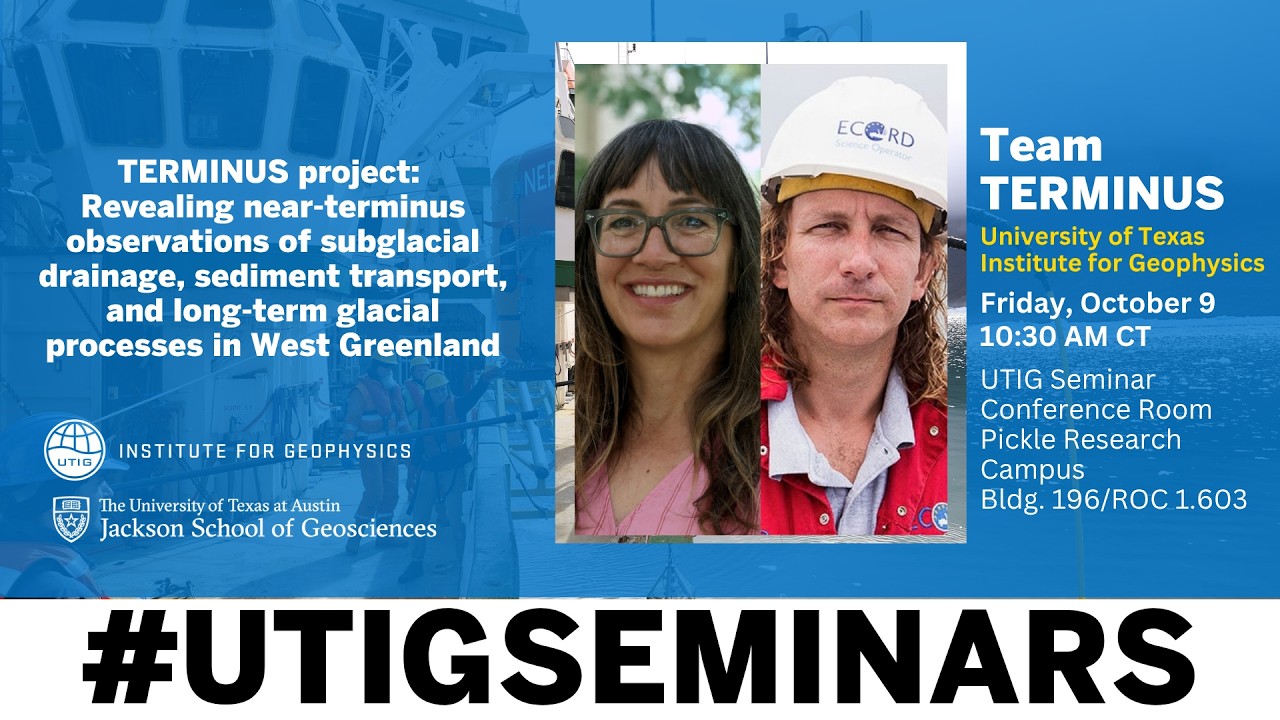
Fall 2026 UTIG Seminar Series: Team TERMINUS
Keywords
Summary
205 words
Critical Evaluation
Value of the Information & Strength of the Argument
The value of the information is high: the project provides unprecedented direct observations of ice-sediment-ocean interactions in a challenging environment. The speakers clearly explain the experimental design, the capabilities of the NUI ROV, and the processing needed to produce time-lapse seafloor maps. The argumentation is solid, supporting claims with quantitative estimates (e.g., ~20 dump trucks of sediment leaving the margin daily) and comparisons across melt conditions. However, the work is preliminary; some interpretations (e.g., the role of rialing in melting) rely on analog tank experiments and are presented with appropriate caution.
Scientific Rigor, Source Quality, Title Accuracy
The seminar is scientifically rigorous, showing careful calibration of data and acknowledgment of limitations (e.g., navigation uncertainties). Sources cited include previous work by Doug Brinkerhoff (coupled ice-sediment dynamics model) and a tank experiment paper on dissolution patterns, but no explicit external references with URLs are provided. The title accurately matches the content, which focuses on the TERMINUS project’s objectives and early findings. No sponsor segment was detected.
173 words
Title / Content Match
The title accurately reflects the seminar content: the TERMINUS project and its preliminary results on glacial sediment processes in West Greenland.
Quality & Reliability
8/10
Presentation of preliminary results from a research expedition, with detailed multi-beam bathymetry, ADCP currents, and photographic evidence. The findings are based on direct observations but are not yet peer-reviewed.
Key Moments
Markers derived by PSI from the transcript: the creator did not define chapters.
- Introduction of project goals and the challenge of studying glacier termini.
- Description of the TERMINUS project and the equipment used, including the RV Celtic Explorer and the NUI ROV.
- Presentation of seafloor mapping results, including bedforms and their upstream migration, suggesting sediment transport by turbidity currents.
- Detailed view of the glacier terminus face with multiple openings, including a 'cave' and a 'seep', and their linkage to subglacial hydrology.
- ADCP data showing focused inflow at the cave on high melt days versus distributed inflow on cloudy days, indicating channel closure.
- Discussion of rialing structures on the ice face and their potential origin from melt-induced convection.
Cited Sources
- Brinkerhoff's coupled ice-sediment dynamics model — Mentioned as motivation for the project; model showing tidewater glacier advance/retreat cycles without climate change.
- Tank experiments on dissolving blocks — Referenced to explain rialing structures on the ice face (analogous to melt-induced flow patterns).
- NUI (Nereid Under Ice) ROV — Purpose-built vehicle used for close-in mapping and sampling at the glacier terminus.
Concurring Sources
- Existing literature on subglacial hydrology heterogeneity — Mentioned as previous work indicating variable pressure and channelization, consistent with observed multiple outlets.
Contribution & Novelties
This talk presents novel observational data from the ice-sediment-ocean interface, including the first detailed ROV-based mapping of a grounding zone in Greenland. It challenges the classic view of single-channel buoyant plume forcing by showing that multiple, distinct discharge points exist and that their activity varies with surface melt intensity. The finding that moraine building may be rapid enough to stabilize glaciers has significant implications for sea-level projection models.
Pour aller plus loin :
- Subglacial channel — Relevant to the discussion of subglacial hydrology and channel closure.
- Tidewater glacier — Background on glacier advance/retreat cycles and processes.
- Moraine — Context for understanding the role of sediment in terminus dynamics.
108 words
Radar Profile
The radar profile is balanced with high scores in quantity and quality of information, and technical depth, while overall reliability is slightly lower due to preliminary results. The strong observational component and clear presentation make it a valuable resource for specialists.