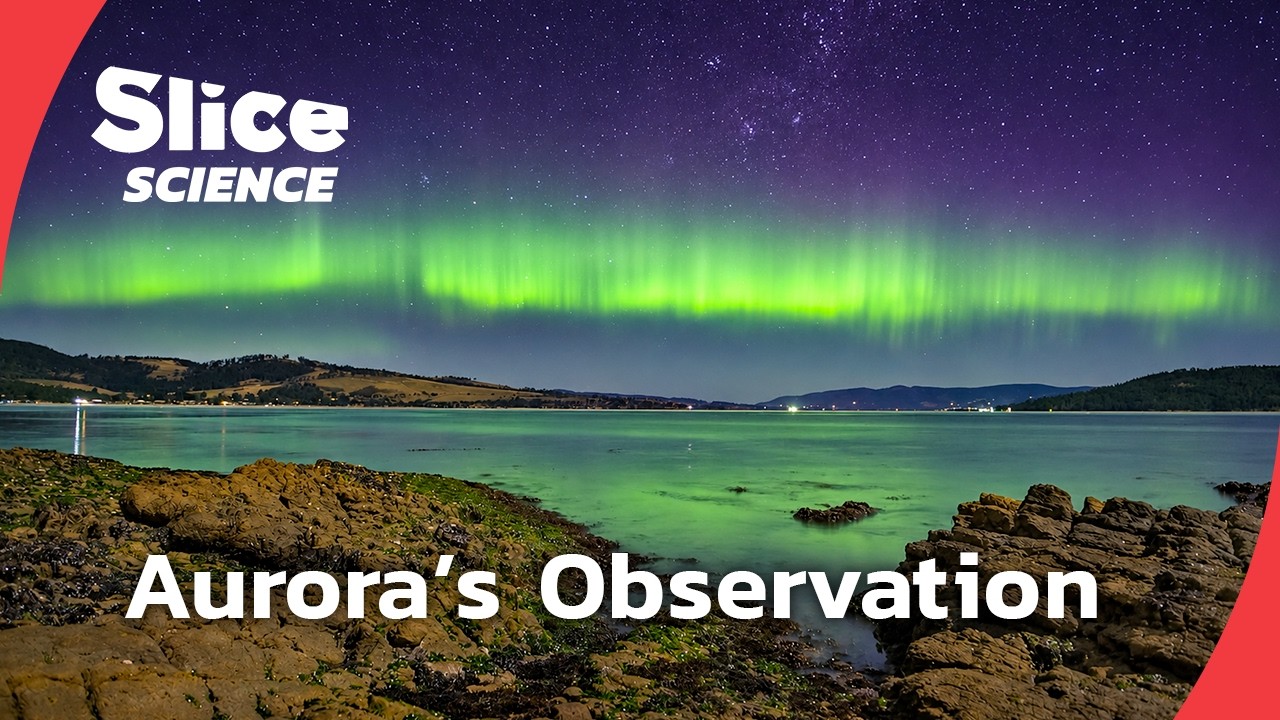
Auroras, Wind And Tides: The Science Behind Natural Phenomena | SLICE SCIENCE | FULL DOC
Keywords
Summary
243 words
Critical Evaluation
Value of the Information & Strength of the Argument
The value of the information lies mainly in the breadth and internal coherence of the five-part panorama: each phenomenon is handled with a consistent four-step template (definition, mechanism, measurement, stakes), which makes the episode a usable introductory map of geophysics and atmospheric science. Concrete anchors are provided where they matter most: the SI unit convention for wind speed, the specific mechanical principle of the cup anemometer versus the time-of-flight principle of the ultrasonic instrument, the named record of Barrow Island and the exoplanetary comparison, the exact distinction between spring and neap tides, the three plate-boundary geometries, and the dual natural/industrial origin of acidifying gases. The environmental and societal stakes are consistently drawn rather than left implicit: monitoring tides for shipping and engineering, earthquake preparedness through building codes and supplies, FGD scrubbers and emission treaties as mitigation. Argumentation, however, is almost entirely assertive. Almost every claim is delivered as a statement of fact with no mechanism derived from first principles, no order of magnitude argued, no uncertainty qualified. Key quantitative statements are dropped without any hint of their basis (the 5,400 mph exoplanet figure, the 500,000 yearly earthquakes), and the causal chains are occasionally compressed to the point of error, notably the account of auroral generation, where the difference between daytime and nighttime auroras is asserted rather than explained and magnetic reconnection is never named. The episode therefore functions well as a structured inventory and poorly as a demonstration; it teaches vocabulary and sequence rather than reasoning.
Scientific Rigor, Source Quality, Title Accuracy
No source is cited anywhere in the programme: no paper, no institution, no researcher, no dataset. Named authorities are absent except for historical attributions (Charles Richter in the 1930s) and institutional conventions (the World Meteorological Organization for the SI unit of wind speed), so the viewer has no route to verify any figure. The description of the video contains no reference links, only hashtags, which confirms the absence of a documentary apparatus. Factual rigour is uneven. Correct or defensible: the solar core temperature of about 14 million °C, the oxygen/nitrogen emission-colour mapping, the 408 km/h Cyclone Olivia gust, the ~64.5 light-year distance and ~5,400 mph winds of HD 189733b, the syzygy/quadrature explanation of spring and neap tides, the 1935 attribution of the Richter scale, and the natural plus anthropogenic sources of sulphur and nitrogen oxides. Incorrect or outdated: the ocean is said to make up ‘almost 60%’ of the Earth (roughly 71% of the surface is water-covered, and water is a small fraction of the planet’s mass); Rossby waves are described as the strong winds of the upper troposphere, whereas they are the large-scale meanders of the jet stream; the Richter scale is presented as the measure of magnitude ‘starting at one and going to nine or greater’, when it is open-ended and has been largely replaced by moment magnitude for anything above moderate size; and ‘convergent/divergent/strike-slip faults’ properly name plate boundaries, faults being the local structures along them. The explanation of auroras also mixes two distinct mechanisms (magnetospheric distortion and particle precipitation) without flagging the simplification. No advertising sequence is present in the transcript. On the title-content match, the promise is kept exactly: all five announced phenomena are treated, in the announced order, with comparable depth.
548 words
Title / Content Match
The title is fully honoured: each of the five phenomena announced (auroras, wind, tides, earthquakes, acid rain) receives a dedicated segment of comparable length, plus a recap. No significant promise is left unmet, and no substantial off-topic digression is present.
Quality & Reliability
6/10
The documentary is a competent textbook-level overview: the physics of auroras, the workings of cup and ultrasonic anemometers, the lunar/solar origin of spring and neap tides, the three main plate-boundary types and the chemistry of acid deposition are all presented broadly correctly. However, no source, study or expert is ever named, and several statements are loose or outdated: the ocean is said to cover 'almost 60%' of the Earth (the figure is about 71% of the surface), Rossby waves are conflated with the jet-stream winds of the upper troposphere, the Richter scale is presented as the current standard for magnitude despite having been largely superseded by moment magnitude, and the distinction between 'daytime' and 'nighttime' auroras is muddled. Figures that can be checked (Cyclone Olivia's 408 km/h gust at Barrow Island in April 1996, the ~5,400 mph winds of HD 189733b at 64.5 light-years, ~500,000 detectable earthquakes per year) are accurate.
Key Moments
Markers derived by PSI from the transcript: the creator did not define chapters.
- Opening montage and statement of intent: a tour of five natural phenomena.
- Definition of auroras, origin of the word, and the aurora borealis / aurora australis distinction.
- Solar fusion, convection cells, solar wind and the magnetosphere: how auroral photons are produced and why oxygen and nitrogen give different colours.
- Wind speed: SI units and the WMO convention, the cup anemometer, then the ultrasonic anemometer's time-of-flight principle.
- Drivers of wind speed: pressure gradient, upper-tropospheric Rossby waves and local weather systems.
- Records: the 408 km/h gust of Cyclone Olivia at Barrow Island (1996) and the ~5,400 mph winds of exoplanet HD 189733b.
- Tides defined through lunar and solar gravitation, and their predictability from the constant motion of Sun and Moon.
- Spring tides at new and full moon, neap tides at quarter phases, and the applications of tide prediction.
- Earthquakes: tectonic plates, faults, and the convergent, divergent and strike-slip geometries.
- The Richter scale, annual earthquake frequency, secondary hazards and preparedness measures.
- Acid rain: sulphur and nitrogen oxide sources, wet and dry deposition, and their effects on soils, water, health and stone.
- Mitigation through flue-gas desulfurization and international emission treaties, followed by the episode recap.
Concurring Sources
- World Meteorological Organization — standard units and instruments for wind measurement — Confirms the programme's statement that wind speed is expressed in metres per second as the WMO convention, and that cup and ultrasonic anemometers are the standard instruments.
- Bureau of Meteorology (Australia) — Cyclone Olivia and the 408 km/h world record gust, Barrow Island, 10 April 1996 — Corroborates the wind record quoted in the episode, including the location, date and value.
- USGS Earthquake Hazards Program — earthquake frequency and magnitude scales — Supports the order of magnitude of ~500,000 detectable and ~100,000 felt earthquakes per year, while confirming that magnitude measurement has moved beyond the Richter scale.
- NOAA / Space Weather Prediction Center — auroral physics and the solar wind–magnetosphere interaction — Confirms the general chain described (solar wind, magnetospheric coupling, particle precipitation, oxygen and nitrogen line emission).
- USGS — acid rain and atmospheric deposition — Confirms the sulphur dioxide / nitrogen oxide origin, the wet versus dry deposition distinction, and the acidification damage to soils and freshwater ecosystems.
Dissenting Sources
- USGS — moment magnitude versus the Richter scale — The episode presents the Richter scale as the operative measure of earthquake magnitude, with a range 'from one to nine or greater'. In practice the scale is open-ended and has been superseded by moment magnitude for moderate to large earthquakes; presenting Richter as the current standard is an outdated simplification.
- NOAA — global ocean coverage — The programme states that 'the Earth is almost 60% ocean water'. Approximately 71% of the Earth's surface is covered by ocean, and water represents only a small fraction of the planet's total mass; the figure as stated is both numerically wrong and ambiguous in what it measures.
- American Meteorological Society — glossary of Rossby waves and the jet stream — Rossby waves are described in the episode as 'the strong winds in the upper troposphere'. They are in fact large-scale horizontal meanders in the flow, whose existence depends on the jet stream and the Coriolis parameter; conflating the two obscures the mechanism.
- BGS / USGS — faults versus plate boundaries — The episode calls the three plate-boundary geometries (convergent, divergent, strike-slip) 'types of faults'. Faults are the local discontinuities along which displacement occurs, whereas convergence and divergence describe the relative motion of plates; the terminology conflates two distinct scales.
Contribution & Novelties
The episode breaks no new ground and reports no original research; its originality, such as it is, lies in the editorial pairing of five phenomena usually treated separately, which makes visible the common thread of measurement: what cannot be observed directly (wind, plate motion, magnetospheric coupling) is inferred through instruments and proxies. The parallel between terrestrial wind records and exoplanetary wind speeds, and the explicit treatment of the natural versus anthropogenic share of acidifying emissions, are the two moments where the documentary goes slightly beyond textbook recitation. The rest is consolidation of established knowledge.
Pour aller plus loin :
- Aurora — Background on the solar wind–magnetosphere interaction and the oxygen/nitrogen emission lines responsible for auroral colours.
- Anemometer — Covers cup, vane and ultrasonic instruments and the calibration issues that the episode leaves out.
- Rossby wave — Clarifies the distinction, blurred in the documentary, between Rossby waves and the jet-stream winds of the upper troposphere.
- Tide — Full treatment of spring and neap tides, tidal constituents and harmonic prediction beyond the syzygy/quadrature simplification.
- HD 189733 b — Context for the exoplanetary wind-speed estimate quoted in the episode and the methods used to obtain it.
- Flue-gas desulfurization — Technical detail on the scrubbing process presented as the main mitigation for acid rain.
210 words
Radar Profile
The profile is that of a well-structured encyclopaedic primer: information quantity and reliability sit at a moderate level, while technical depth is deliberately capped, with no equations, no data handling and no methodological discussion. The near-equal scores in quantity and quality indicate a broad but shallow treatment, and the low technical score is not compensated by any element of demonstration or uncertainty analysis.