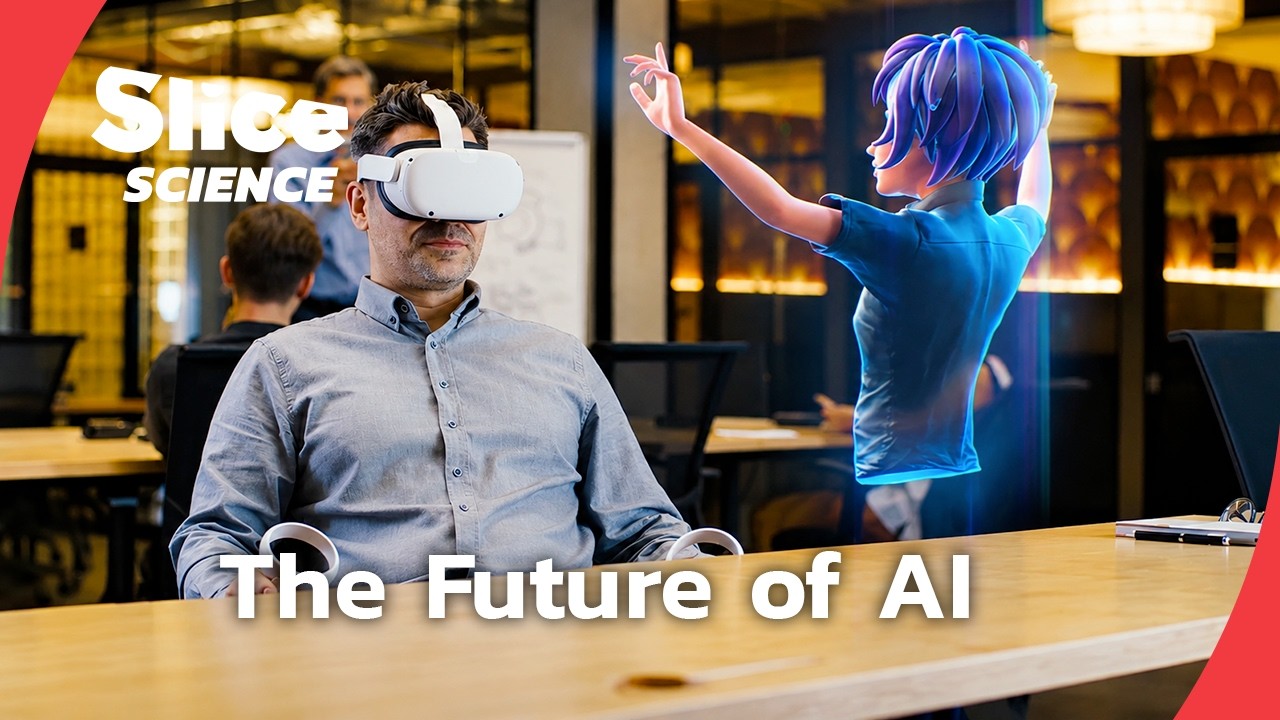
Can Artificial Intelligence Become Conscious? | SLICE SCIENCE | FULL DOC
Title history
- Can Artificial Intelligence Become Conscious? | SLICE SCIENCE | FULL DOC — observed on 20261119-1440 UTC (YouTube)
Keywords
Summary
160 words
Critical Evaluation
Value of the Information & Strength of the Argument
The documentary offers substantial value by assembling a diverse panel of experts who articulate both technical and philosophical perspectives on AI consciousness. The argumentation is generally sound, with experts grounding their claims in current research and logical reasoning. For instance, several contributors correctly point out that large language models lack true understanding, as demonstrated by their inability to grasp context or intentions. The use of Moravec’s paradox provides a clear illustration of the gap between human and machine capabilities. However, some predictions about AGI and the singularity are presented as near‑certain certainties without sufficient empirical evidence, weakening the overall rigor. The documentary succeeds in raising critical questions about the ethical implications of creating entities that may emulate consciousness, even if definitive answers are beyond its scope.
Scientific Rigor, Source Quality, Title Accuracy
The scientific rigor is moderate; the film relies on expert commentary rather than citations to peer‑reviewed literature. While the experts are credible, the lack of direct references to specific studies reduces its academic reliability. The title is well‑chosen, as the documentary explicitly addresses the central question of AI consciousness. The content aligns well with the title, delving into philosophical, neurological, and technological dimensions of machine consciousness. The inclusion of divergent viewpoints enhances its objectivity, although some speculative segments are presented with a tone of certainty. Overall, the documentary is informative but not exhaustive, and it serves as a valuable introduction to the topic rather than a rigorous scientific analysis.
250 words
Title / Content Match
The title accurately reflects the documentary's central question about AI consciousness, which is explored through expert interviews and philosophical discussion.
Quality & Reliability
7/10
The documentary features a range of experts from neuroscience, ethics, and technology, providing informed perspectives. However, it includes speculative predictions and does not present peer-reviewed research. The information is reliable for general understanding but not for academic citation.
Key Moments
Markers derived by PSI from the transcript: the creator did not define chapters.
- Introduction to the documentary's scope, with expert quotes on the singularity and AI risks.
- Discussion on the philosophical impossibility of self-aware AI and the nature of consciousness.
- Quantum computing's potential to accelerate AI development and its impact on training and encryption.
- Analysis of job displacement due to AI and the controversial predictions about minimum wage jobs.
- Examination of robotics and AI convergence, including war robots and sex robots.
- Ethical considerations and the importance of transparency and accountability in AI systems.
- Closing reflections on human tendency to anthropomorphize AI and the ultimate question of machine consciousness.
Cited Sources
- The Age of Robots (Documentary) — The documentary itself, produced by Sideways Film and directed by Alan Senkel, serves as the primary source for the statements made by various experts.
Contribution & Novelties
The documentary synthesizes multiple expert perspectives on whether AI can become conscious, highlighting the gap between public perception and technical reality. It uniquely combines discussions of quantum computing, robotics, and ethical frameworks within a single narrative, offering a comprehensive overview of the current debate. While it does not present original research, it provides a balanced introduction to the subject.
Pour aller plus loin :
- Technological singularity — Key concept referenced throughout, explaining the hypothesized point of AGI surpassing human intelligence.
- Moravec’s paradox — Cited in the film to illustrate why tasks that are easy for humans are hard for AI and vice versa.
- AI alignment — Central ethical challenge discussed, focusing on ensuring AI systems act according to human values.
120 words
Radar Profile
The scores profile shows a documentary that is information-rich (8) and moderately reliable (7) but with a lower technical depth (6) and only average quality precision (7). This suggests a comprehensive, accessible overview that is more expansive than rigorous, suited for general audiences rather than specialists.