Understanding conformational complexity of membrane-interacting proteins
Keywords
Summary
130 words
Critical Evaluation
Value of the Information & Strength of the Argument
The first talk provides a systematic computational approach to predict scramblases, expanding the known repertoire and highlighting the dynamic nature of membranes. The argumentation is strengthened by experimental validation from collaborating labs and a functional assay to confirm scramblase activity. The second talk breaks new ground by showing a lipid-driven allosteric switch in LC3, linking membrane binding to autophagy regulation; the use of simulations to propose a mechanism and then verify with biophysical and cellular experiments makes the case compelling. Both presentations are logically structured, with clear hypothesis testing and appropriate caveats about the preliminary nature of some results.
Scientific Rigor, Source Quality, Title Accuracy
The scientific rigor is high: both speakers use well-established methods (molecular dynamics, AlphaFold, fluorescence assays) and cite ongoing collaborations. The sources are implicit (original research), but no external references or links are provided in the description, so the reliance on primary work is clear. The title is highly appropriate, directly reflecting the content about membrane protein conformation and lipid coupling. No sponsorship or advertising was present, and the Q&A segment indicates peer engagement.
187 words
Title / Content Match
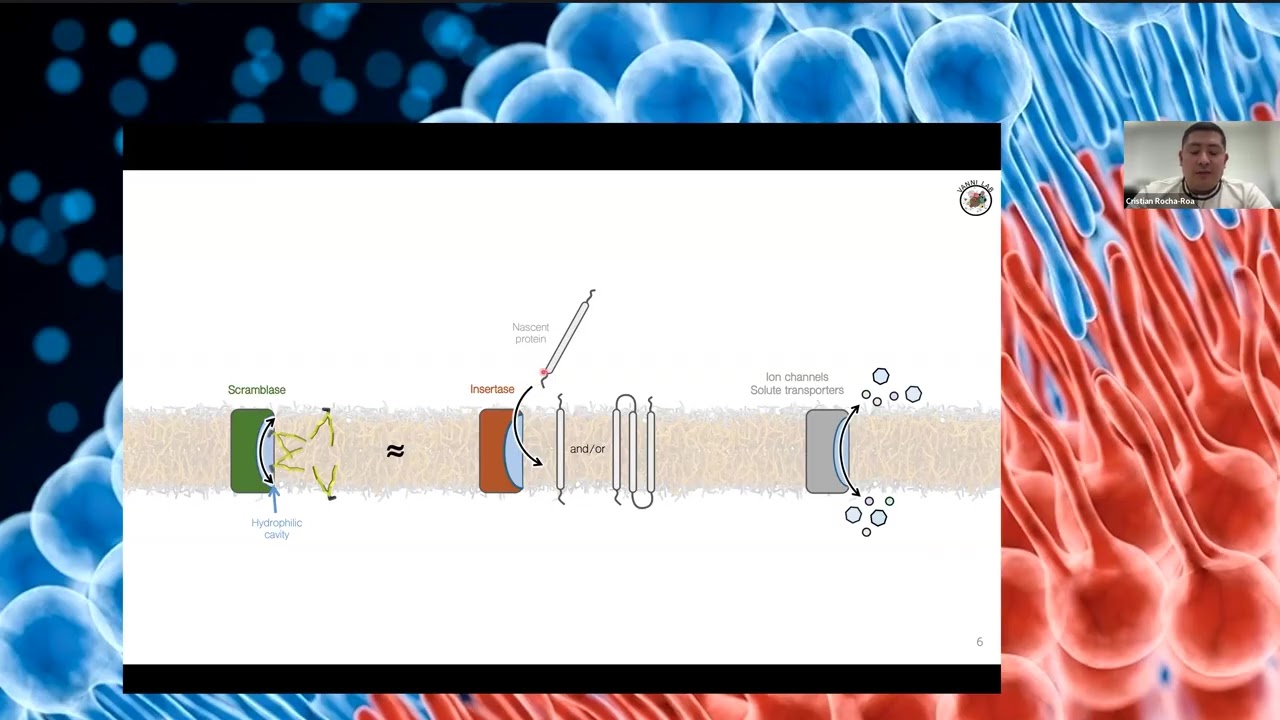
The title accurately reflects the content: both talks focus on the conformational behavior of membrane-interacting proteins, particularly lipid scrambling and allosteric regulation.
Quality & Reliability
8/10
The webinar features two original research presentations from early-career scientists, with a clear methodology (molecular dynamics simulations, biochemical assays) and collaboration with established researchers. The results are presented as preliminary but are supported by computational and in vitro validation.
Key Moments
Markers derived by PSI from the transcript: the creator did not define chapters.
- Introduction by Dr. Josh Pemberton, welcoming the two speakers.
- Cristian Rocha-Roa begins his talk on in silico identification of scramblases using MD simulations.
- Rocha-Roa presents the BLTP complex and AlphaFold predictions, followed by Q&A.
- Jesu Castin starts her talk on the allosteric lipid switch in LC3 and its role in autophagy.
- Castin concludes; final discussion and closing remarks.
Contribution & Novelties
The webinar delivers novel insights: the identification of new scramblase candidates through a computational pipeline, the suggestion that insertases may double as scramblases, and the discovery of a lipid-sensitive allosteric site in LC3 that can be reprogrammed. This adds to our understanding of membrane dynamics and protein regulation in native environments.
Pour aller plus loin :
- Molecular dynamics simulations — Core technique used to study lipid-protein interactions.
- Scramblase — Overview of scramblase proteins and their role in lipid asymmetry.
- Autophagy — Cellular pathway central to the second talk.
- LC3 protein — Marker of autophagosomes and subject of the allosteric study.
100 words
Radar Profile
The profile shows high scores in quality, technique, and reliability, with moderate quantity, indicating a dense but focused presentation. The content is technical and well-supported, appealing to a specialized audience.