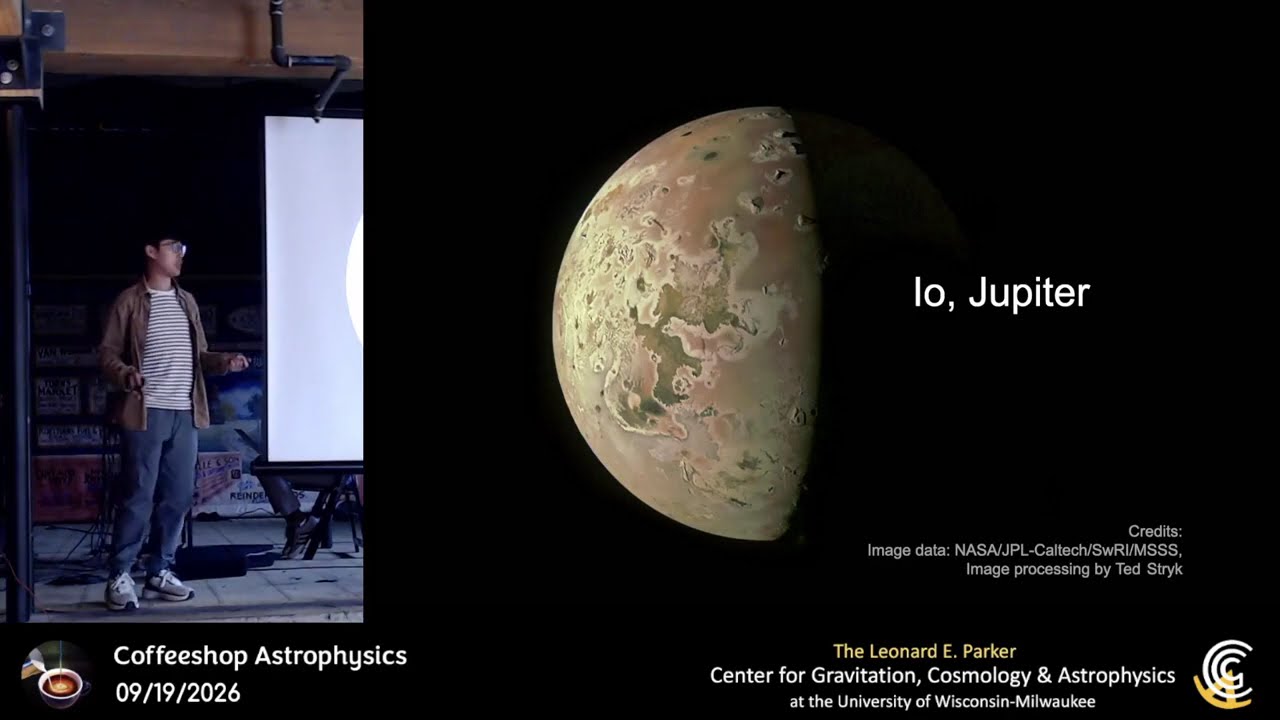
Moons of the Solar System - Sep. 19, 2026
Keywords
Summary
183 words
Critical Evaluation
Value of the Information & Strength of the Argument
The video provides substantial value by synthesizing current knowledge about solar system moons in an accessible yet technically accurate manner. The argumentation is well-structured, moving from definitions to formation processes, then to specific geological features, and finally to habitability discussions. The speakers effectively use analogies (e.g., recipe for making a moon) and vivid imagery to convey complex concepts like tidal heating and cryovolcanism. The reasoning is generally robust, with careful distinctions between confirmed facts and hypotheses, such as the uncertain subsurface ocean on Europa. The presentation also acknowledges the limits of current knowledge, particularly regarding the search for life, and remains appropriately cautious. The interactive elements, such as audience questions and live measurements, enhance engagement without compromising scientific integrity.
Scientific Rigor, Source Quality, Title Accuracy
The scientific rigor is commendable: the presenters correctly describe established theories (e.g., the leading impact hypothesis for the Moon’s formation) and cite real missions (Voyager, Galileo, Cassini) and observatories (ALMA). They also differentiate between observational evidence (e.g., Enceladus’s plumes) and well-founded speculation (e.g., Europa’s ocean). However, some simplifications, such as the exact percentages of Titan’s atmosphere, are slightly imprecise (95% nitrogen vs. 98.4% actually measured), though these do not undermine the overall message. The title ‘Moons of the Solar System’ perfectly matches the content, which is a literary tour of several moons without delving into a single one exhaustively. The video’s structure, with chapters, enhances clarity. No contradictions with known scientific consensus were detected.
248 words
Title / Content Match
The title accurately reflects the content: a comprehensive tour of moons in the solar system, including formation, geology, and astrobiological potential.
Quality & Reliability
8/10
The video presents well-established scientific knowledge about moons, with accurate descriptions and references to actual missions and discoveries. The speakers are PhD students and postdocs from a university astrophysics center, lending credibility. However, it is a popular science presentation without peer review.
Chapters
Cited Sources
- Artemis mission (NASA) — Mentioned as an example of recent lunar activity.
- ALMA observatory — Image of a circumplanetary disk around PDS 70.
- Voyager 1 — Discovered volcanoes on Io and imaged Europa.
- Galileo spacecraft — Detected Europa's induced magnetic field.
- Cassini spacecraft — Observed Enceladus's plumes.
- Europa Clipper — NASA mission to fly by Europa.
- JUICE (ESA) — ESA mission to study Jupiter's icy moons.
- Dragonfly — NASA drone mission to Titan.
Contribution & Novelties
The video synthesizes a wide range of planetary science topics into a cohesive narrative, making it a valuable educational resource. Its original contribution lies in connecting formation processes with geological features and astrobiological potential in a single presentation. The perspectives from multiple presenters add depth, and the practical demonstrations (e.g., using angular measurements) help convey scale.
Pour aller plus loin :
- Tidal heating — Explanation of the mechanism that powers Io’s volcanoes and subsurface oceans on icy moons.
- Hydrothermal vent — Deep-sea ecosystems that thrive without sunlight, relevant to habitability on ocean moons.
- Europa (moon) — Detailed article on Europa’s geology and potential ocean.
- Titan (moon) — Overview of Titan’s atmosphere and methane cycle.
114 words
Radar Profile
The radar profile shows a balanced performance across all dimensions, with slightly higher scores for information quantity and quality, and a moderate technical level. This indicates a solid educational video that is both informative and accurate, though not extremely advanced in complexity.