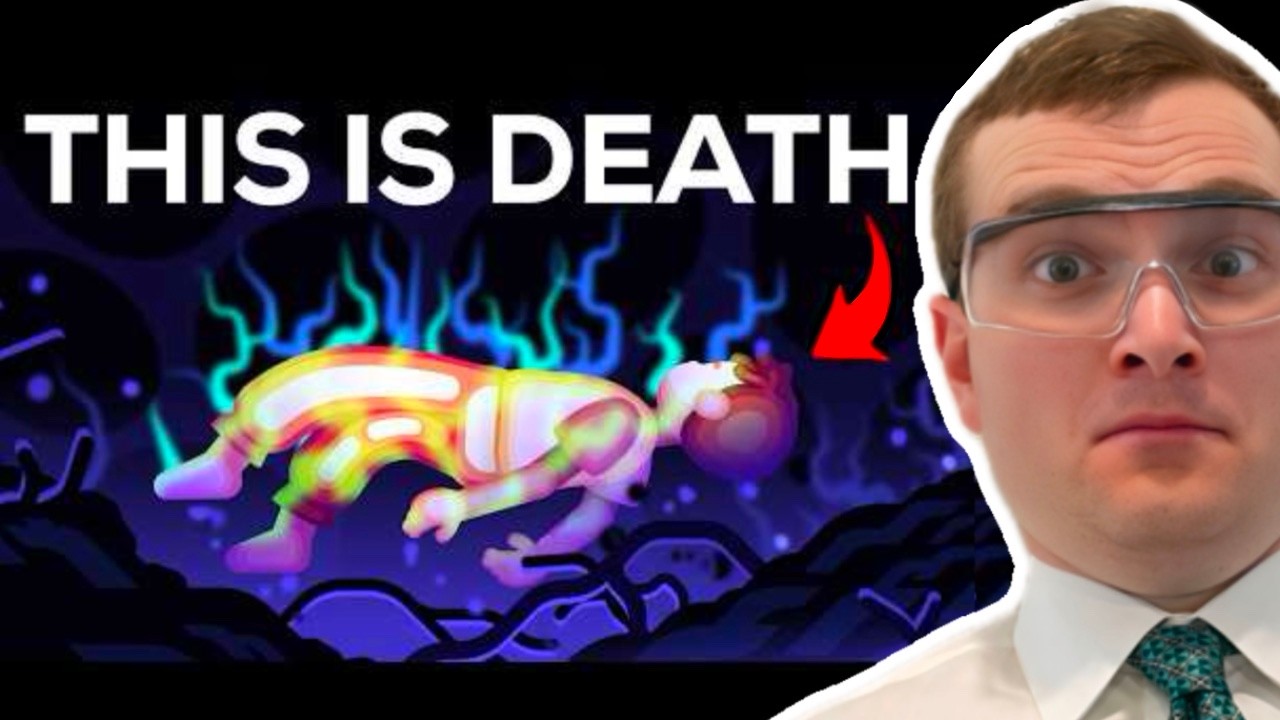
What Really Happens When You Die? - Nuclear Engineer Reacts to Kurzgesagt
Title history
- What Really Happens When You Die? - Nuclear Engineer Reacts to Kurzgesagt — observed on 20261119-1825 UTC (YouTube)
Keywords
Summary
162 words
Critical Evaluation
Value of the Information & Strength of the Argument
The video offers significant added value by applying an engineering systems perspective to biological death. The engineer uses analogies to nuclear reactor failures to illuminate the cascading nature of physiological breakdown, such as comparing ATP depletion to loss of control rods and the calcium storm to a chain reaction. He critically evaluates the original video, pointing out oversimplifications and emphasizing that timings are highly variable. His argumentation is logical and structured, distinguishing between known facts, reasonable inferences, and unknowns. He also acknowledges his own limitations, stating he is not a doctor and encouraging corrections, which strengthens his credibility. The discussion of the afterlife is handled with philosophical humility, separating scientific knowledge from personal belief.
Scientific Rigor, Source Quality, Title Accuracy
The video relies solely on the original Kurzgesagt production as its source, with no additional citations or external references provided. The engineer’s commentary is based on his professional knowledge as a nuclear engineer, but he admits to not being a medical expert, which limits the rigor of some biological claims. He does, however, demonstrate familiarity with terms like apoptosis, ATP, and rigor mortis, and he often corrects the original video’s simplifications. The title accurately describes the content: a reaction video by a nuclear engineer to a Kurzgesagt explainer about death. There is no evidence of comment trends, as no comments were provided for analysis.
233 words
Title / Content Match
The title accurately reflects the content: a nuclear engineer's reaction to a Kurzgesagt video about death, focusing on the biological processes and offering analogies to nuclear systems.
Quality & Reliability
7/10
The video provides an expert engineering perspective, correcting and refining biological facts, but relies on the original video's content and personal knowledge. The engineer is not a medical professional and admits uncertainty, which limits the absolute reliability.
Key Moments
Markers derived by PSI from the transcript: the creator did not define chapters.
- Introduction and first analogy: heart as a pump compared to reactor coolant.
- Discussion of brain death definitions and the importance of distinguishing between clinical and cellular death.
- Explanation of the calcium storm and catastrophic cascading neuron failure, likened to a chain reaction.
- Rigor mortis and the role of ATP in muscle contraction and relaxation.
- Emergence of the necrobiome and the immune system's final stand, with comparison to loss of central coordination.
Cited Sources
- What Really Happens When You Die? (Kurzgesagt) — Original video being reacted to.
Contribution & Novelties
The primary contribution of this video is the novel engineering perspective applied to the biological process of death. The engineer draws parallels between nuclear reactor shutdown and the human body’s cascade of failures, offering fresh analogies that help explain complex mechanisms. He also corrects potential misconceptions from the original video, such as the 80% red blood cell claim and the universality of the 20-minute brain death timeline. The philosophical reflection on the afterlife adds depth, but the video does not present new scientific research.
Pour aller plus loin :
- Brain death — Legal and medical definition of irreversible loss of brain function, relevant to the discussion of death definitions.
- Apoptosis — Programmed cell death, a normal process that also occurs during death, as mentioned in the video.
- Necrosis — Unprogrammed cell death due to injury, contrasting with apoptosis.
- Rigor mortis — Post-mortem muscle stiffening due to ATP depletion, a key stage in the death cascade.
- Near-death experience — Reported experiences during clinical death, referenced in the video as a potential phenomenon.
171 words
Radar Profile
The radar shows strong scores in information quantity and quality, with moderate technicality and reliability, indicating a well-informed but subjective commentary. The relatively high technical level reflects the nuclear engineer's expert analogies, while the reliability score is tempered by his lack of medical credentials and reliance on the original video.