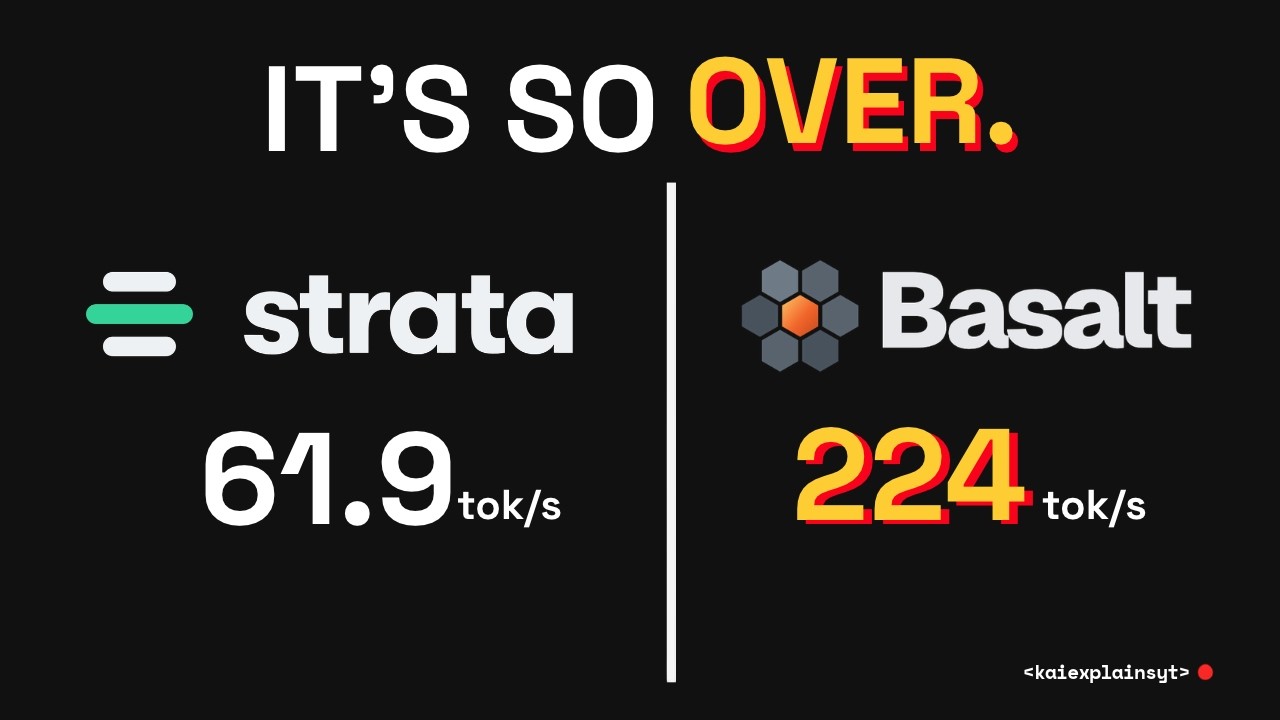
Basalt Runs Qwen 3.8 Flash Next At 224 Token/sec
Title history
- Basalt Runs Qwen 3.8 Flash Next At 224 Token/sec — observed on 20261120-1642 UTC (YouTube)
Keywords
Summary
207 words
Critical Evaluation
Value of the Information & Strength of the Argument
The video provides high informational value by demystifying a widely shared benchmark and revealing a critical configuration detail that affects model quality. The argumentation is logical and evidence-based, drawing on specific test cases, data from GitHub issues, and the creator’s own experiments. The reasoning is transparent, acknowledging both the benefits and drawbacks of each engine, and avoids hype. The use of concrete examples, such as the RTX 5080 case, effectively illustrates the impact of the route tail skip. The conclusion to disable the skip for full quality is actionable and well-supported.
Scientific Rigor, Source Quality, Title Accuracy
The video demonstrates strong scientific rigor by referencing primary sources: the official GitHub repositories for Strata and Basalt, specific issue threads, release notes, and the developer’s own benchmarks. It critically evaluates these sources, noting potential biases and experimental conditions. The title, however, is somewhat misleading as it emphasizes a single token/s figure (224 tok/s) that is not the full picture; the video itself debunks that number, showing real-world performance is lower and depends on configuration. This discrepancy is addressed honestly, but the title could have been more accurate. Overall, the sourcing is commendable, but the title overstates a specific metric.
206 words
Title / Content Match
The title emphasizes a specific token/s figure that is a highlight of the comparison, but the video provides a broader analysis of the two engines, including a critical look at how that number is achieved. It is somewhat representative but not fully capturing the content.
Quality & Reliability
8/10
The video provides a thorough technical analysis, references specific benchmarks and source code, and critically examines performance claims. It acknowledges uncertainties and provides actionable recommendations. However, some data points rely on individual user reports and forum threads, which are less rigorously verified.
Chapters
- Strata vs Basalt: the 170 tok/s thread
- Qwen 3.8 Flash-Next and the two engines
- The benchmarks everyone is sharing
- Who can actually run Basalt (RTX 50 only)
- The "RTX 3080" misquote
- How a mixture-of-experts model runs on your GPU
- The route tail skip Strata turns on by default
- The RTX 5080 case: 80 → 66 tok/s
- What the skip costs in quality
- The one-line fix: STRATA_ROUTE_TAIL_SKIP=0
- Pin your engine version
- What switching really gets you: 25% less waiting
- Why Basalt's headline numbers run high
- Where Basalt struggles: Windows, laptops, parallel agents
- The cost of switching
- Stay on Strata or switch to Basalt?
- What to do first
Cited Sources
- Strata GitHub repository — Main repository for the Strata inference engine
- Basalt GitHub repository — Main repository for the Basalt inference engine
- Basalt issue #309 (RTX 5080 case) — User report comparing performance; key evidence for the route tail skip impact
- Strata v0.1.42 release notes — Release that introduced route tail skip by default
- Strata quant quality docs — Documentation on quality metrics including KL divergence
- AkitaOnRails: LLM benchmark — Detailed benchmarks by Basalt developer for both engines
- Basalt community benchmarks — Community-submitted performance numbers for Basalt
- Adamant (Basalt fork for RTX 30/40) — Community fork aiming to support older Nvidia cards
Concurring Sources
- Basalt issue #309 (RTX 5080 case) — Primary evidence for the performance difference when tail skip is disabled
- AkitaOnRails: LLM benchmark — Independent benchmarks that support the 25% real-job time improvement
Contribution & Novelties
The video contributes by exposing the route tail skip mechanism in Strata, which silently degrades model quality for speed on smaller VRAM cards. It provides a clear actionable fix and re-evaluates the Strata vs. Basalt comparison under fair conditions, showing that Basalt is not as dramatically faster as claimed. This is original analysis that helps users make informed decisions.
Pour aller plus loin :
- Mixture of experts — Explains the architecture behind Qwen 3.8 Flash-Next and the trade-offs.
- Kullback–Leibler divergence — Metric used in the video to quantify quality impact of skipping experts.
- Blackwell (microarchitecture) — The Nvidia GPU architecture required for Basalt, with details on its capabilities.
108 words
Radar Profile
The radar profile shows high scores across quantity, quality, technical depth, and reliability, with slightly lower reliability due to reliance on forum-reported data. The balanced shape indicates a well-rounded technical analysis.
💬 The comment section is predominantly positive and engaged, with viewers praising the technical depth and sharing their own benchmarks. Some comments express curiosity about AI narration, but the overall sentiment is supportive. Out of 30 comments, the tone is enthusiastic and appreciative.