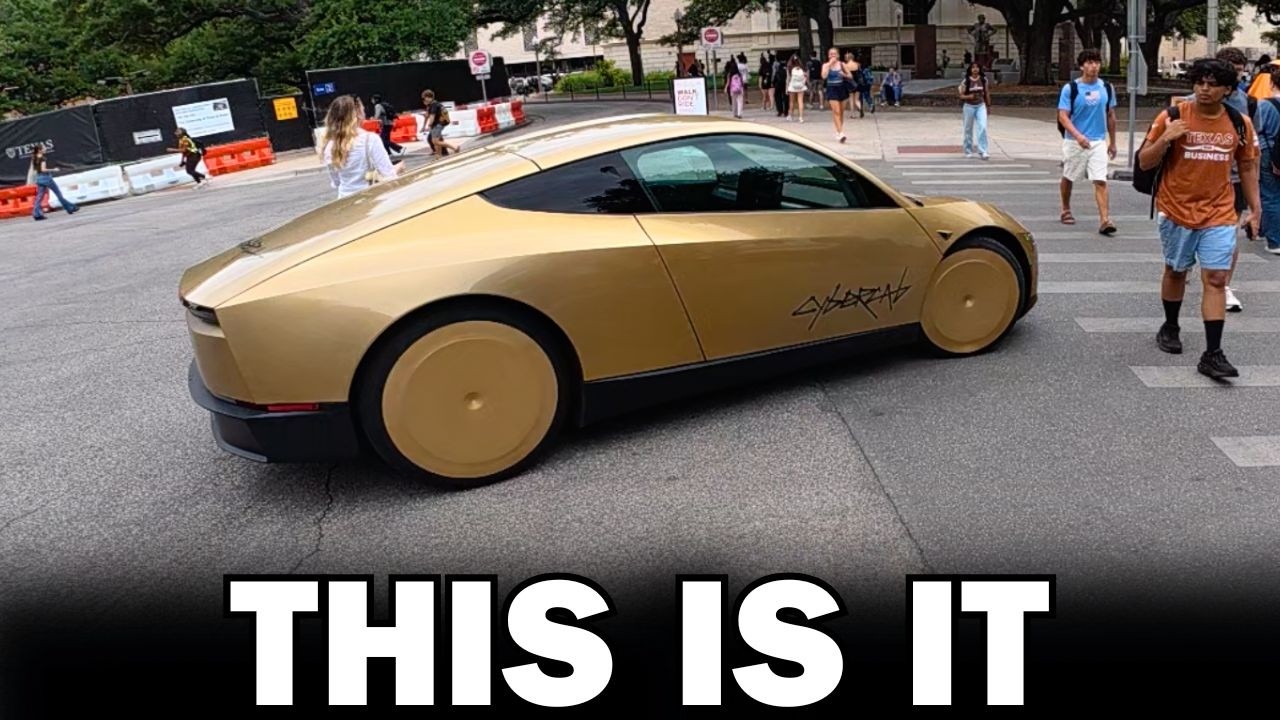
Why Tesla Cybercab Will Dominate Everything
Title history
- Why Tesla Cybercab Will Dominate Everything — observed on 20261110-0254 UTC (YouTube)
Keywords
Summary
161 words
Critical Evaluation
Value of the Information & Strength of the Argument
The video provides a compelling and well-structured argument, supported by practical data from his own rides and a clear economic framework. Farzad effectively explains the ‘two-cost model’ of Uber (vehicle cost plus driver margin) versus Tesla’s single-cost model (vehicle cost only), making a strong case for why Tesla can underprice competitors. His reasoning about network effects and the inevitability of driver displacement is logically sound and addresses counterarguments, such as Uber partnering with self-driving car makers. He also introduces the concept of government capture as an obstacle, which adds depth. However, the analysis is subjective and lacks external data or citations beyond his own books and articles, and the bias is acknowledged.
Scientific Rigor, Source Quality, Title Accuracy
The video cites few external sources, relying mainly on the author’s personal experience and his own publications (books and an article). The description includes links to his books and website, but these are not independent sources. The argumentation is internally consistent but not rigorously sourced. The title is somewhat hyperbolic but accurately reflects the video’s content. The author discloses his financial interests in Tesla and other companies, which mitigates transparency concerns. Overall, the rigor is moderate; the video is more of an expert opinion piece than a scientific study.
216 words
Title / Content Match
The title matches the video's thesis, which argues that the Tesla Cybercab will disrupt Uber and dominate the market. It is somewhat sensationalist but aligned with the content.
Quality & Reliability
6/10
The content is based on firsthand experience and personal analysis, with some economic reasoning. The author is a former Tesla employee and shareholder, which introduces potential bias, but he provides transparent disclaimers. The evidence is anecdotal rather than systematically gathered, limiting its scientific rigor.
Key Moments
Markers derived by PSI from the transcript: the creator did not define chapters.
- Introduction and choosing destination in the Robotaxi app
- Cybercab arrives and features are demonstrated
- Comparison of pricing and wait times between Robotaxi and Uber
- Discussion on Uber's two-cost model and why it can't compete
- Rant on government capture and proposal for AI dividend fund
- Final thoughts and conclusion
Cited Sources
- Master Plan: What Elon Musk is Actually Building — Book by the author, referenced as his work
- Abundance or Collapse — Book by the author, referenced as his work
- Exclusive: Can Tesla's Cybercab Actually Kill Uber — Article on the author's website expanding on the video's thesis
External References
Contribution & Novelties
The video offers a unique firsthand user experience of the Tesla Cybercab and a well-articulated economic argument for its disruptive potential. It provides a clear comparison of costs and wait times in a real-world scenario, and introduces the concept of Uber’s ‘two-cost model’ versus Tesla’s integrated model, which is a novel framing. The call for an AI dividend fund as a policy response adds a constructive element to the discussion.
Pour aller plus loin:
- Robotaxi — Overview of autonomous ride-hailing services.
- Autonomous car — Background on self-driving technology and its challenges.
- Network effect — Explains the supply-demand dynamics central to the video’s argument.
- Uber — Context on Uber’s business model and history.
112 words
Radar Profile
The radar profile shows a moderate overall performance, with strengths in information quantity (8) and information quality (7), while technical level (6) and reliability (5) are lower. This indicates a content-rich, well-presented video that is more opinion-driven than rigorously researched.
💬 très positif — Les commentaires analysés (30) sont majoritairement enthousiastes envers le Cybercab et critiques envers Uber, avec de nombreux témoignages personnels sur les prix élevés et le service décevant d'Uber.