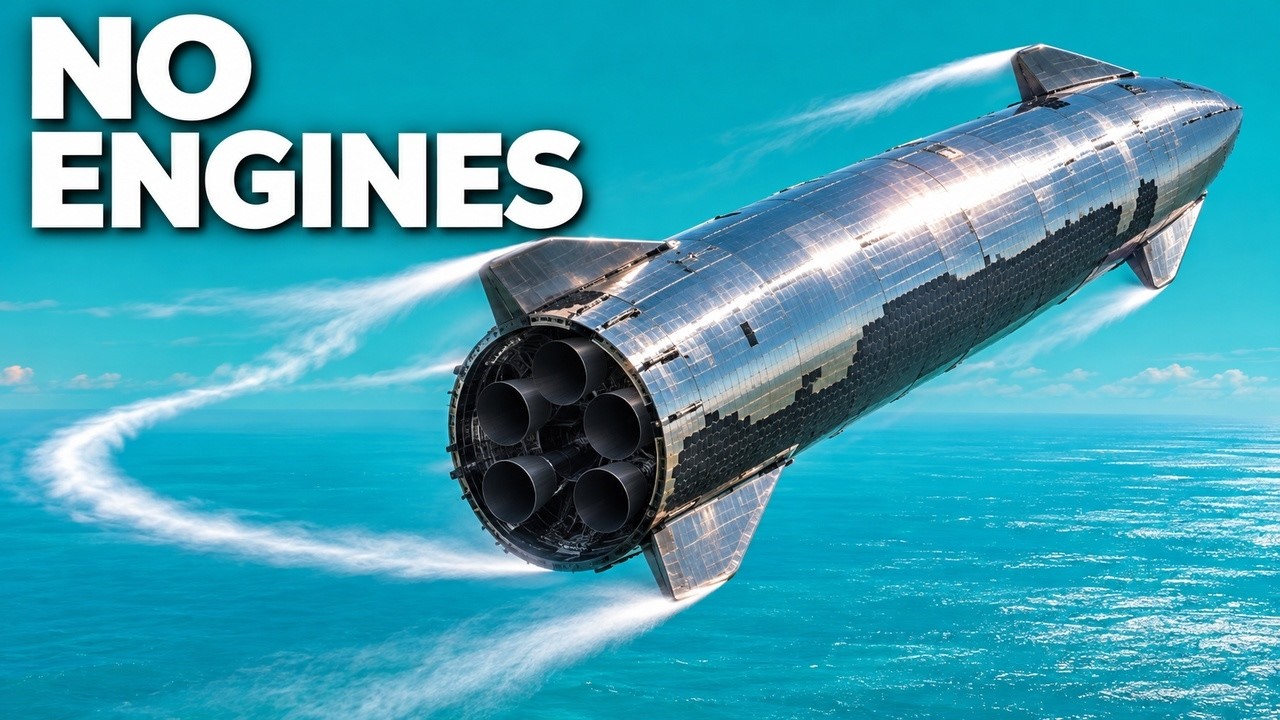
Why Starship Zigzagged Home Instead of Flying Straight
Title history
- Why Starship Zigzagged Home Instead of Flying Straight — observed on 20261118-1349 UTC (YouTube)
Keywords
Summary
156 words
Critical Evaluation
Value of the Information & Strength of the Argument
The video offers a clear and coherent explanation of the engineering logic behind Starship’s unusual flight path. It builds the argument step-by-step: first establishing the need for the atmosphere to brake, then explaining how banking turns create cross-range, and finally why the overland route and Gulf swoosh are necessary. The author uses analogies (hand out of car window) and historical comparisons (Space Shuttle) to make complex concepts accessible. The argument is solid, though some claims about the ‘airline loop’ are forward-looking and somewhat speculative. No counterarguments are presented, but the reasoning is internally consistent and aligns with official SpaceX communications.
Scientific Rigor, Source Quality, Title Accuracy
The video references SpaceX’s official website update page, FAA safety regulations and environmental review, and post-flight reports from CBS News and Aviation Week. While these are credible sources, specific URLs are not provided in the description (only book links and sponsor links). The author also mentions his own experience as a Tesla employee and discloses stock holdings, adding transparency. The title accurately reflects the content, which focuses on the zigzag path and its rationale. No comments are analyzed for this video, so no public reception trends are reported.
203 words
Title / Content Match
The title accurately reflects the content, focusing on the unexpected flight path and the physics behind it.
Quality & Reliability
7/10
Well-structured explanation based on official SpaceX updates, FAA regulations, and post-flight reporting from CBS News and Aviation Week. Author discloses holdings and experience. Some economic interpretations are personal but grounded. Minor reliance on secondary sources without direct URLs.
Chapters
Cited Sources
- Master Plan: What Elon Musk is Actually Building — Book mentioned in the video for deeper understanding of SpaceX's industrial machine.
- Abundance or Collapse — Book listed in description; not directly cited in the video.
External References
Contribution & Novelties
The video’s original contribution is its accessible synthesis of publicly available information about Flight 15’s return trajectory, explaining the physics of banking turns and the safety rationale behind the zigzag path. It also connects the S-turns and ‘swoosh’ to shuttle entry guidance and future airline-like operations.
Pour aller plus loin :
- Atmospheric reentry — Provides background on thermal protection and drag mechanics.
- Bank angle — Explains the principle of tilting the lift vector for steering.
- Lifting body — Discusses the concept of using the body itself for lift, relevant to Starship’s belly-first entry.
- Cross range — Describes lateral range achievable by a reentry vehicle.
104 words
Radar Profile
The radar profile shows balanced strengths with high scores in quantity and quality of information, moderate technical depth, and slightly lower reliability due to reliance on secondary sources without direct links.