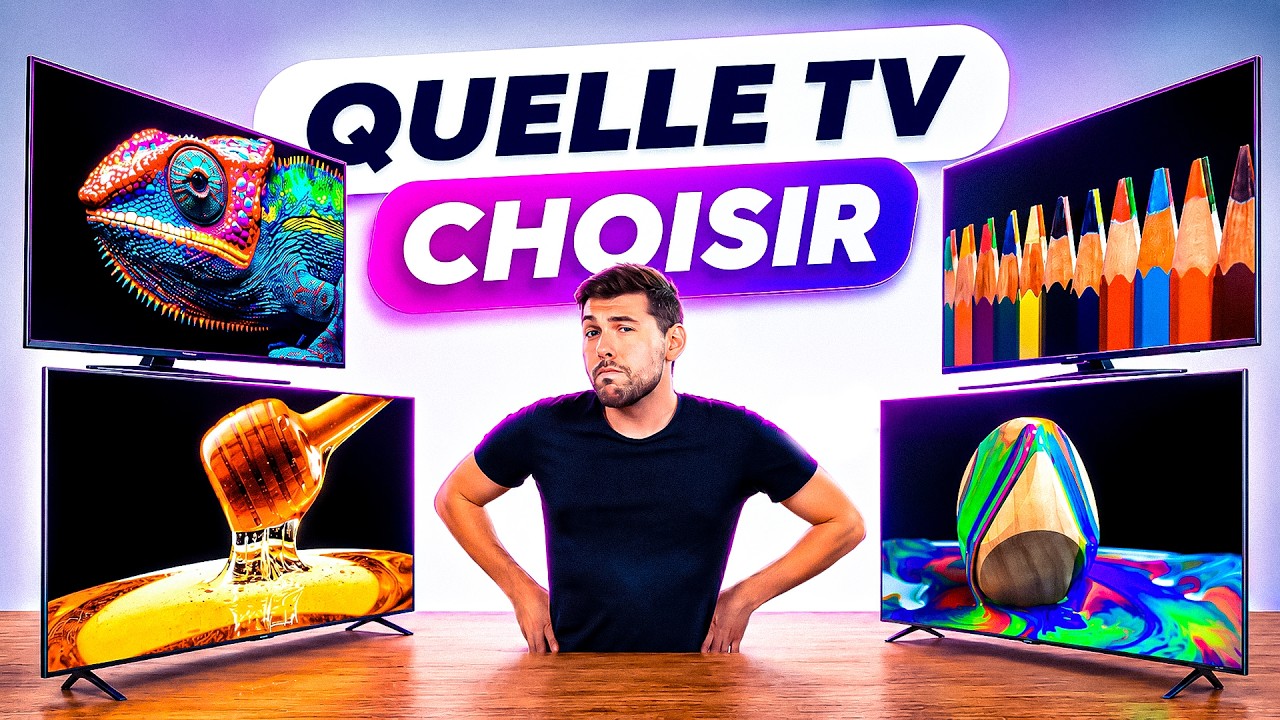
On a testé les TV à moins de 1000€ : voici la vérité
We tested TVs under €1000: here is the truth
Keywords
Summary
129 words
Critical Evaluation
Value of the Information & Strength of the Argument
The video provides high value by combining objective measurements (luminance in cd/m², contrast ratios, delta E values) with practical explanations of how these parameters affect real-world viewing. The argumentation is solid: each claim is supported by data from a probe, and the presenters clearly explain trade-offs (e.g., OLED vs. mini-LED). The step-by-step comparative approach, using the pearl visualization, makes technical results accessible without oversimplification. However, the selection of four models with different sizes and technologies introduces a methodological limitation, as comparisons are not strictly apples-to-apples. Nevertheless, the overall reasoning is coherent and well-structured, leading to a justified recommendation.
Scientific Rigor, Source Quality, Title Accuracy
The scientific rigor is good for a consumer tech review: measurements are taken under controlled conditions (HDR, Filmmaker mode), and thresholds like delta E < 3 are explicitly cited. The video is non-sponsored, and transparency is declared. Sources are provided via links to detailed written tests on Frandroid, which adds credibility. The title directly matches the content: it tests TVs under €1000 and reveals performance differences. The only minor gap is the absence of durability or long-term reliability data, which is not part of the protocol. Overall, the title and content are in strong alignment.
208 words
Title / Content Match
The title accurately reflects the content: the video tests four TVs under €1000 and reveals their performance differences, with the LG C5 as the winner.
Quality & Reliability
8/10
The video uses a rigorous measurement protocol (sonde, candela, delta E) and transparent non-sponsored methodology. However, it is a consumer-oriented test rather than a peer-reviewed study, with some subjective assessments.
Chapters
Cited Sources
- Test du TV LG OLED65C5 — Full review of the LG C5 OLED TV by Frandroid
- Test du Hisense U8Q — Full review of the Hisense U8Q TV
- Test du TCL C8K — Full review of the TCL C8K TV
- Test du Samsung 55QN70F — Full review of the Samsung 55QN70F TV
- Guide d'achat TV — Buying guide for TVs
External References
Contribution & Novelties
The video introduces an original and engaging format using a physical pearl-counting system to visualize measurement results, making technical data more accessible to a general audience. It effectively bridges objective lab measurements with practical purchasing advice.
Pour aller plus loin :
- OLED — Relevant to understand the contrast and response time advantages of OLED panels.
- Mini-LED — Relevant to understand the backlighting technology used in high-end LCD TVs and its benefits in brightness and local dimming.
- Color difference — Relevant to the delta E metric used in the video to assess color fidelity.
- HDMI 2.1 — Relevant to the gaming-oriented features and connectivity discussed for the Samsung and LG models.
110 words
Radar Profile
The radar chart shows a well-rounded profile with high scores in information quantity (8) and reliability (8), while technical depth (7) is slightly lower, reflecting a consumer-focused scientific approach that prioritizes clarity over exhaustive technical detail.
💬 Orientation: balanced. Out of the 30 comments analyzed, many praised the format and clarity, while some criticized the selection of TVs and the lack of durability and refresh rate tests.