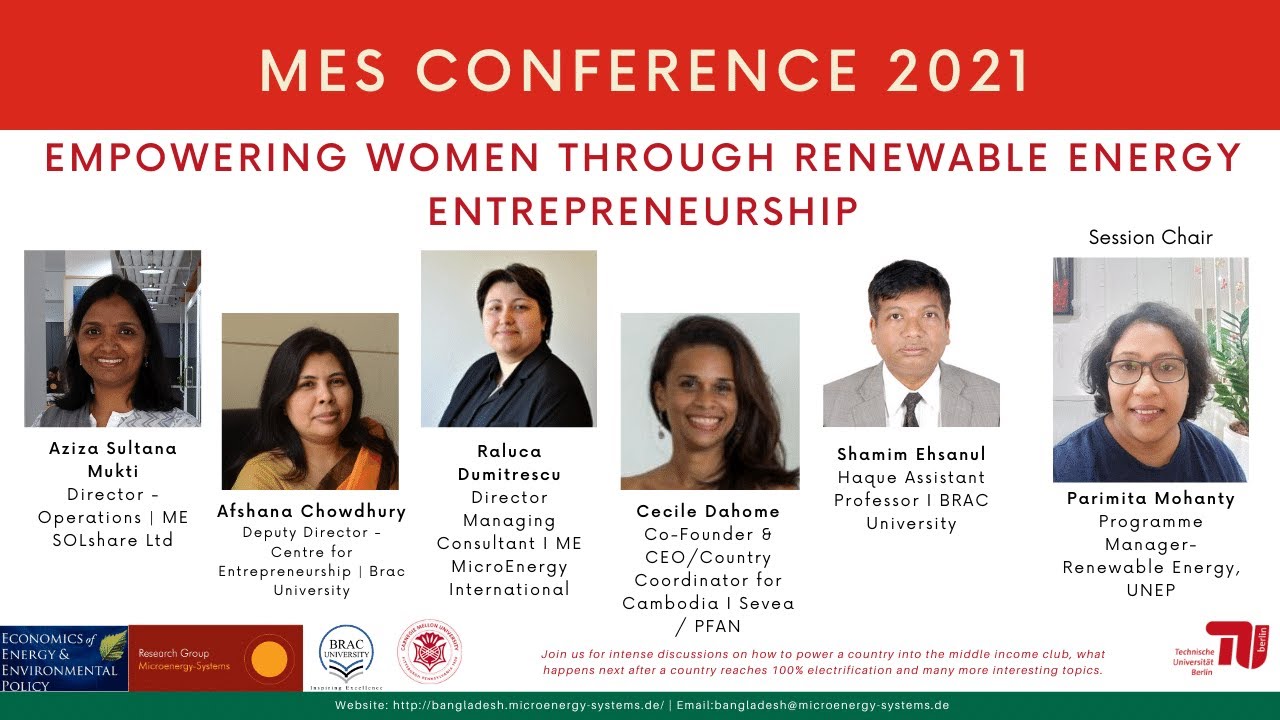
Empowering Women through Renewable Energy Entrepreneurship | 2021 MES Conference
Keywords
Summary
160 words
Critical Evaluation
Value of the Information & Strength of the Argument
The information provided is valuable due to the practical expertise of the panelists, who have directly worked with women entrepreneurs in the renewable energy sector across Asia, Africa, and Latin America. They offer concrete examples of successful interventions, such as BRAC University’s incubation center and SOLshare’s model in Bangladesh. The argumentation is mostly experience-based, with repeated emphasis on the need for holistic support systems including finance, training, and mentorship. However, the discussion lacks empirical data or rigorous analysis, relying on anecdotal evidence and general observations. The panelists effectively highlight systemic barriers and propose actionable solutions, though some claims are not substantiated by specific studies or reports. Overall, the value is high for practical insights, but the argumentation would benefit from stronger evidential support.
Scientific Rigor, Source Quality, Title Accuracy
The scientific rigor is moderate. The panelists are recognized professionals, but they reference no specific academic papers or external studies. The session is a recorded conference panel, which inherently provides expert opinions rather than peer-reviewed research. The title accurately matches the content, focusing on women, renewable energy, and entrepreneurship. The description provides a link to the MicroEnergy Research Group’s website, which serves as the only external source. No comments were available for analysis, so public reception cannot be assessed.
217 words
Title / Content Match
The title accurately reflects the session's focus on women, renewable energy, and entrepreneurship.
Quality & Reliability
7/10
The panel features experienced practitioners from diverse organizations and regions, providing practical insights. However, the discussion is largely anecdotal and lacks rigorous data or verifiable references, limiting its scientific robustness.
Key Moments
Markers derived by PSI from the transcript: the creator did not define chapters.
- Introduction of the session and panelists by the chair Parimita Mohanty.
- Background presentation on the impact of COVID-19 on women and the role of renewable energy.
- Afsana Chowdhury discusses common challenges faced by women entrepreneurs in Bangladesh.
- Raluca Dumitrescu shares key learnings from energy access projects and the role of digitalization.
- Aziza Sultana Mukti talks about SOLshare's approach and female end-users.
- Cécile Dahome and Shamim Ehsanul Haque provide additional perspectives on scaling and partnerships.
- Final reflections and closing remarks from the chair.
Cited Sources
- MicroEnergy Systems Research Group — Official website of the organizing research group, providing information about the MES conference and related initiatives.
Contribution & Novelties
The session contributes by consolidating practical experiences from multiple countries, highlighting the intersection of gender, energy access, and entrepreneurship. It underscores the need for tailored support mechanisms such as specialized incubation centers and policy changes. The discussion also brings forward lesser-known examples like the ‘swarm electrification’ concept and the importance of productive use of energy for women’s economic empowerment.
Pour aller plus loin :
- Sustainable Development Goal 7: Affordable and Clean Energy — Relevant to the core theme of energy access as a foundation for development.
- UN Women: Women and Sustainable Development Goals — Provides context on gender equality in sustainable development.
- The concept of ‘swarm electrification’ mentioned by Raluca Dumitrescu, which refers to community-based decentralized energy systems, is further explored in academic literature on microgrids and peer-to-peer energy trading, though no specific URL is provided due to uncertainty.
139 words
Radar Profile
The radar profile shows relatively balanced scores, with information quantity and quality scoring moderate to high, while technical level is slightly lower, reflecting the panel's focus on practical and social aspects rather than technical details. Reliability is moderate, consistent with expert opinions without rigorous scientific validation.