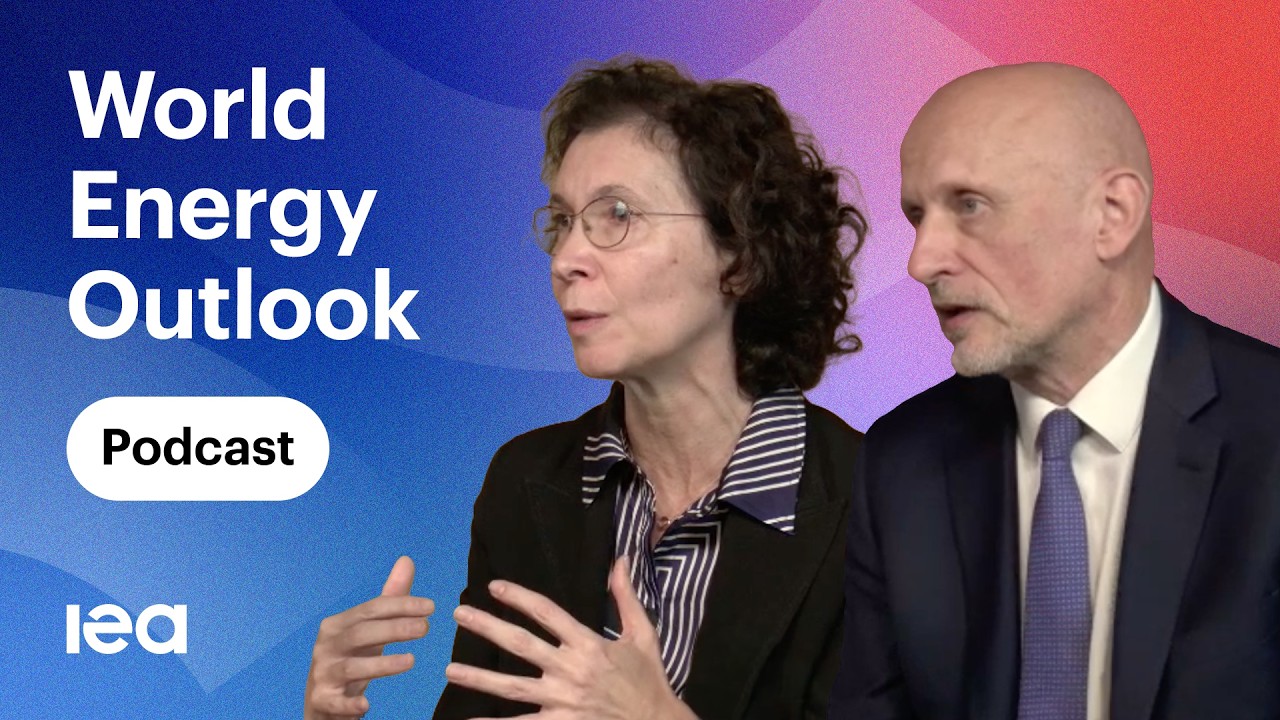
Podcast episode: World Energy Outlook 2026: Key takeaways
Keywords
Summary
152 words
Critical Evaluation
Value of the Information & Strength of the Argument
The value of the information is high: the speakers are directly involved in the report’s creation, providing authoritative insights into the analysis and scenarios. The argumentation is structured and coherent, explaining how the crisis triggers policy responses. Tim Gould’s explanation of the oil product market tightness versus crude prices is nuanced. Laura Cozzi’s link between energy security and climate alignment is well-argued. However, the discussion remains at a strategic level, without diving into technical modeling or quantitative detail. The reasoning is clear and accessible.
Scientific Rigor, Source Quality, Title Accuracy
The scientific rigor is solid: the content is based on the IEA’s World Energy Outlook, which uses extensive data and modeling. The speakers cite specific numbers (e.g., 400 million barrels release, 20 million barrels per day transit, 2.7 million barrels demand drop) and reference real-world events. The sources are appropriate and include the IEA’s own work plus mentions of international summits. The title accurately describes the podcast content; it is not misleading. The video has very few views and no comments, so public reception cannot be assessed.
186 words
Title / Content Match
The title accurately reflects the content: a podcast episode discussing key takeaways from the World Energy Outlook 2026.
Quality & Reliability
8/10
The content is produced by the IEA, a reputable international organization, featuring lead authors of the World Energy Outlook. The discussion is expert-based and grounded in official data, although it presents a high-level overview rather than detailed technical analysis.
Key Moments
Markers derived by PSI from the transcript: the creator did not define chapters.
- Introduction to the podcast and context of the energy crisis.
- Tim Gould explains how the energy system coped with the supply shock, including stock releases and demand reductions.
- Laura Cozzi describes the scenarios used in the World Energy Outlook, including the responses case and low Hormuz case.
- Tim Gould discusses the low Hormuz scenario and the possibility of reducing Strait transit via new pipelines and diversification.
- Electrification as a strategic response: Laura Cozzi notes the growing electricity demand and policy shifts in 25 countries.
- Domestic energy supplies and the shift toward self-sufficiency, with examples like Indonesia's solar targets.
- Diversification beyond the Strait: supply chain concentration, critical minerals, and other choke points.
- Discussion on oil and gas prices after the crisis, including LNG supply wave and potential price declines.
- Climate goals and the alignment of energy security policies with emission reductions, noting temperatures around 2.4-2.5°C.
- Clean cooking crisis and the need for policy support, with mention of the upcoming summit in Nairobi.
Cited Sources
- International Energy Agency — Main website of the IEA, which publishes the World Energy Outlook.
- World Energy Outlook 2026 — The flagship report discussed in the podcast.
Contribution & Novelties
The podcast offers an early, authoritative summary of the 2026 World Energy Outlook, focusing on the implications of the Strait of Hormuz disruption. It introduces the new scenarios (responses case, low Hormuz case) and highlights the shifting policy priorities toward electrification and domestic supply. The discussion provides valuable perspectives from the report’s lead authors, making complex analysis accessible.
Pour aller plus loin :
- World Energy Outlook — Background on the annual IEA publication.
- Energy security — Definition and dimensions of energy security.
- Electrification — Process of converting energy consumption to electricity.
- Strait of Hormuz — Strategic chokepoint for oil and gas transit.
102 words
Radar Profile
The radar profile shows high quality and reliability scores, with a moderate level of technical depth. The content is information-dense and backed by authoritative sources, but does not reach the highest technical sophistication due to its accessible format.