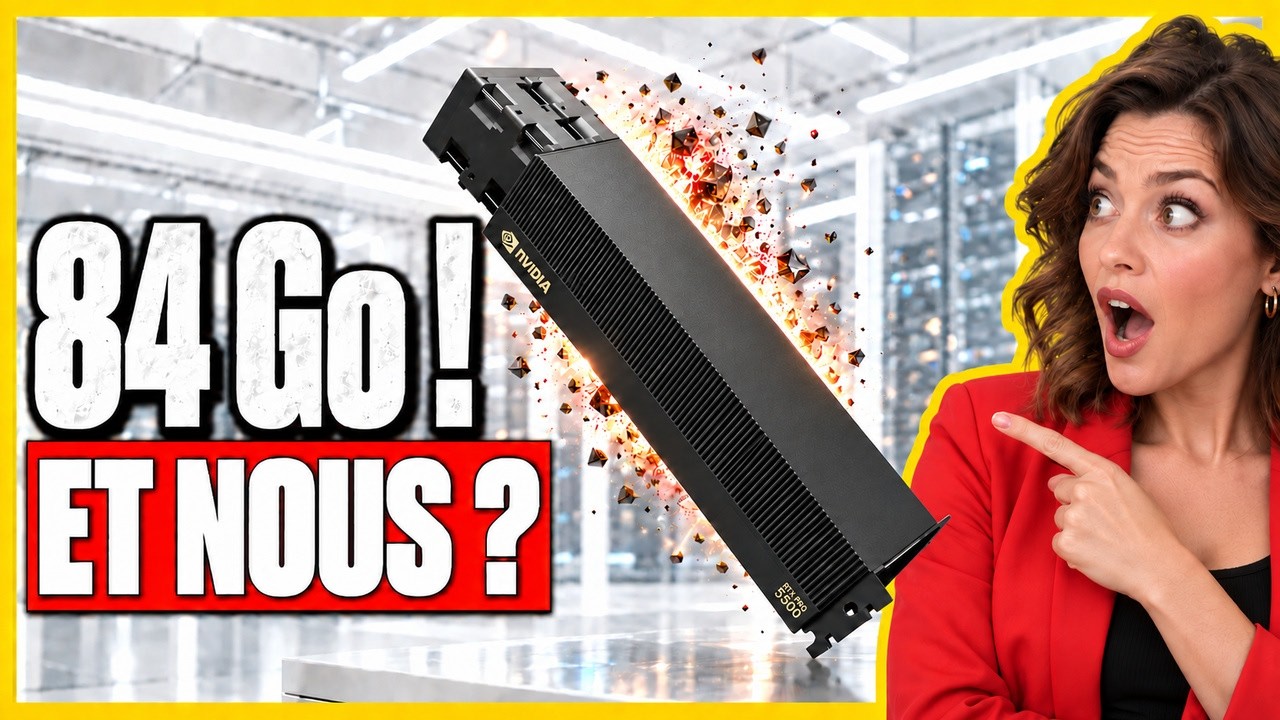
NVIDIA sort la VRAIE RTX 5090… avec 2,6× plus de VRAM ! Arnaque ???
NVIDIA releases the REAL RTX 5090… with 2.6× more VRAM! Scam???
Title history
- NVIDIA sort la VRAIE RTX 5090… avec 2,6× plus de VRAM ! Arnaque ??? — observed on 20261031-2326 UTC (YouTube)
Keywords
Summary
157 words
Critical Evaluation
Value of the Information & Strength of the Argument
The video provides valuable insights into the practical implications of VRAM capacity for local AI inference, correctly explaining concepts like weight residency, KV cache overhead, and the performance impact of memory offloading. The comparison between the RTX PRO 5500 and other cards (3090, 5090, 6000) offers a clear quantitative framework. The argumentation is coherent: it builds from the leaked specs to a functional analysis of AI capabilities, then shifts to a critical evaluation of Nvidia’s commercial segmentation. However, the value is limited by the lack of independent benchmarks or concrete performance tests. The reliance on unverified leaks weakens the foundational evidence, and the speculative claims about the card being a rejected Chinese market SKU remain unsubstantiated. Despite this, the logical structure effectively connects technical specs to real-world utility.
Scientific Rigor, Source Quality, Title Accuracy
The scientific rigor is moderate. The video correctly identifies the architectural similarities (GB202 die) and provides accurate bandwidth and core counts, but it fails to cite any official documentation or independent references, relying solely on a leak attributed to PNY. The analysis of AI memory constraints is technically sound and accessible. The title uses aggressive clickbait (‘VRAIE RTX 5090’, ‘Arnaque ???’) which is partially warranted given the identical GPU core, but it risks overpromising. The host explicitly clarifies that the card is not a ‘scam’ but a strategic product differentiation, which aligns the content with the title’s question. However, the lack of verified sources and reliance on rumor-based speculation prevents a higher score for overall rigor.
259 words
Title / Content Match
The title is sensationalist and clickbaity ('VRAIE RTX 5090', 'Arnaque'), which is partially justified as the card uses the same GB202 die as the 5090. The content clearly addresses the 'scam' question by explaining the commercial differentiation, though the tone is more conversational than critical.
Quality & Reliability
6/10
Content is based on leaked specifications (PNY) and qualitative analysis of memory implications for AI. No primary data or explicit sources cited in the video. The reasoning is logically coherent but relies on speculation about Nvidia's commercial strategy and pricing.
Key Moments
Markers derived by PSI from the transcript: the creator did not define chapters.
- Introduction of the RTX PRO 5500 announcement and the key VRAM question.
- Presentation of the card's specifications: 84 GB GDDR7 ECC, 600W, bandwidth.
- Comparison with RTX 5090: same GPU die and CUDA cores, lower bandwidth.
- Explanation of why VRAM is critical for local AI models, including offloading costs.
- Comparison to RTX 3090, showing the card is equivalent to 3.5x 3090s.
- Analysis of Nvidia's product positioning and the MIG virtualization feature.
- Discussion on price speculation and Nvidia's commercial strategy of limiting gaming VRAM.
Cited Sources
- Amazon Shop (Support link) — Affiliate link provided by the creator in the description to support the channel.
- PNY (Leaked source of RTX PRO 5500 specs) — Mentioned in the video as the source of the leaked technical specifications for the RTX PRO 5500.
Contribution & Novelties
The video’s originality lies in interpreting the newly leaked RTX PRO 5500 specs through the lens of local AI inference needs, contrasting the VRAM-centric requirements of LLMs with traditional gaming benchmarks. It effectively translates a hardware announcement into practical implications for AI users, while also dissecting Nvidia’s commercial motivations behind memory segregation. The breakdown of why memory bandwidth matters less than capacity for running large models is particularly useful for practitioners.
Pour aller plus loin :
- CUDA — Core parallel computing platform for Nvidia GPUs, essential for understanding the execution of AI workloads.
- Multi-Instance GPU (MIG) — Official feature allowing a single GPU to be partitioned into isolated instances, directly relevant to the MIG capabilities discussed.
- GDDR7 SDRAM — The latest graphics memory standard cited for the card’s 84 GB configuration.
- Transformer (deep learning architecture) — Provides context on KV caches and memory demands of modern LLMs mentioned in the analysis.
151 words
Radar Profile
The profile shows strong scores in information quantity and technical level, reflecting dense spec analysis. Quality and reliability are slightly lower due to reliance on leaks and lack of independent verification, showing a gap between the deep technical analysis and the evidential basis.