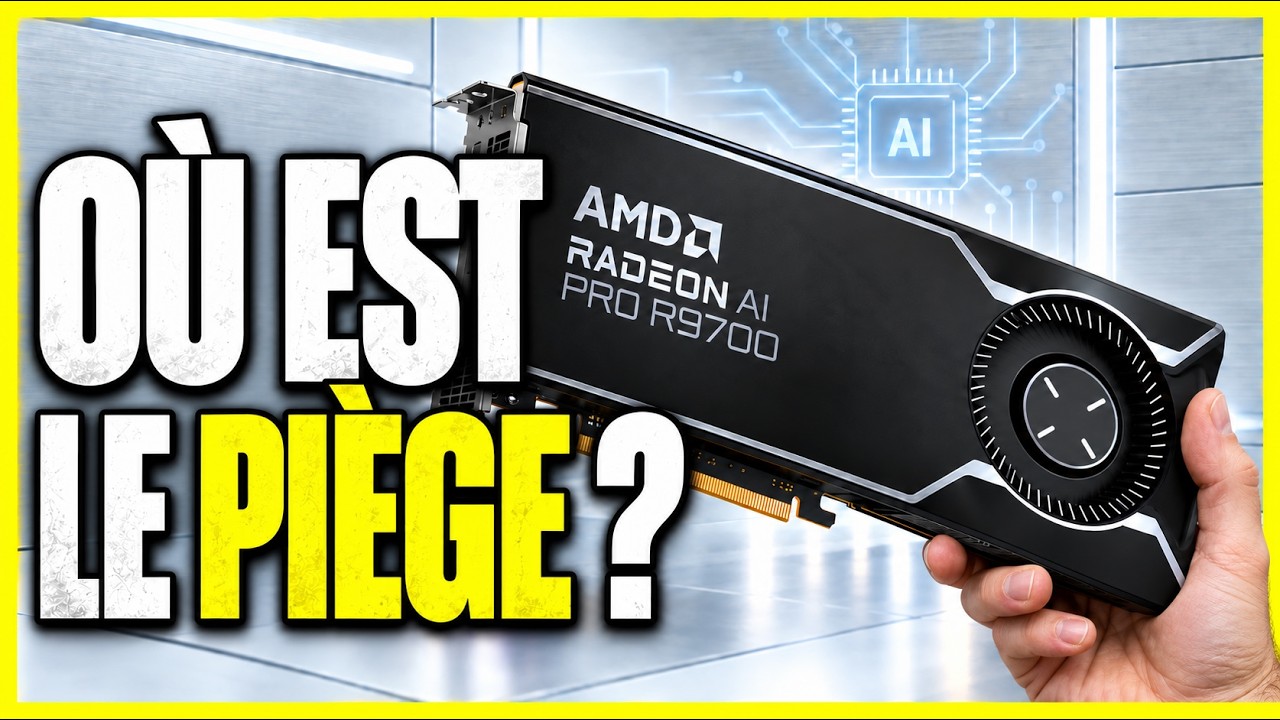
32 Go pour 1500 € : où est le piège de cette carte AMD ?
32GB for €1500: What’s the catch with this AMD card?
Title history
- 32 Go pour 1500 € : où est le piège de cette carte AMD ? — observed on 20261031-2320 UTC (YouTube)
Keywords
Summary
167 words
Critical Evaluation
Value of the Information & Strength of the Argument
The video offers substantial value by addressing a niche yet important topic: affordable high-VRAM GPUs for local AI. It clearly explains the technical constraints (VRAM vs. compute) and justifies the relevance of the R9700. The argumentation is logical and balanced, presenting both strengths and weaknesses without overhyping. The presenter uses concrete model examples and compares specifications across competitors, strengthening credibility. However, some performance claims are based on AMD’s official figures, which may be optimistic, and the presenter acknowledges this by advising caution. Overall, the information is useful for potential buyers and well-structured.
Scientific Rigor, Source Quality, Title Accuracy
The video demonstrates reasonable scientific rigor through accurate technical details and honest disclosure of limitations. No external sources are explicitly cited, but the presenter references his own experience and AMD’s official announcements. The title is well-matched to the content, as it investigates potential drawbacks of the card. The video includes no comments to analyze.
161 words
Title / Content Match
The title accurately reflects the content: the video explores the pros and cons of a 32 GB AMD card at a low price, identifying legitimate trade-offs such as reduced bandwidth and software ecosystem gaps.
Quality & Reliability
7/10
The video provides accurate technical specifications and realistic performance expectations, but relies partly on AMD's official marketing figures and personal experience, without independent benchmark data. The author acknowledges limitations and does not oversell the card, but some claims would benefit from third-party verification.
Key Moments
Markers derived by PSI from the transcript: the creator did not define chapters.
- Introduction to the AMD Radeon AI PRO R9700 and its purpose for local AI inference.
- Explanation of the VRAM problem in AI and why 32 GB is crucial.
- Detailed specifications of the card: Navi 48, 32 GB GDDR6, 640 GB/s bandwidth.
- Performance expectations for LLMs like DeepSeek R1 and Mistral, plus AMD's claimed improvements.
- Comparison with Intel Arc Pro B70, NVIDIA RTX Pro series, and RTX 5090, including pricing.
- Discussion of limitations: power consumption, lack of CUDA, Windows incompatibility, and multi-GPU setup challenges.
- Final verdict: great value for Linux-based local AI, but not for CUDA-dependent tasks.
Contribution & Novelties
The video sheds light on an underrated product in the French market, clarifying its value proposition and practical constraints. It effectively bridges the gap between AMD’s official claims and real-world usage scenarios, particularly for AI enthusiasts on a budget. The presenter offers actionable advice on when to choose this card over NVIDIA alternatives.
Pour aller plus loin :
97 words
Radar Profile
The radar profile shows high scores in information quantity and technical level, reflecting the video's dense technical content. Quality and reliability are slightly lower, indicating some subjective elements and reliance on official marketing. The overall profile suggests a competent but not fully independent review.