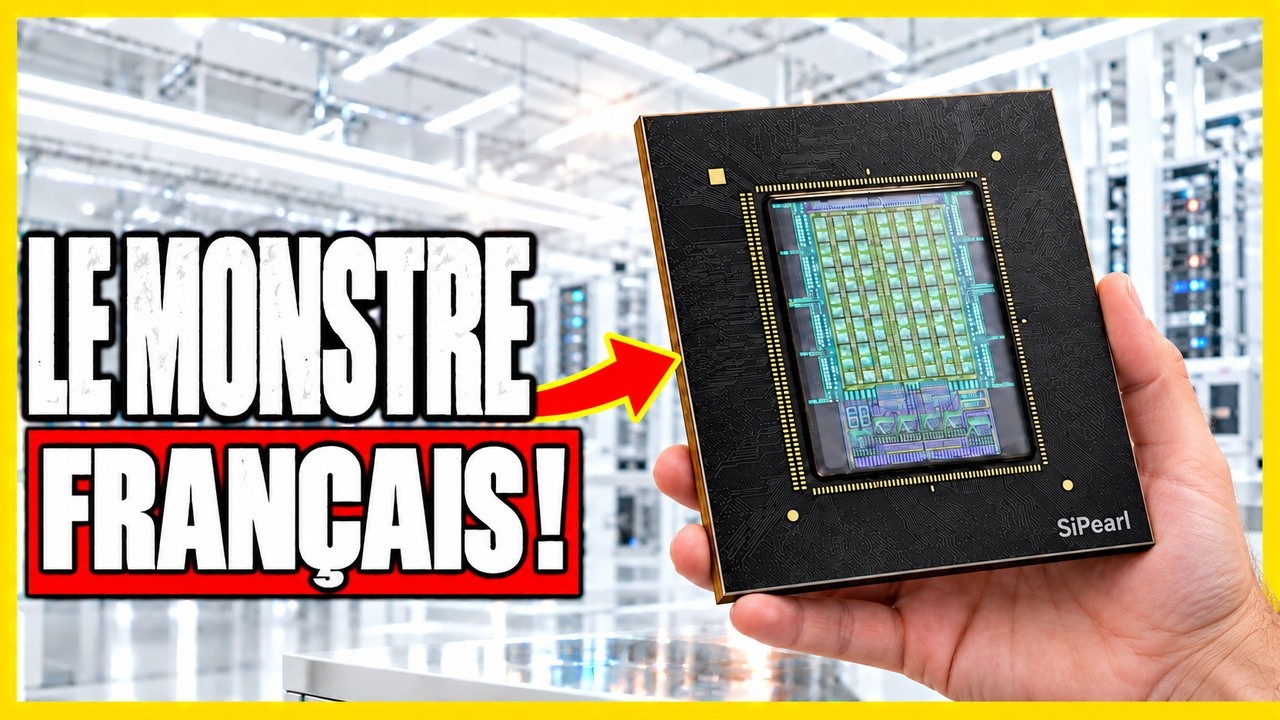
5 ANS de retard : l'Europe joue sa souveraineté avec ce CPU français
5 YEARS behind: Europe gambles its sovereignty on this French CPU
Title history
- 5 ANS de retard : l'Europe joue sa souveraineté avec ce CPU français — observed on 20261031-2327 UTC (YouTube)
Keywords
Summary
171 words
Critical Evaluation
Value of the Information & Strength of the Argument
The video offers a substantive look at a seldom-covered topic, explaining the technical choices behind Rhea1 (HBM, cache hierarchy, core configuration) in an accessible manner. The presenter’s argument that the memory subsystem is the key differentiator is well-supported by examples of how data throughput bottlenecks affect computing. He also provides context on JUPITER’s architecture and the complementary roles of CPUs and GPUs. However, the reasoning sometimes relies on personal impressions rather than cited data, and some technical details (like process node) are based on uncertain memory. The overall argumentation is coherent and favors a nuanced view: it acknowledges both the achievement and the limitations regarding European sovereignty.
Scientific Rigor, Source Quality, Title Accuracy
No specific scientific sources are cited; the creator refers to ‘information found’ and uses his own knowledge. He transparently admits when he is unsure, which adds credibility. The title emphasizes sovereignty, a theme echoed in the content, but the video also clarifies the dependencies (TSMC fabrication, Arm licensing). The absence of benchmarks and official datasheets is a limitation; the creator calls for future testing. The video does not overclaim and rightly labels the project as a promising start rather than a definitive solution.
205 words
Title / Content Match
The title accurately reflects the content: the video discusses the delayed arrival of a French-designed CPU and its implications for European sovereignty, though the tone is slightly sensationalistic.
Quality & Reliability
7/10
The video provides a clear, structured overview of the SiPearl Rhea1 processor, its architecture, and its role in the Jupiter supercomputer. The creator openly acknowledges uncertainties (e.g., exact process node, core generation) and refrains from overstatement. However, lack of concrete performance data and reliance on personal interpretation limit the reliability.
Key Moments
Markers derived by PSI from the transcript: the creator did not define chapters.
- Introduction of the Rhea1 CPU and news of deliveries to Bull and HPE.
- Context of JUPITER supercomputer and the role of CPUs vs GPUs.
- Core specs: 80 Arm Neoverse V1 cores, SVE 256-bit, 61 billion transistors.
- Memory architecture: 64GB HBM2e, DDR5, caches, and the logic behind it.
- Node configuration in JUPITER: 2 Rhea1 per node, 160 cores, 128GB HBM.
- Discussion of the OpenCUBE server and cloud platform with European CPUs.
- Interests for scientific clouds and meteorological computing.
- Acknowledgment of Arm's age and TSMC manufacturing, but emphasis on integration and sovereignty.
- Conclusion: absence of benchmarks, but the achievement is significant for Europe.
Cited Sources
- SiPearl Rhea1 - le CPU français à 80 coeurs et 64 Gio de HBM qui arrive dans Jupiter — Mentioned in a comment by the author as a companion article; also referenced in the video description as a source for more info.
Concurring Sources
- SiPearl official website — The company's official page, not directly cited in the video but consistent with the presented specifications and roadmap.
Dissenting Sources
- Some commenters claim Rhea1 is not truly sovereign due to TSMC and ARM dependencies — Public comments argue that the design uses UK-owned IP and Taiwanese fabrication, challenging the notion of sovereignty. This is a valid counterpoint acknowledged by the presenter.
Contribution & Novelties
This video provides a clear synthesis of the SiPearl Rhea1’s features and its significance for European technological independence, filling a gap in public awareness about a niche but strategic hardware project. It explains the memory-centric design philosophy in an accessible way, which is often obscured in technical datasheets. The presenter also contextualizes the delivery milestones and the role within the JUPITER supercomputer, offering a realistic perspective on the challenges ahead.
Pour aller plus loin :
- ARM Neoverse (Wikipedia) — For background on the ARM architecture used in Rhea1, its generations, and server-oriented features.
- High Bandwidth Memory (Wikipedia) — Technical explanation of HBM technology, its evolution, and application in HPC.
- Exascale computing (Wikipedia) — Overview of supercomputers reaching exaflop performance, such as JUPITER, and the challenges involved.
126 words
Radar Profile
The radar profile shows a well-balanced video: high quantity of information and technical level, while quality and reliability are slightly lower due to lack of hard data. The presenter's honest uncertainties and the absence of benchmarks prevent a top score, but the depth of discussion is commendable.
💬 Sur les 30 commentaires analysés, le climat est équilibré avec une légère tendance critique : de nombreux commentaires soulignent les limites de la souveraineté (fabrication TSMC, licence ARM), tout en reconnaissant l'avancée technologique et l'effort de SiPearl. Plusieurs commentaires appellent à des benchmarks et à une fonderie européenne, et certains saluent positivement l'initiative malgré les réserves.