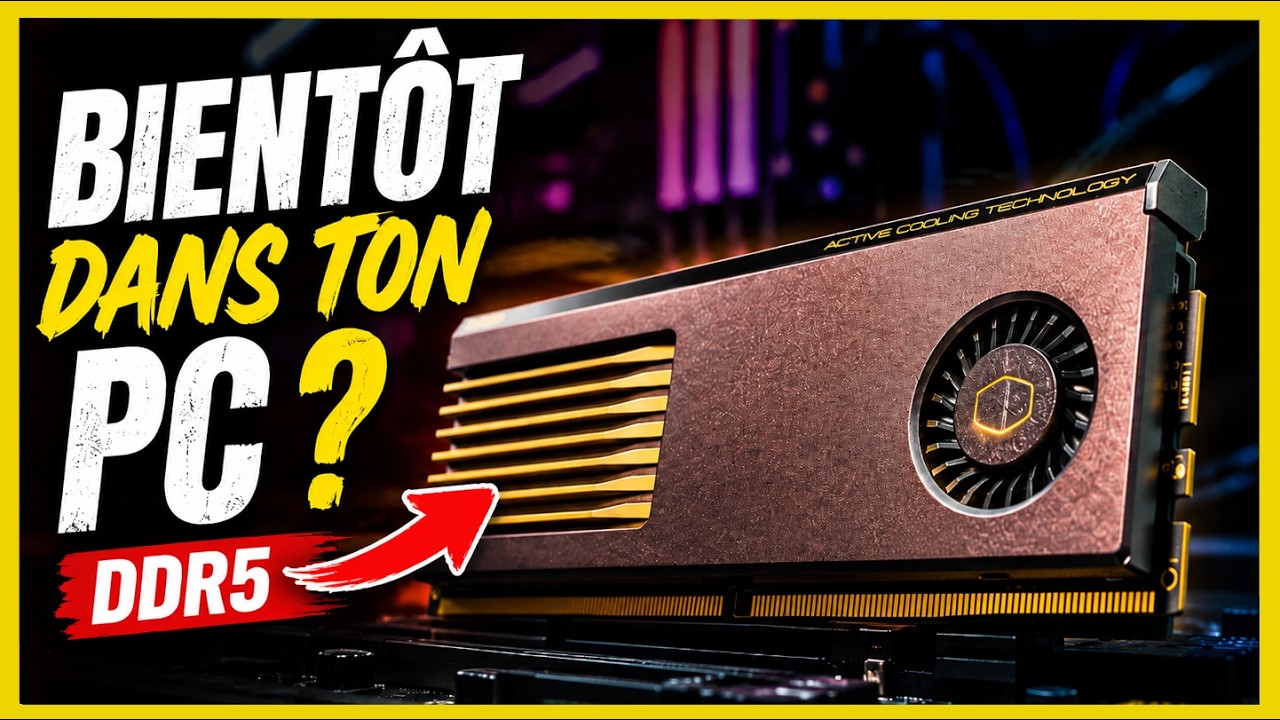
10000 MT/s : de la DDR5 AMD EXPO hors normes chez G.SKILL
10000 MT/s: Extraordinary AMD EXPO DDR5 from G.SKILL
Title history
- 10000 MT/s : de la DDR5 AMD EXPO hors normes chez G.SKILL — observed on 20261101-0117 UTC (YouTube)
Keywords
Summary
192 words
Critical Evaluation
Value of the Information & Strength of the Argument
The video offers substantial value in contextualizing the hardware announcement. It accurately explains underlying technical causes of high temperatures (PMIC, high frequencies, increasing density) and introduces key technologies like QDIMM. The argumentation is robust and balanced; it does not merely hype the product but systematically analyzes use cases where the tech is genuinely useful (AI, heavy compilation) versus negligible gain (gaming for the majority). The creator structures the discourse as a pros/cons analysis, acknowledging the practicality and moving on to the future implications of memory-centric computing, which solidifies the credibility of the reasoning.
Scientific Rigor, Source Quality, Title Accuracy
The scientific rigor is acceptable for a tech news review. The creator correctly distinguishes between AMD and Intel architectures and mentions industry-standard components. However, external citations are absent; the content relies on the presenter’s expertise and general industry knowledge rather than quotable studies or official data sheets. The title accurately mirrors the content, focusing on the ‘10000 MT/s’ frontier and G.Skill’s initiative. Since no comments were provided, analysis of public reception is omitted, and no advertising break was detected within the provided transcript.
191 words
Title / Content Match
The title accurately reflects the video's focus on high-speed DDR5 (10000 MT/s level) and G.SKILL's new active cooling initiative, which is the main topic of discussion.
Quality & Reliability
7/10
The video offers good technical depth with clear explanations of PMIC, QDIMM, and AMD vs Intel architectural differences. The reasoning is logical and balanced, but it relies heavily on the creator's editorial opinion and lacks external citations or referenced benchmarks, which slightly limits verifiability.
Key Moments
Markers derived by PSI from the transcript: the creator did not define chapters.
- Introduction addressing the new active cooling solution for DDR5 RAM from G.Skill and Cooler Master.
- Explanation of why RAM is becoming a critical heat component: PMIC, higher tensions, and frequencies.
- Deep dive into the QDIMM technology and its role in cleaning the clock signal and improving integrity.
- Comparison between AMD's low-latency and synchronization approach vs Intel's raw frequency strategy.
- Use cases that justify active cooling: AI local models, benchmarks, and heavy compilations.
- Analyzing drawbacks of mechanical parts: wear, dust, cumulative noise, and thickness issues.
- Predicting the future of memory (memory-centric computing, DDR6) and concluding thoughts.
Cited Sources
- Amazon Affiliate Shop (MAKERTRONIC) — Affiliate link provided in the video description where the creator recommends products.
Contribution & Novelties
The video adds value by framing a seemingly gimmicky product (active cooling RAM) within the larger context of the increasing thermal and electrical demands of DDR5, successfully explaining why this is a necessary evolution rather than pure marketing. It bridges the gap between physical constraints (heat, signal degradation) and market trends (memory-centric computing).
Pour aller plus loin:
- DDR5 SDRAM - Essential background on the DDR5 standard, its features (PMIC, on-die ECC), and frequency progression.
- Power management integrated circuit - More details on the PMIC that moved from motherboard to RAM, central to the heating problems discussed.
- Processing-in-memory - Related to the future ‘memory-centric’ trend, exploring architectures that bring computation closer to data to avoid memory bottlenecks.
116 words
Radar Profile
The scores are quite balanced, indicating a well-rounded video that offers solid quantity and quality of information, with a good technical level, while maintaining enough clarity to be useful. The reliability score is slightly tempered by the reliance on editorialized analysis.