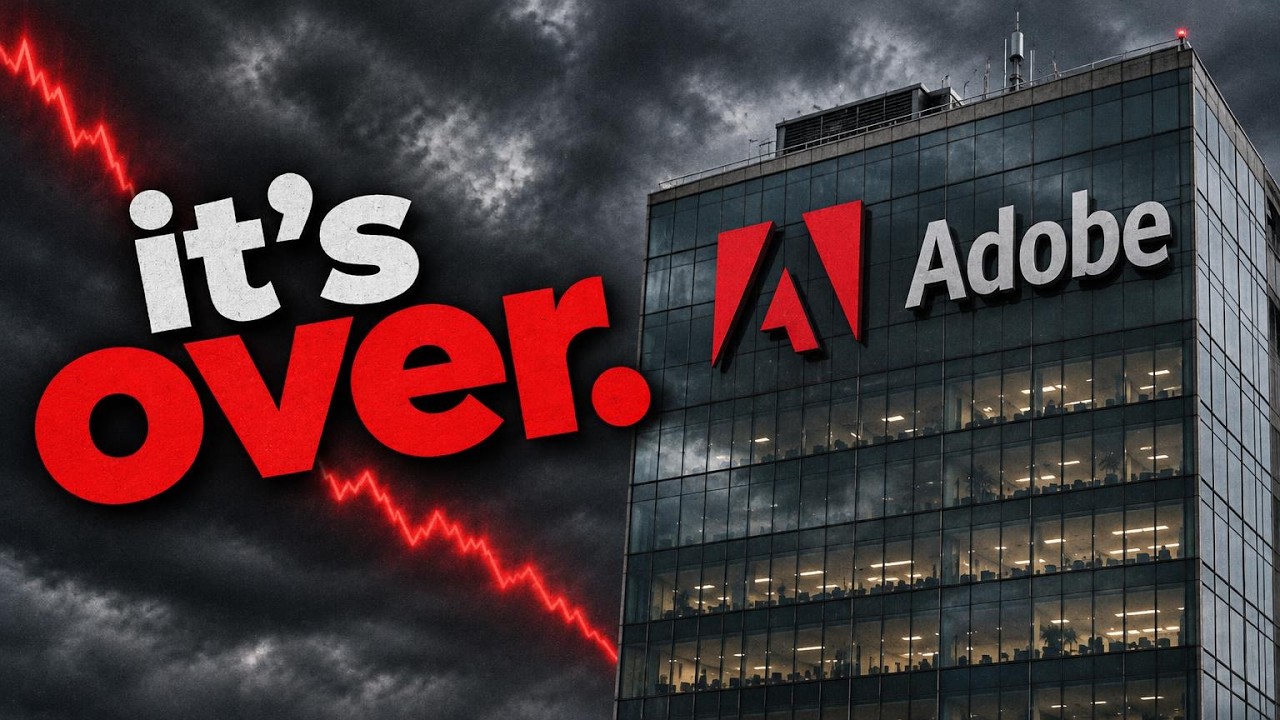
AI Just Killed Adobe.
Keywords
Summary
210 words
Critical Evaluation
Value of the Information & Strength of the Argument
The video delivers exceptional value by compiling a high density of specific financial and competitive data—revenue figures, analyst price targets, user growth stats, and strategic moves—into a coherent narrative. The argument is structured logically with four clearly articulated reasons, each supported by concrete examples (e.g., ChatGPT’s 700 million images, Affinity becoming free, FTC settlement). The reasoning is balanced: it acknowledges Adobe’s continuing profitability and countermeasures, while still explaining the market’s pessimism. The author’s analytical framework around ‘default status’ is insightful, and the Kodak analogy provides a compelling lens. However, the argument relies heavily on third-party media reports and analyst opinions without direct sourcing, which slightly weakens its persuasive power but doesn’t undermine its internal coherence.
Scientific Rigor, Source Quality, Title Accuracy
The rigour is moderate: the video cites many real events, dates, and numbers (e.g., Adobe’s Q1 2026 results, Redburn’s downgrade, FTC lawsuit), but does not provide primary sources, URLs, or verification for any of these claims. The absence of any linkable references in the description or narration reduces the ability to fact-check. The title is attention-grabbing and accurately reflects the debate, though the content nuances it. The source quality is typical for video essays: aggregated but plausible. The video does not cite scientific literature, but for a business analysis, the reliance on reputable news outlets and analyst reports is acceptable, even if not documented. Public comments were not provided, so no trends could be analyzed.
245 words
Title / Content Match
The title brilliantly captures the central theme—whether AI is killing Adobe—but the content concludes that AI erodes Adobe's default status rather than kills it, which is a nuanced take that matches expectations.
Quality & Reliability
7/10
The video provides a dense set of specific financial figures, dates, and analyst actions, but relies on aggregated news and provides no direct citations or verifiable links, lowering its standalone reliability.
Key Moments
Markers derived by PSI from the transcript: the creator did not define chapters.
- Adobe's record Q1 revenue and CEO announcement trigger 7% stock drop.
- The prompt replaces the toolbar; examples include ChatGPT's image generator and Google's Nano Banana.
- Free alternatives (Affinity, DaVinci Resolve) and price comparison with Creative Cloud.
- Adobe's missteps: terms-of-use controversy, FTC lawsuit, and Firefly training disclosure.
- Wall Street's concern about AI revenue being only 2% of total; analyst downgrades by Redburn and Wells Fargo.
- Adobe's open platform strategy and partnerships with Disney, Google, and Microsoft announced at Adobe Max 2026.
Cited Sources
- Adobe Q1 FY2026 earnings report — Mentioned as record $6.4 billion revenue, 12% YoY growth.
- Redburn Atlantic analyst Omar al-Shik's downgrade — Initiated sell rating on Adobe in July 2025, citing AI competition.
- Wells Fargo analyst Michael Turan's downgrade — Cut Adobe to underweight on October 12, 2026, with a $225 target.
- FTC lawsuit against Adobe — Alleged hidden termination fees and cancellation hurdles.
- Canva's relaunch of Affinity as free — Announced on October 30, 2025.
Contribution & Novelties
The video offers a fresh analytical lens by framing Adobe’s crisis not as a collapse but as the loss of ‘default status,’ supported by a multi-causal breakdown. It compiles a wealth of 2025-2026 events into a coherent timeline, including recent analyst actions and corporate partnerships that had not been widely synthesized. The ‘prompt vs. toolbar’ concept succinctly captures the paradigm shift in creative tools.
Pour aller plus loin :
- Creative Cloud — Provides background on Adobe’s subscription model, the core of the debate.
- Generative artificial intelligence — Explains the technology behind the AI tools threatening Adobe.
- Software as a service — Context for the industry-wide pricing shift and vulnerability to AI disruption.
112 words
Radar Profile
The radar profile shows high information quantity (9) but slightly lower quality and reliability (7 each), indicating a data-rich yet not fully verifiable analysis. The technical level is moderate (6), accessible to a general audience with some financial/tech familiarity. The fiabilité score (7) aligns with the presentation's reliance on aggregated news rather than primary sources.