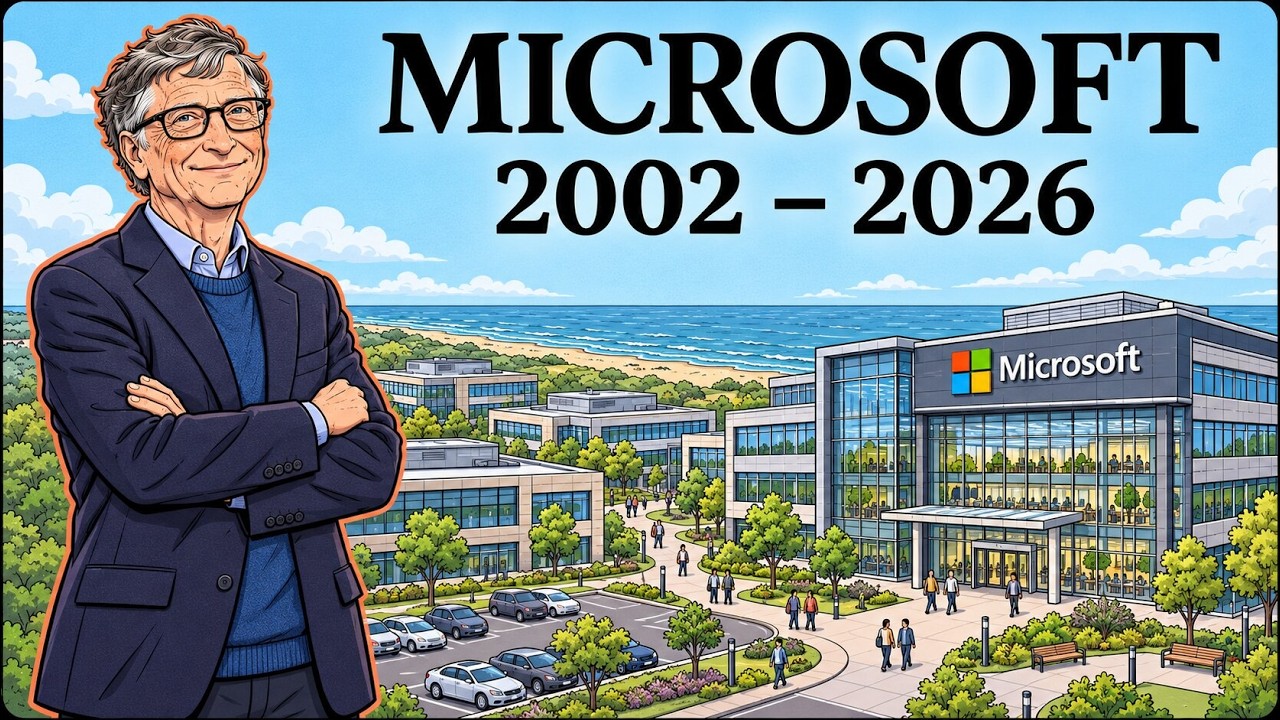
The ENTIRE History of Microsoft in 30 Minutes
Keywords
Summary
256 words
Critical Evaluation
Value of the Information & Strength of the Argument
The informational value is genuinely high for the format: the narrative is dense with dated, checkable anchors — 4 April 1975, 12 August 1981, 20 November 1985, 13 March 1986, 24 August 1995, 18 May 1998, 4 February 2014 — and it consistently attaches a monetary figure to each strategic move (the roughly $75,000 for QDOS rights, the $61 million raised at IPO, $2.5 billion for Minecraft, $26 billion for LinkedIn, roughly $7.5 billion for GitHub, $69 billion for Activision Blizzard, $1 billion then roughly $10 billion for OpenAI). Values are also given proportionally, as when annual capital expenditure is compared with the 1986 IPO proceeds, which makes scale legible rather than merely numeric. The argumentative strength lies in the discipline of a single explanatory variable. Rather than a list of product launches, the video repeatedly asks the same question — where is the choke point, and did the company get there first — and applies it symmetrically to successes and to failures, which is what gives the piece its analytic bite. The concrete device of ‘Linda’, the office manager who does not care who built the machine as long as it runs her accounting software, converts an abstract lock-in mechanism into an intelligible causal chain, and the transition from a per-desk licence to a per-month data-centre fee is one of the sharper observations in the video. The weaknesses are equally clear. The metaphor is applied post hoc and is therefore close to unfalsifiable: any success can be redescribed as ‘owning a toll booth’ and any failure as ‘defending one’, so the framing organises the story more than it tests it. The attribution of agency to ’the toll booth itself’ as the structural villain is a narrative device rather than an argument, and it lets individual decisions, misjudgements and organisational politics dissolve into an abstraction. The counterfactual on mobile is asserted rather than demonstrated — the claim that no amount of money could have dislodged Apple and Google is plausible but supported only by the outcome. The AI section carries the most weight and the least evidence: a single adoption percentage attributed to Nadella, a single quoted line from a leaked memo, and revenue and capex projections that are simply stated. Finally the piece slides from analysis into a motivational register in its closing minute, generalising a corporate history into advice about careers and skills, which is a legitimate rhetorical choice but sits outside the analytical frame it had built.
Scientific Rigor, Source Quality, Title Accuracy
On rigour, the video offers no bibliography, no document titles with dates of publication, no links, and its description is a narrative hook rather than a source list, so nothing can be traced from the video itself. It paraphrases real primary material — Gates’s 1976 open letter to hobbyists, the 1995 internal memo warning of an internet ’tidal wave’, a 2026 internal memo on Copilot — but never quotes them at length nor identifies where they can be consulted. Numbers are delivered with high apparent precision (48% Azure growth, $36.6 billion net income, 4.5% of 450 million seats) without a stated origin, and several claims are hedged with ‘reportedly’ or ‘people still argue’, which is honest but leaves the load-bearing figures unsupported. The proper-noun errors scattered through the transcript — Altair rendered as ‘Altter’, Ballmer as ‘Balmer’, Altman as ‘Alman’, QDOS as ‘CQOS’, Compaq as ‘Compact’, the memo as ‘Internet Title Wave’ — are almost certainly artefacts of automated transcription, but they do signal that small details were not checked against a written source, and they sit oddly beside the confident precision of the financial figures. The treatment of the 1980 IBM agreement is also simplified: the standard account credits IBM’s own decision not to seek exclusivity as much as Microsoft’s negotiating skill, whereas the video presents it almost entirely as Microsoft’s coup. On source diversity, the whole modern section rests on a single implicit register — earnings releases and press reporting — with no regulatory filings, no court documents and no competing business histories brought in, and no counter-hypothesis tested against the toll-booth frame. On title fit, the promise of a ‘complete history in 30 minutes’ is approximately met in scope but not in balance: the antitrust case and the AI pivot are treated at length, while the Xbox business, the research division, the post-2001 regulatory settlements outside the United States and the non-Western markets are mentioned in passing or not at all. This mismatch is real but modest, and it does not undermine the video’s central argument.
764 words
Title / Content Match
The title is broadly honoured: the video does run chronologically from 1975 to 2026 in under 30 minutes. It is closer to a thesis-driven strategic essay over selected episodes than to a 'complete' history, with gaming, research and non-US markets given little or no room.
Quality & Reliability
6/10
The well-documented stretch (1975–2019) is broadly accurate on dates, deal values and market outcomes, and the causal narrative is coherent. Reliability is lowered by the complete absence of citations or links, by figures stated to several significant figures without provenance, by vaguely attributed claims ('reportedly', 'people still argue'), and by repeated distortion of proper nouns that points to an automated transcript (Altair, Ballmer, Altman, QDOS, Compaq, 'Internet Tidal Wave'). The most consequential material — the 2025–2026 capex, layoffs, stock moves and OpenAI renegotiation — is presented as settled fact with no traceable source.
Key Moments
Markers derived by PSI from the transcript: the creator did not define chapters.
- Cold open: the 30 July 2026 session in which Microsoft is said to have added roughly $450 billion in market value in a single day, framed as the end point of a fifty-one-year story.
- Statement of the central thesis: Microsoft won less by building the best products than by identifying the point everyone had to pass through and charging at it — the 'toll booth' metaphor.
- January 1975: the Popular Electronics Altair 8800 cover, and the bluff in which Gates and Allen promise a BASIC interpreter they have not written and have never run on the real machine.
- The 1980 IBM negotiation, the licensing of QDOS from Seattle Computer Products for roughly $75,000, and the decisive detail that Microsoft keeps the right to license MS-DOS to other manufacturers.
- The Windows and Office era: incremental releases riding on the DOS base, the 1995 launch of Windows 95, and the point at which roughly nine in ten personal computers run Microsoft software.
- Netscape, the bundled free browser, and the antitrust case filed on 18 May 1998 through to the 2000 break-up order and its reversal on appeal in 2001.
- The Ballmer years as a structural trap: revenue and profits rising while the share price stagnates for sixteen years, and the mobile transition missed after the 2007 iPhone launch.
- Satya Nadella's appointment on 4 February 2014, the instruction to stop organising the company around Windows, and the shift of the revenue model from the desk to the data centre.
- The OpenAI investment and its integration into Bing, Office and GitHub, alongside the roughly $69 billion Activision Blizzard acquisition.
- The economics of the AI bet: roughly $190 billion of planned capital expenditure, weak paid Copilot adoption, successive layoff and voluntary-exit programmes, and the 2026 stock drawdown.
- Conclusion: the record single-day gain as vindication, the unresolved question of whether the new toll booth costs more to run than it collects, and the generalisation to careers and industries.
Cited Sources
- An Open Letter to Hobbyists (Bill Gates, 1976) — Paraphrased as the moment Microsoft asserted that software is a product rather than something shared freely; quoted by content, never linked or dated precisely in the video.
- Internet Tidal Wave internal memo (Bill Gates, May 1995) — Cited as the warning that the web browser could reduce the operating system to plumbing; the memo is described but not sourced or excerpted at length.
- Popular Electronics, January 1975 issue (Altair 8800 cover) — Presented as the starting point of the whole story; no issue reference, link or archive location is given.
- United States Department of Justice and state attorneys general antitrust complaint (18 May 1998) — The basis for the monopoly findings, the 2000 break-up order and the 2001 appeal; referred to by outcome rather than by document.
- Internal Microsoft memo on Copilot (reported mid-2026) — Quoted for the line that the product 'has to earn the right to exist'; the video does not say where or how the memo was obtained.
- Microsoft quarterly earnings disclosures (July 2026 and 28 October 2026) — Source of the Azure growth, capital spending, revenue and net income figures in the final section; the numbers are stated without pointing to the filings themselves.
Concurring Sources
- History of Microsoft — Corroborates the general chronology: 1975 founding, the 1980 IBM contract, the 1986 IPO, the antitrust period and the Nadella-era reorientation.
- Altair 8800 — Confirms the January 1975 Popular Electronics cover and the writing of a BASIC interpreter for a machine the authors did not yet possess.
- 86-DOS (QDOS) — Supports the account of Tim Paterson at Seattle Computer Products and the acquisition of the operating system rights by Microsoft for a sum in the region of $75,000.
- United States v. Microsoft Corp. — Confirms the 1998 suit, the 2000 ruling and break-up order, and its reversal on appeal in 2001.
- Satya Nadella — Confirms the 4 February 2014 appointment and the cloud-first reorientation described as the turning point of the story.
Contribution & Novelties
The distinctive contribution is not new factual material — the founding episode, the IBM contract, the antitrust case and the Nadella pivot are all well-trodden ground — but the application of one economic lens consistently across the whole arc, and its extension into the least-documented part of the story. Treating the 2026 AI capital expenditure as the construction cost of a new toll booth, and then asking whether that booth can ever repay its construction, is a useful reframing of an otherwise purely financial debate: it converts a question about margins into a question about whether the choke point still exists at all, given that the OpenAI agreement is no longer exclusive and customers can route through other clouds. The symmetric use of the metaphor for failure as well as success is the piece’s best analytic move, and the transition from a one-off licence sold with a machine to a recurring monthly charge on a data centre is a genuinely clarifying way to describe what changed between 2010 and 2020. What is genuinely original is thin, however: the narrative supplies no new evidence, no interviews, no documents and no quantitative model, so its value lies in synthesis and framing rather than in discovery.
Further reading:
- History of Microsoft — Reference chronology against which the video’s dates and deal values can be checked.
- Altair 8800 — Background on the January 1975 machine and the MITS BASIC episode that opens the video.
- An Open Letter to Hobbyists — The 1976 text whose argument the video identifies as the seed of Microsoft’s commercial model.
- United States v. Microsoft Corp. — Primary account of the antitrust proceedings summarised in the middle section.
- Vendor lock-in — The economic mechanism that the ’toll booth’ metaphor is describing in non-metaphorical terms.
- Disruptive innovation — The framework most often used to explain the smartphone transition the video treats as a missed road.
- ‘Internet Tidal Wave’ memo (1995), and the concept of path dependence in technology markets — both are central to the argument but are cited by name only here, as no reliable address is offered for them.
350 words
Radar Profile
The profile is that of a dense, well-paced narrative: information quantity is very high and information quality solidly above average, while technical depth stays moderate because product mechanics are rarely explained. Overall reliability sits in the upper-middle range — the documented pre-2020 history holds up well, whereas the figures carrying the most weight, all drawn from 2025–2026, arrive without any traceable provenance.